
Research Signal – Source date 2023-06-08
Inflammation is part of the body’s defense system, but aging can change its balance. The immune system may become more inflammatory while becoming less effective at responding to challenges and clearing damaged or senescent cells. This combination is often called inflammaging, meaning chronic, low-grade inflammation associated with aging.
A review published on June 8, 2023, organizes this relationship across cells, organs, diseases, and possible interventions. Its central picture is not a single switch that turns aging on or off. It is a feedback problem involving cells that remain active after they stop dividing, immune cells whose functions change over time, and tissues whose environments affect both inflammation and repair.
The immune system can become louder and less capable
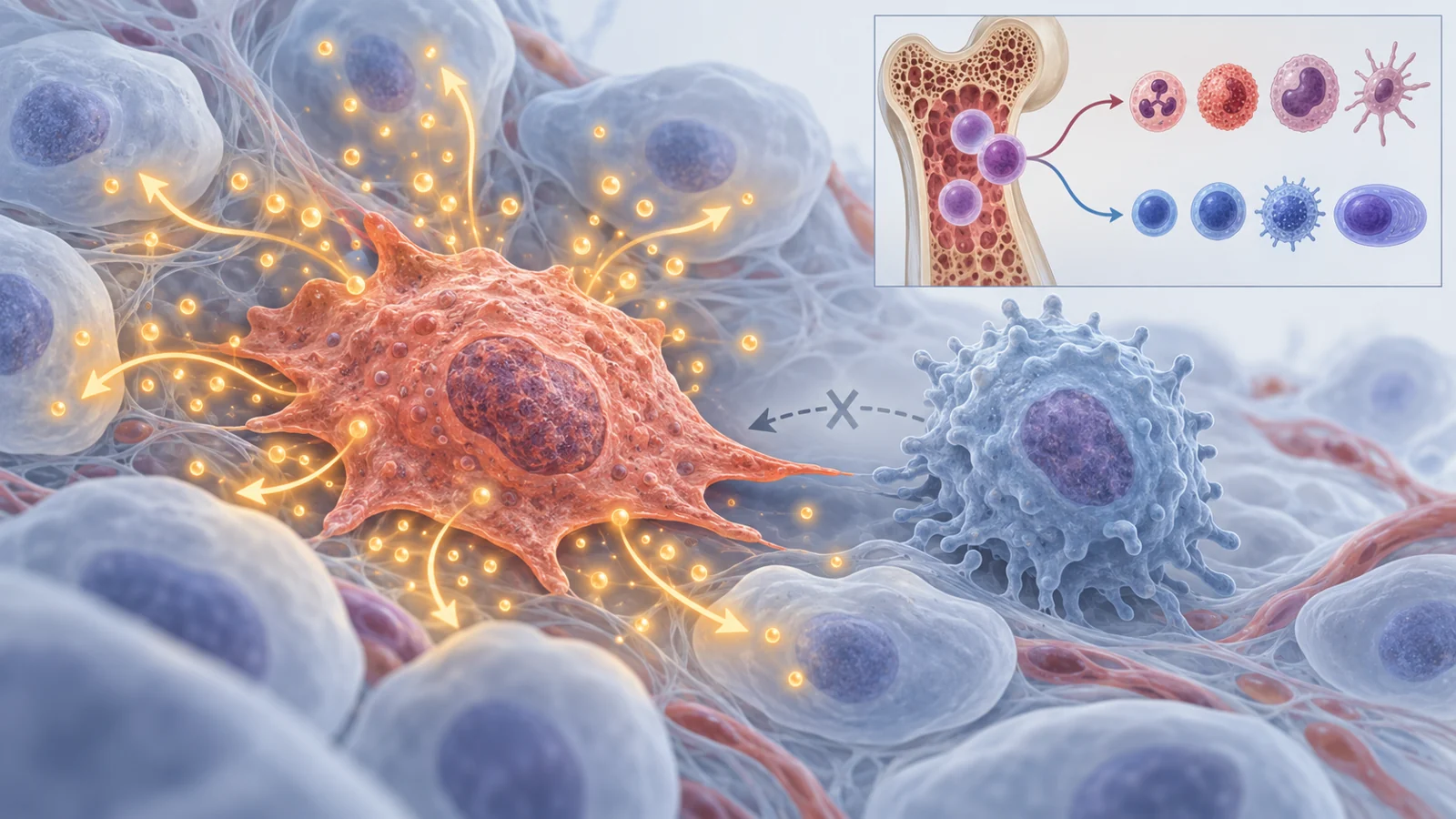
Senescent cells do not divide normally, but they can remain metabolically active. They release a collection of factors known as the senescence-associated secretory phenotype, or SASP. These secretions can promote inflammation and can encourage nearby normal cells to enter senescence. In this setting, an inflammatory response is not necessarily a sign that the immune system is protecting tissue effectively. It may also be part of a self-reinforcing process.
The immune system is supposed to help remove senescent cells and inflammatory material. With age, however, immune cells themselves undergo immunosenescence. The review describes this as a reduced ability to respond to endogenous and external antigens, alongside a reduced capacity to clear senescent cells. Chronic inflammatory activity can accelerate immune-cell aging, while weakened clearance leaves more senescent cells and inflammatory factors in place. The result is a difficult combination: more inflammatory signaling, but less reliable cleanup and coordination.
The review also notes that this pattern varies between people. Older men in one reported comparison showed higher activity in inflammation-related modules and a more pronounced decline in naive T- and B-cell proportions than older women. Centenarians have been reported to retain stronger anti-inflammatory abilities. These observations do not reduce aging to a single immune score, but they show why “more immune activity” is too simple a way to describe what happens with age.
Senescent cells keep changing their surroundings
Skin provides a concrete example of how a cell can affect its neighbors without continuing to divide. During aging, senescent cells accumulate in the skin. Senescent dermal fibroblasts release more extracellular vesicles than their nonsenescent counterparts, according to the review. Those vesicles can interfere with the normal differentiation of keratin-forming cells and weaken the skin barrier, while also being associated with increased production of the inflammatory cytokine IL-6.
The important point is not that every senescent cell has the same effect in every tissue. It is that senescence can have consequences beyond the original cell. A cell that has stopped proliferating can still alter its local environment through its secretions. If immune clearance is less effective, the tissue may remain exposed to those signals for longer. This helps explain why reducing inflammation is not identical to restoring tissue function: the source of the signal, the surrounding cells, and the ability to remove the initiating cells all matter.
Bone marrow changes the supply of immune cells
Aging also affects inflammation through the production of new blood and immune cells. The review describes how red bone marrow is gradually replaced by fat cells with age. Changes in the marrow environment and reduced nutrient-factor secretion from stromal cells can shift hematopoietic stem cells toward myeloid-cell production and away from lymphocyte production.
That shift matters because T and B cells are part of the lymphoid branch of immune development. The review links the altered balance to fewer precursors for these cells as people age. It also describes an important distinction: the number of hematopoietic stem cells may increase even as their self-renewal and colony-forming functions decline. More stem cells, in other words, do not automatically mean a healthier or more adaptable source of immune cells.
The aging marrow is also described as having reduced Wnt signaling, along with accumulated senescent cells and inflammatory cytokines. These changes place immune-cell production inside a tissue context. The immune system’s later behavior depends partly on the environment in which replacement cells develop, not only on the properties of mature cells circulating in the blood.
Inflammation can damage tissue and still support repair
Persistent inflammation can impair organs. In the kidney, the review associates chronic low-grade inflammation with disrupted repair after injury, immunosenescence, and organ damage. Older people show immune features that overlap with those described in chronic kidney disease, including fewer naive lymphocytes, more pro-inflammatory T cells, and reduced phagocytic activity in monocyte-lineage cells.
The heart illustrates why immune activity cannot be judged by its inflammatory label alone. Long-term inflammation promotes cardiac and vascular fibrosis, and the review connects age-related declines in AMPK and GDF11 expression with increased cardiac fibrosis. Yet macrophages in a healthy heart also help remove dying or senescent cells, maintain the myocardium, and support repair after injury.
After a myocardial infarction, the review describes recruited macrophages as initially showing a pro-inflammatory M1 phenotype and later transitioning toward an anti-inflammatory M2 phenotype. The later state is associated in the review with angiogenesis and scar formation during recovery. Whether inflammation is damaging or useful therefore depends partly on timing, location, cell state, and the task the tissue is trying to complete. Broadly suppressing immune activity could affect those functions along with harmful signaling.
Different interventions aim at different parts of the problem
The review’s intervention table includes approaches that alter signaling and others intended to remove senescent cells. These categories should not be treated as interchangeable.
Metformin is described as an approved treatment for type 2 diabetes. In the review, its aging-related mechanisms include preventing NF-κB from moving into the nucleus, reducing phosphorylation of IκB and IKKα/β, and increasing AMP-activated protein kinase activity. The table also describes effects involving the Nrf2 and GPx7 pathway and connects them with reduced oxidative damage and chronic inflammation. These are mechanisms discussed in the review, not evidence that metformin is an approved treatment for aging.
Rapamycin is described as an mTOR inhibitor approved for preventing organ rejection after kidney transplantation and for treating lymphangioleiomyomatosis. The review reports that it has extended lifespan in various species and that its inhibition of mTORC1 can attenuate inflammatory characteristics of senescent cells. The relevant evidence spans biological models and specific clinical indications; it does not establish a generally effective anti-aging regimen for people.
Dasatinib and quercetin represent a different strategy. The review describes dasatinib as effective against senescent human fat-cell progenitors and quercetin as more effective against some senescent endothelial cells and mouse bone-marrow mesenchymal stem cells. Used together, they are reported to target a broader set of senescent-cell-associated phenotypes than either alone. The table lists a phase II trial for chronic kidney disease, but that listing does not establish a successful result or effectiveness against aging generally.
Engineered immune-cell approaches move closer to targeted clearance. The review describes CAR-T cells directed at uPAR or FAP as clearing senescent cells in preclinical animal models, with FAP-targeted cells also reducing cardiac fibrosis in those models. Adoptive natural-killer-cell infusion is likewise described as reducing senescence markers and SASP levels in preclinical work. These examples show how different the intervention questions are: changing inflammatory signaling, altering nutrient-sensing pathways, eliminating selected cells, or recruiting immune functions against them.
Aging does not proceed at one speed
A major complication is that aging is not synchronized across the body. The review discusses a mouse aging atlas covering many organs and ages, with findings consistent with asynchronous progression between and within organs. Widespread immune-cell activation became particularly prominent with age, but the timing and pattern of changes varied across tissues.
Individual histories add another layer. The review uses the idea of “immunobiography” to describe how the type, dose, intensity, and sequence of past antigen exposures can shape a person’s immune aging. Genetics and social factors may also influence inflammation and immunosenescence. A pathway that appears important in an old mouse tissue, or in a particular human cell population, cannot simply be treated as a universal explanation for every older person.
Single-cell and spatially resolved methods may help researchers see which cell types are changing, where they are located, and how their states differ across organs. The review also points to machine-learning approaches that combine multimodal data and may identify biomarkers of biological aging or conserved regulatory programs across species. These tools can make aging biology more precise, but they are research capabilities in the review’s 2023 perspective, not established clinical tests for choosing an intervention.
That variation is why the most useful question is not simply how to suppress inflammation. It is which inflammatory process is harmful, in which tissue, at what stage, and whether the intervention preserves immune functions needed for defense and repair. The review offers a way to organize those questions while leaving the choice of an effective human treatment unresolved.
What targeting inflammation could mean for healthier aging
Research that separates damaging inflammatory activity from useful immune work could eventually support more precise ways to protect organ function. Treatments might be directed at inflammatory pathways, at the accumulation of senescent cells, or at the tissue environments that shape immune-cell production. The practical benefit would be measured in everyday capability: maintaining healthier tissues, responding to injury, and recovering more effectively as people grow older.
That prospect remains conditional from the June 2023 perspective of the review. These approaches would need to produce meaningful benefits in humans while preserving the immune functions required for infection defense, tissue maintenance, and repair. The evidence summarized here supports a promising research direction, not a demonstrated method for extending human lifespan or a treatment recommendation.
Key Sources
- Primary source: Inflammation and aging: signaling pathways and intervention therapies.
DOI or Journal Page · Review or Meta-Analysis · 2023-06-08
Keep exploring