
Research Signal – Source date 2025-08-06
Immunosenescence is the gradual remodeling and dysfunction of the immune system with age. It can produce a confusing combination: immune cells remain active enough to sustain chronic inflammation, yet the overall system becomes less reliable against unfamiliar pathogens and less responsive to vaccination. An August 6, 2025 review, “Immunosenescence: signaling pathways, diseases and therapeutic targets,” brings together the cellular changes, signaling pathways and treatment approaches that help explain why these two outcomes can coexist.
The issue is not simply that immunity becomes weaker, or that it needs to be stimulated more strongly. Aging changes which immune cells are produced, how diverse they are, how long dysfunctional cells persist and whether the tissues around them can support a useful response. A treatment that increases one immune measurement may therefore leave several other parts of the system unchanged.
Aging changes the immune supply line
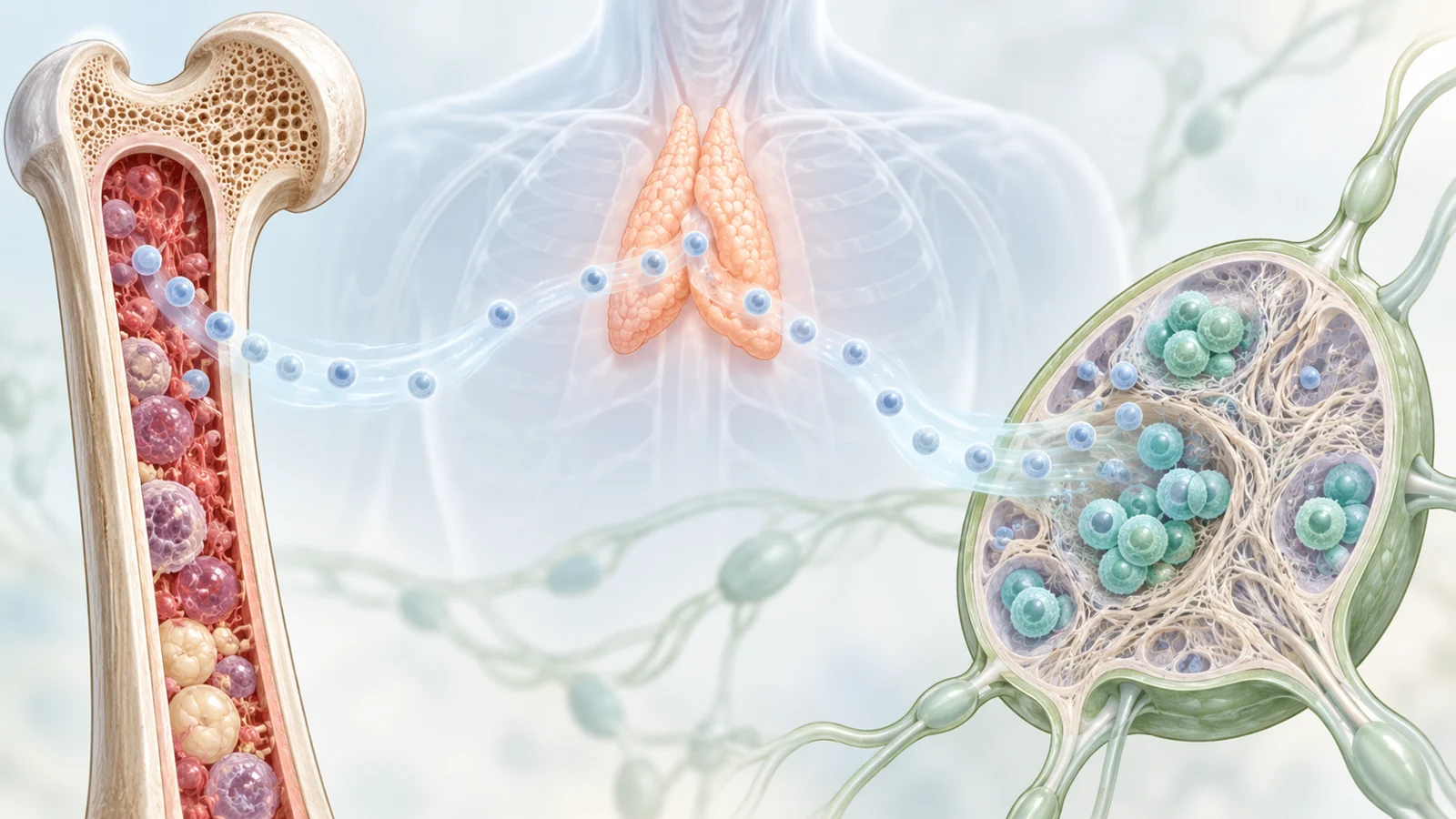
The process begins well before an immune cell encounters an infection. Blood-forming stem cells, or hematopoietic stem cells, generate the cells that populate the immune system. The review describes aging stem cells as more numerous but less capable overall, with impaired differentiation and regenerative function. Their output becomes biased toward myeloid cells, while production of lymphoid cells, including T and B cells, declines.
The thymus adds a second constraint. It gradually shrinks and loses thymic epithelial tissue, reducing the production of naïve T cells. These are not inexperienced in the sense of being defective; they are cells available to participate in responses to targets the immune system has not encountered before. As their supply contracts, the diversity of the T-cell receptor repertoire also narrows, leaving fewer distinct ways to recognize new threats.
Memory cells still have value. Older people often have a larger representation of memory T cells, particularly memory CD8 T cells, as well as memory B cells. Chronic exposure to antigens and age-related inflammation help drive this shift. Memory populations can respond rapidly to threats they have seen before, and some age-associated B-cell populations contribute to pathogen control. The result is not a clean replacement of useful cells with useless ones. It is a change in balance: retained experience can support familiar responses while a reduced naïve-cell pool limits flexibility against unfamiliar targets.
When damage signals disrupt cellular maintenance
The review places NF-κB near the center of this problem. NF-κB is a transcription factor that helps regulate inflammatory gene activity after cellular stress or damage. With aging, accumulated DNA damage and oxidative stress can keep this pathway more active. Persistent NF-κB signaling promotes the inflammatory state known as inflammaging, while also being linked to reduced T-cell diversity and tissue degeneration.
NF-κB can also affect the housekeeping systems that help cells remove damaged components. The review describes a connection between NF-κB and mTOR, a regulator of cell growth, metabolism and cellular recycling. mTOR complex 1 supports processes such as protein production and glycolysis while restraining autophagy, the recycling pathway that helps clear damaged material. When autophagy is impaired in aging immune cells, damaged mitochondria and protein aggregates can accumulate, adding to oxidative stress and inflammasome activity.
A single pathway adjustment is unlikely to repair this entire feedback system. In senescent CD8 T cells, autophagy may remain impaired even when mTOR complex 1 activity is reduced. The review points to persistent p38 MAPK activation as one alternative brake on autophagy. This is an important complication for therapeutic design: lowering one growth or inflammatory signal does not necessarily restore the cell’s full maintenance program.
New immune cells still need the right places
Immune renewal depends on more than the cells released into circulation. The thymus must provide an environment where new T cells can develop, while lymph nodes and other peripheral immune organs help cells survive, move, interact and become activated. Aging changes these surroundings as well as the cells themselves.
The review highlights fibrosis in lymph nodes as a possible obstacle to thymic rejuvenation. Even if a treatment increases the production of new T cells, altered lymph-node structure could limit the ability of those cells to receive survival signals or interact effectively with other immune cells. The spleen is also described as closely connected to immune aging, with experimental findings suggesting that young splenic cells or spleen-directed approaches can influence immune-cell activity in older animals.
This tissue dependence separates organ repair from cell-directed treatment. Restoring thymic output, expanding a circulating cell population and rebuilding the environments that organize immune responses are related goals, but they are not interchangeable. The review therefore presents combinations of approaches as a possibility while also emphasizing that targeting one immune organ in isolation has important limitations.
The treatment evidence is more specific than the promise
The review summarizes treatment studies in settings that are informative but narrower than ordinary aging. One example involves keratinocyte growth factor, or KGF, in rhesus macaques that had undergone myeloablative total-body irradiation followed by autologous peripheral blood progenitor-cell transplantation. KGF increased de novo T-cell production and recovery of naïve T cells in that intensive immune-reconstitution setting. The finding supports the idea that thymic support can matter when the immune system has been heavily disrupted.
A different example concerns repeated treatment with glycosylated recombinant human interleukin-7 in people living with HIV. The review describes a phase I/IIa randomized, placebo-controlled, multicenter study in which repeated treatment may help achieve and maintain normal circulating CD4 T-cell counts while expanding naïve T-cell populations. The review also discusses increased diversity in the circulating T-cell receptor repertoire with recombinant human IL-7 therapy. Those measurements speak directly to T-cell homeostasis and repertoire breadth in a disease-specific context.
Neither example is a direct demonstration of safe, durable immune rejuvenation in otherwise healthy older adults. The macaque study followed recovery after conditioning, irradiation and transplantation. The IL-7 study involved people with HIV, whose immune biology and clinical needs differ from those of ordinary aging. Their results are useful for identifying biological levers, but they do not make the treatment effects interchangeable across populations or settings.
Counts are not the same as protection
A larger circulating T-cell population or a broader receptor repertoire can be an encouraging sign of immune renewal. It is not the same measurement as fewer infections, stronger protection after vaccination, better control of age-related disease or longer life. Those outcomes depend on coordinated function across many cell types, tissues and signaling systems.
The review’s conclusion keeps the gap open. The mechanisms behind immunosenescence remain incompletely understood, single interventions have not provided an ideal solution, and side effects complicate translation into clinical care. A therapy could improve one immune compartment while disturbing another, or create a short-lived cellular change without restoring the tissue conditions needed for durable responses.
That uncertainty also matters because inflammaging is connected with several age-related disease settings, including neurodegenerative disease, cancer, infectious disease and autoimmune disease. Reducing inflammatory activity without weakening useful defense would require more precise control than a general instruction to increase or suppress immunity. The clinically meaningful target is a functioning system that can renew, coordinate and respond appropriately over time.
What this could change
For older people, the long-term benefit would be practical rather than merely numerical: a better chance of mounting effective responses to unfamiliar infections and obtaining stronger protection from vaccination. That would require restoring immune renewal and function together, including the supply of naïve cells and the tissue environments that help them survive and work.
The possibility remains conditional. The relevant interventions would need to be safe, durable and effective in human aging, with cellular and repertoire changes translating into meaningful protection rather than isolated laboratory improvements. If that connection can be established, immune-aging research could move from increasing selected cell populations toward maintaining the broader capacity to respond when older adults encounter threats they have not seen before.
Key Sources
- Primary source: Immunosenescence: signaling pathways, diseases and therapeutic targets.
DOI or Journal Page · Review or Meta-Analysis · 2025-08-06
Keep exploring