
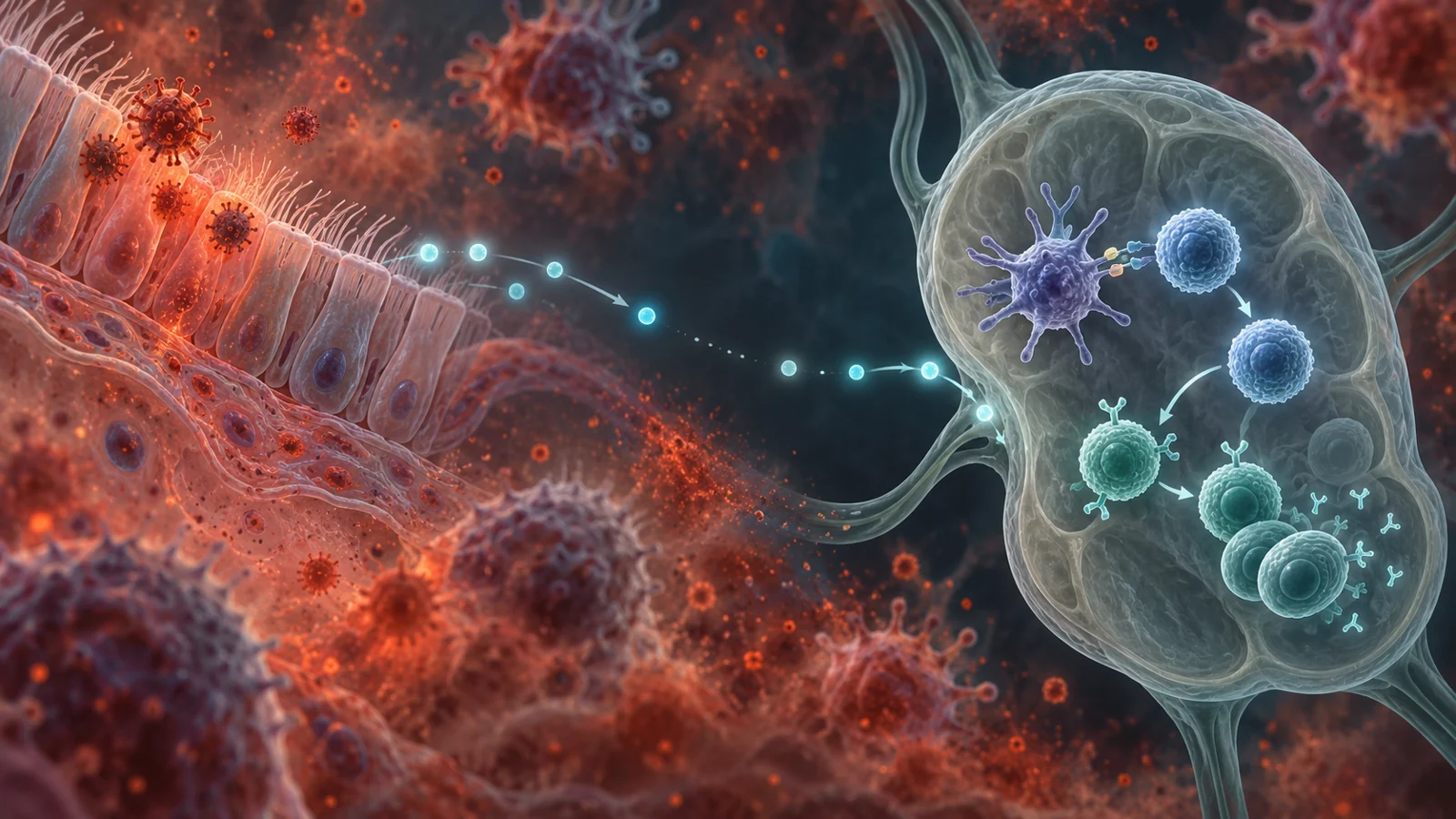
Research Signal – Source date 2021-12-16
Age can make COVID-19 harder to contain without making the immune system simply quiet. The December 16, 2021 review Patho-Physiology of Aging and Immune-Senescence: Possible Correlates With Comorbidity and Mortality in Middle-Aged and Old COVID-19 Patients describes an apparent contradiction: age-related immune changes may weaken protection against a new virus while also leaving the body in a more inflammatory state.
The review is not a newly tested treatment or a clinical model that assigns each person’s outcome to one immune feature. It brings together findings from aging biology, human clinical associations, animal studies and intervention research to explain how response timing, recognition capacity and existing illness might interact during SARS-CoV-2 infection.
An aging immune system can lose precision without becoming inactive
Immunosenescence is the review’s term for age-related changes in immune function. It is broader than losing immune cells. The balance of cell types, their ability to communicate and their readiness to respond to unfamiliar targets can all change. In older adults, fewer naive T and B cells may be available, while more experienced or memory-like cells occupy the system’s limited space. The result can be a narrower range of possible responses even when total cell counts do not look dramatically different.
A second process, inflammaging, describes a chronic, low-level pro-inflammatory condition associated with aging. Senescent cells and a reduced ability to clear them can leave tissues surrounded by inflammatory cytokines and reactive oxygen species. The immune system is therefore not simply switched off. It may be less prepared for a novel threat and more likely to begin from an already activated baseline.
That combination matters in COVID-19 because useful antiviral defense and damaging inflammation are not the same thing. A response must recognize the virus, contain it and coordinate repair. Broad, poorly timed activation can injure tissue even when early protection was inadequate.
Early antiviral signals set the course
The review uses type I interferons to make the timing problem concrete. These are early antiviral signals that help cells resist viral replication and limit the virus’s spread. Their value depends partly on arriving soon enough, before infection has expanded through surrounding tissue.
The review describes a delay in type I interferon production with age and also discusses low or delayed interferon responses in people with serious SARS-CoV-2 symptoms. If the early signal is weak or late, viral control may be less effective at the point when it is most useful. Later, a strong release of inflammatory mediators can contribute to tissue injury rather than restoring orderly control.
This sequence helps resolve the apparent paradox. An older person’s immune response can be inadequate in its first antiviral phase and excessive in a later inflammatory phase. The problem is not that more immunity is always better or that less inflammation is always safer. The immune system has to deliver the right response in the right place and at the right time, while still allowing repair.
The review connects this timing issue with changes in innate immune cells, including macrophages and dendritic cells. Aging can alter how dendritic cells take up material, migrate and produce cytokines. In the lungs, changes in the local environment may also affect dendritic-cell maturation and movement toward lymphoid organs, where T-cell activation is organized. These are proposed biological links assembled across different studies, not a single measurement that predicts an individual’s course.
Recognition depends on breadth and cooperation
The next problem appears after the immune system detects an unfamiliar target. Naive T cells are cells that have not yet encountered the particular antigen that matches their receptors. They provide a pool from which a new adaptive response can be built. With age, the supply of naive T cells falls and the range of receptors they carry becomes more limited.
A narrower repertoire can reduce the odds that the body has a well-matched starting point for a new virus. It also changes the work expected of the cells that remain. The review links very low naive T-cell counts with severe COVID-19 outcomes, while presenting the age-related loss of recognition breadth as a possible contributor rather than a universal rule.
Adaptive immunity is a coordinated process, not a head count. Lymph nodes help bring antigen-presenting cells, T cells and B cells into contact. The review describes age-related changes in these structures, including altered lymphocyte movement, fewer interactions between T and B cells and smaller or less numerous germinal centers. Those changes may make it harder to build the organized response needed for effective antibody production and cellular control.
B cells also need a diverse starting population to recognize different threats and refine antibodies. The review describes a less diverse B-cell repertoire in older people; its example of fewer naive B cells and plasma cells alongside more memory B cells comes from mice. This helps explain why antibody quality and recognition range matter alongside antibody quantity. Changes in immune-cell repertoires do not, by themselves, show that COVID-19 vaccination is ineffective in older adults. They show why protection depends on how well the immune system can generate a suitable response, not only on how many cells or antibodies are present at one moment.
Age is one part of a crowded risk picture
The review does not treat immune aging as an isolated explanation for severe COVID-19. Older age often overlaps with hypertension, cardiovascular disease, diabetes and obesity, and these conditions can affect organs and inflammatory regulation before infection begins. The clinical associations are strong enough to matter, but an association between a condition and severe disease is not the same as an independently measured cause.
Obesity illustrates why attribution is difficult. The review discusses visceral fat as a possible contributor to inflammatory activity and notes that adipose tissue can produce hormones and inflammatory cytokines. It also describes research proposing that adipose tissue with ACE2-expressing cells might influence viral involvement and disease severity. These are mechanisms under discussion, not proof that one tissue explains an individual’s outcome.
The review further cites CT findings in which severe disease, compared with mild disease, was associated with more fatty liver and epicardial adipose tissue in both older adults and people under 40. The comparison complicates an age-only story: age may alter immune coordination, while metabolic and structural factors can add risk across age groups. Diabetes, cardiovascular disease and obesity may also cluster together, making it difficult to separate their effects from age-related immune changes without stronger individual-level evidence.
For readers, the practical lesson is modest but important. Chronological age is not a complete immune profile, and a population-level association should not be converted into a personal prognosis. The review’s connecting argument is that several overlapping influences may shape vulnerability, not that one biomarker or one diagnosis reliably determines what will happen.
Senolytics show how translation can outrun evidence
The review uses senolytics as one possible route toward reducing harmful effects of senescent cells. Senolytics are drugs intended to remove cells that have entered a senescent state. The rationale is that fewer senescent cells might mean less of the pro-inflammatory and pro-thrombotic signaling associated with the senescence-associated secretory phenotype, or SASP.
The evidence discussed in the review comes from different settings. In idiopathic pulmonary fibrosis, a human clinical research context, the combination of dasatinib and quercetin was associated with lower SASP-related pro-inflammatory cytokines. Separately, fisetin and dasatinib plus quercetin were discussed in a mouse model of beta-coronavirus infection, where the findings included lower SASP and improved survival.
Those findings cannot be transferred directly from one setting to another. A cytokine change in people with a different age-related lung disease is not the same endpoint as survival in a mouse infection model. Neither example establishes that senolytics are safe or beneficial for older people with COVID-19, reverses human immune aging or selects the right treatment for a particular patient. The example is useful because it separates a plausible biological rationale from demonstrated clinical benefit.
What this could change
A better account of immune aging could eventually support vaccine approaches and treatments designed for the way older adults’ immune systems recognize threats, transmit antiviral signals and regulate inflammation. The intended benefit would be more reliable protection against serious infection while limiting the inflammatory injury that can follow an unbalanced response.
In the review’s 2021 outlook, that possibility depends on clinical validation. Researchers would need to show that targeting relevant age-associated immune changes improves patient outcomes while preserving useful antiviral activity. A single marker, a broad immune booster or a blanket anti-inflammatory strategy is unlikely to capture the coordination problem described here. The practical payoff would come from matching intervention to the timing and function of the response, with evidence that the approach helps people rather than only improving a laboratory measurement.
Key Sources
- Primary source: Patho-Physiology of Aging and Immune-Senescence: Possible Correlates With Comorbidity and Mortality in Middle-Aged and Old COVID-19 Patients.
DOI or Journal Page · Peer-Reviewed Paper · 2021-12-16
Keep exploring