
Research Signal – Source date 2023-07-17
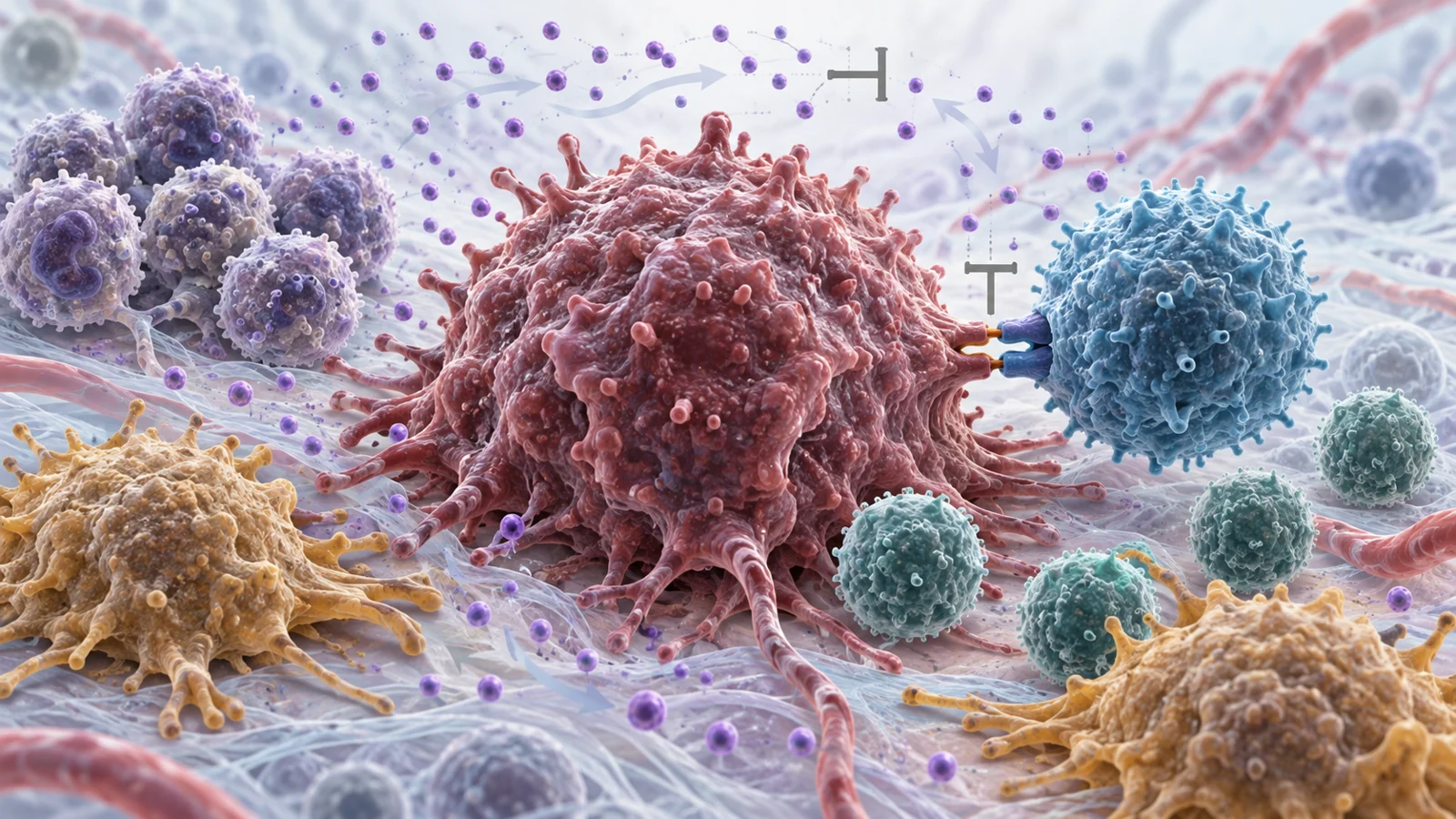
For people with non-small cell lung cancer whose tumors lack targetable mutations, or whose treatment has stopped working, the tumor microenvironment can be as important as the tumor itself. This is the living neighborhood around a tumor: immune cells, signaling proteins and other surrounding cells that can either support an immune attack or help the cancer avoid it.
A review published on July 17, 2023, examined one especially complicated possibility. Blocking interleukin-1 beta, usually written as IL-1β, might reduce cancer-supporting inflammation and make checkpoint immunotherapy more effective. Yet the clinical studies discussed in the review did not produce a simple success story. The biology made the combination plausible; the reported trial results showed why plausibility alone is not enough.
One tumor neighborhood can suppress immunity in more than one way
IL-1β is an inflammatory signaling protein. In the setting described by the review, increased IL-1β can change the tumor microenvironment so that immune suppression becomes easier to maintain. Preclinical findings linked higher IL-1β activity with the accumulation of myeloid-derived suppressor cells, or MDSCs. These cells suppress immune responses directed at tumors. Their accumulation was also associated with more regulatory T cells, which can further reduce the tumor-fighting activity of natural killer cells and cytotoxic T cells.
The inflammatory environment may also recruit tumor-associated macrophages. The review describes IL-1β as helping attract these macrophages through a signaling process involving MCP-1. Once present, the macrophages can contribute to further IL-1β production and inflammasome activity, creating conditions that support tumor growth and spread. The proposed effect is not simply that inflammation surrounds the tumor. It is that inflammatory signaling can reshape which immune cells are present and what they do.
The PD-1/PD-L1 pathway acts through a different but related route. PD-1 is found on immune cells including tumor-specific T cells, while PD-L1 can be expressed by tumor cells and by several immune and epithelial cells. When PD-1 on a T cell engages PD-L1, the interaction sends signals that reduce T-cell activity. In the tumor microenvironment, continued engagement can contribute to T-cell exhaustion, leaving tumor-infiltrating lymphocytes less able to carry out an effective response.
This is the reason checkpoint inhibitors can be useful in some settings: they are intended to interrupt the PD-1/PD-L1 restraint on T cells. The review describes an active tumor microenvironment as one containing PD-1-positive activated CD8-positive T cells alongside PD-L1 expression, a setting in which checkpoint inhibition may have something to reactivate. IL-1β, by contrast, appears in the review as a way of altering the surrounding immune conditions. One pathway can help create a suppressive neighborhood while the other can restrain the T cells trying to work within it. That makes them complementary treatment targets in theory.
Associations and experiments answer different questions
The review separates observations about patients from experiments that directly altered these pathways. A retrospective association connected smoking history in NSCLC with increased IL-1β production and higher PD-L1 expression in tumor cells. This suggests a relationship worth studying, but it does not by itself show that smoking-related IL-1β activity caused checkpoint resistance or that blocking both pathways would benefit a particular patient.
Experimental findings supplied a more direct test of the combination idea. The review describes work in which acute IL-1β exposure promoted chemoresistance and increased PD-L1 in the NSCLC tumor environment. In a mouse model, combined anti-IL-1β and anti-PD-1 treatment produced a stronger effect than either treatment alone, with tumor growth completely inhibited for the reported 30-day period. Tumors receiving the combination had a higher percentage of CD8-positive T cells, consistent with a reduction in the immune-suppressive effects associated with IL-1β.
The review also describes canakinumab treatment in humanized NSCLC cells as slowing tumor growth while remodeling the tumor microenvironment. These findings help explain why researchers considered combining IL-1β inhibition with checkpoint blockade. They do not show that the same benefit occurs broadly in people with NSCLC. Preclinical intervention can demonstrate that a mechanism is biologically actionable; it cannot substitute for evidence that a treatment improves patient outcomes at an acceptable safety cost.
The clinical results tested established cancer, not just the mechanism
An important starting point was the CANTOS trial, where IL-1β inhibition was incidentally associated with a lower incidence of lung cancer and lower lung cancer mortality. That observation concerned the occurrence and outcome of lung cancer in the setting of an anti-inflammatory intervention. It was not a demonstration that an IL-1β inhibitor combined with a checkpoint inhibitor could treat established NSCLC.
The NSCLC studies discussed in the review asked more direct treatment questions. CANOPY-1 did not meet its primary endpoints. CANOPY-2 evaluated canakinumab with docetaxel in patients who had previously received PD-1/PD-L1 inhibitors and platinum-based chemotherapy. In the comparison described by the review, adding canakinumab did not significantly improve progression-free survival or overall survival over docetaxel alone. The discussion also reported a higher incidence of fatal infections, an important safety concern when an intervention changes inflammatory and immune activity.
CANOPY-A evaluated canakinumab with disease-free survival as its primary endpoint. It also did not meet its primary endpoint, although the review describes its safety profile as comparable to previous canakinumab trials. Progression-free survival, overall survival and disease-free survival are different measures of what happens to patients over time. A result in one setting cannot simply be transferred to another, and an unmet endpoint does not prove that every possible regimen or subgroup would fail. It does show that the attractive pathway story had not yet translated into a broadly demonstrated clinical advantage in the reported studies.
Could biomarkers help identify who benefits?
An unresolved question is whether biomarkers could identify a subgroup that benefits from adding IL-1β inhibition. Answering it would still require evidence that the combination improves outcomes in that subgroup.
The review discusses C-reactive protein, or CRP, as one concrete example of an inflammation marker associated with outcomes during checkpoint treatment. In advanced NSCLC, higher pretreatment CRP was associated with worse progression-free and overall survival and with a lower overall response rate. An early decline in CRP after checkpoint treatment was associated with improved progression-free survival. These observations make CRP relevant to research on inflammation and treatment response, but they do not establish a validated rule for selecting patients for an IL-1β and PD-1/PD-L1 combination.
The biomarker picture is not settled. The review discusses IL-6 and IL-8, M-MDSC-related gene patterns and serum IL-1β as possible avenues for understanding response and resistance. Its discussion also contains serum IL-1β associations pointing in different directions: one account links elevated levels with poorer response and survival, while another describes elevated levels as potentially associated with improved checkpoint response. A single simple claim that higher IL-1β reliably predicts benefit or failure would therefore overstate the evidence.
A useful biomarker would need to do more than correlate with inflammation or prognosis. It would need to distinguish patients who are likely to gain additional benefit from IL-1β inhibition from those who would receive only added toxicity or treatment burden. That requires validation in the specific combination and clinical setting being considered. Until then, the biological rationale and the outcome associations remain pieces of a hypothesis rather than a patient-selection test.
What better matched treatment could mean for lung cancer patients
For patients whose tumors lack targetable mutations, a validated way to recognize an IL-1β-driven, immune-suppressive environment could eventually make treatment more individual. A responsive subgroup might gain an additional option designed to reduce the inflammatory conditions that restrain immune activity while checkpoint treatment addresses the PD-1/PD-L1 brake. Patients unlikely to benefit could avoid an ineffective combination and its unnecessary side effects.
That possibility remains conditional from the July 2023 perspective of the review. Researchers would still need to show clinical benefit with acceptable safety and validate which measurements identify genuine responders. If those steps succeed, the practical value would not be the pathway diagram itself. It would be a better-matched treatment choice for people who currently have limited options or whose first immune-based treatment no longer works.
Key Sources
- Primary source: Comprehensive Review: Unveiling the Pro-Oncogenic Roles of IL-1ß and PD-1/PD-L1 in NSCLC Development and Targeting Their Pathways for Clinical Management.
DOI or Journal Page · Review or Meta-Analysis · 2023-07-17
Keep exploring