
Research Signal – Source date 2025-10-07
A score calculated from a brain scan can look like a biological difference between people. But if the measurement changes when someone’s head is tilted, part of that difference may come from scan geometry instead.
A study published on 7 October 2025 compared three ways to calculate DTI-ALPS, a diffusion MRI measure taken from white matter near small veins. The conventional calculation was associated with head pitch in data from 172 older adults. Two approaches that account for orientation did not show that association in this sample. One of them, a new method called LD-ALPS, also had a modest link with cognitive test scores after accounting for another diffusion measure.
Correcting for head orientation addresses one source of measurement bias; it does not establish that the score measures brain fluid movement.
A directional score depends on the scan’s axes
DTI-ALPS uses diffusion MRI to estimate how readily water molecules move in particular directions within white matter regions near medullary veins. The calculation compares directional diffusion values in these regions. Researchers have used the resulting index as an indirect way to study perivascular fluid dynamics, including processes sometimes discussed in relation to the brain’s glymphatic system.
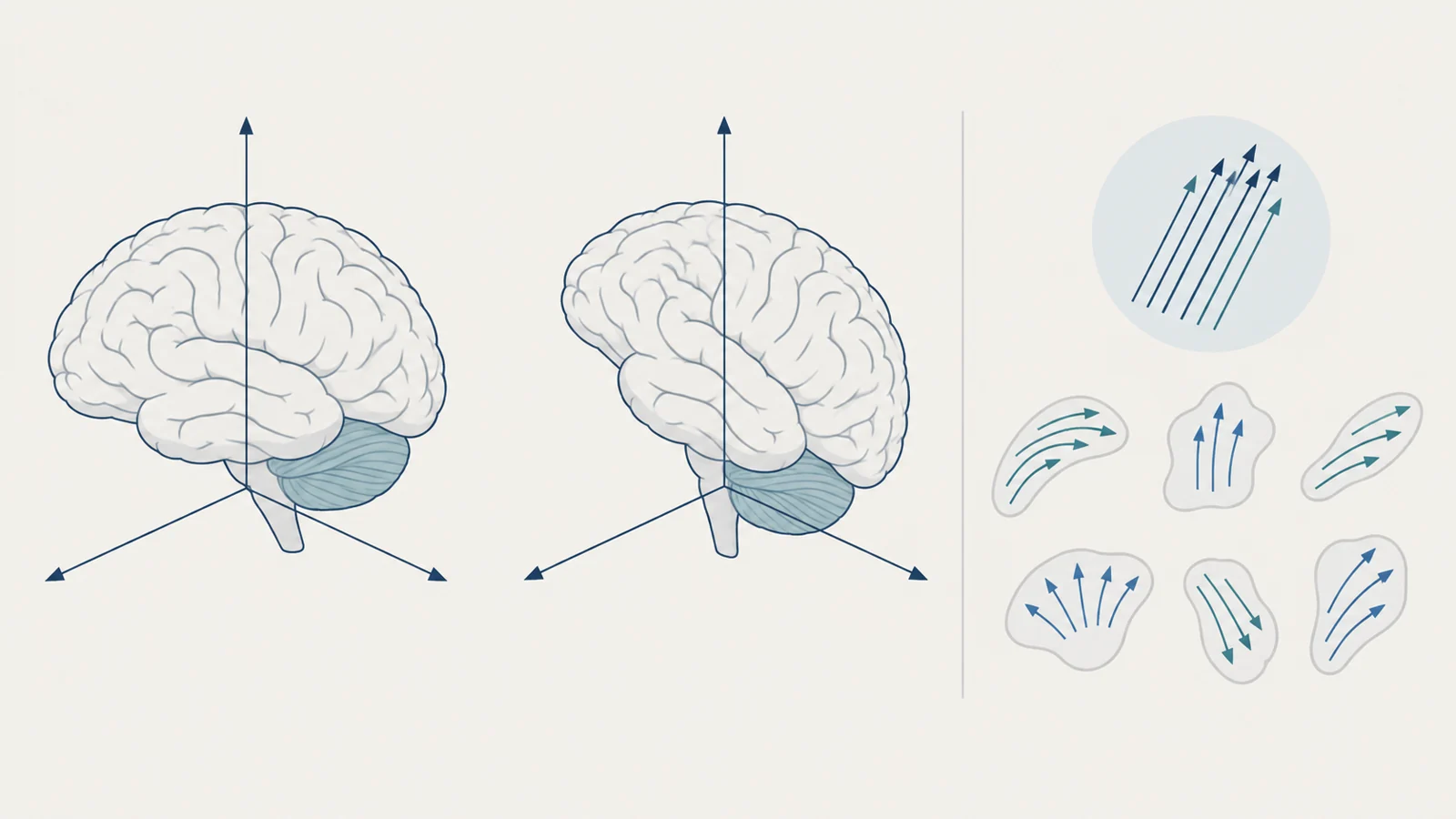
The score does not directly track fluid moving through those spaces. Its value also reflects the geometry and diffusion properties of the white matter being measured. That matters because the conventional formula uses diffusion directions defined relative to fixed imaging axes.
When the head is aligned as expected, the relevant white matter directions have a particular relationship to those axes. Tilt the head, and the anatomy rotates relative to the measurement coordinates. A directional component in the formula can then change even if the tissue itself has not undergone a physiological change. The score may shift because the scan is projecting the same underlying structure onto different axes.
This is a measurement problem with a recognizable consequence: if participants differ in head position, an uncorrected score may partly track that position. Differences between people—or between groups—could then be harder to interpret as biological differences alone.
The three calculations behaved differently in ADNI scans
The researchers compared conventional unrotated ALPS with vector-registered ALPS and their new Local Diffusion ALPS, or LD-ALPS. They used diffusion MRI data from 172 participants in the Alzheimer’s Disease Neuroimaging Initiative (ADNI), a group that included cognitively normal people and participants with varying degrees of cognitive impairment. One participant was excluded as an outlier from later analyses.
In the unrotated calculation, the score was associated with absolute head pitch: the correlation was −0.513. In practical terms, larger departures from the relevant head angle tended to accompany lower unrotated scores in this sample. The vector-registered and LD-ALPS scores did not show a statistically significant association with pitch or absolute pitch. Neither method showed a detected association with yaw or roll either.
For this dataset, orientation correction removed the observed link between pitch and the calculated score. That is a narrower finding than proof that either method is immune to all orientation effects in every scanner, dataset or population. The comparison does show why head position can matter when interpreting a conventional result: the same formula may produce systematically different values as anatomy turns relative to its axes.
The average values also differed across the calculations. The reported means were 1.26 for unrotated ALPS, 1.30 for vector-registered ALPS and 1.43 for LD-ALPS. These are outputs of different procedures, not thresholds that can be read as levels of fluid flow. A higher value under one calculation does not by itself mean that more fluid is moving.
Reporting the correction step changes how older results read
The paper also surveyed DTI-ALPS research found through a PubMed search conducted on 13 September 2024. Of 141 research papers identified in that search, the authors classified 121 as lacking a stated aligned-slice prescription or vector-registration step. They cautioned that some papers may have used a correction without describing it.
That qualification matters when reading earlier work. A missing methods detail is not evidence that investigators skipped the step. But if a paper does not say how the image orientation was handled, readers cannot readily tell whether the reported value may be vulnerable to the same geometric influence seen in this comparison.
The survey was explicitly non-exhaustive and describes reporting in the literature up to its search date, not current practice. Its useful lesson is about reproducibility: explaining whether and how orientation was corrected lets other researchers judge what a score may capture and compare results more fairly.
LD-ALPS allows directions to vary across regions
Vector registration corrects the relationship between diffusion directions and the relevant anatomical axes. LD-ALPS changes another assumption in the calculation. Conventional approaches treat the main diffusion directions within each region as relatively uniform. The local method instead estimates directions within individual regions and accounts for local variation among voxels, or small image elements.
In the study’s processing, researchers grouped the primary diffusion directions within each region, identified a representative direction, and used local directions in calculating the score. The method allows the direction pattern to differ between regions rather than requiring one shared orientation to hold across them. This may preserve information that would be smoothed over when a region’s diffusion pattern is treated as uniform.
That additional detail takes more computation than vector registration. The authors describe the added demand as modest relative to the broader diffusion MRI preprocessing pipeline, but it is still a more involved calculation. The results therefore raise a practical choice: vector registration addressed the observed head-pitch association in this sample with a simpler approach, while LD-ALPS adds a way to represent local directional variation that may matter for other comparisons.
The cognitive association was small and observational
All three scores had weak associations with Mini-Mental State Examination (MMSE) results, a measure of cognitive functioning used in the study. LD-ALPS had the strongest reported correlation with MMSE, at 0.310, compared with 0.260 for vector-registered ALPS and 0.250 for the unrotated score. The relationships remained similar after accounting for absolute head pitch.
A more demanding comparison accounted for mean diffusivity (MD), an ordinary measure of average water diffusion in the same regions. MD itself had a stronger association with MMSE than any ALPS score. After accounting for MD, the unrotated and vector-registered scores no longer had statistically significant associations with MMSE. LD-ALPS retained a modest association: r = 0.172, p = 0.025.
That result is interesting because it suggests the local calculation may capture some variation in these data beyond what MD captured. It is not evidence that LD-ALPS can diagnose cognitive impairment, predict an individual’s future, or explain why cognition differs. The analysis was observational and used one existing sample; a modest correlation does not establish clinical value or cause and effect.
What head-position correction could reveal about brain aging
A more reliable way to calculate DTI-ALPS could help researchers make clearer comparisons across people and studies. If the orientation findings hold up in broader datasets, reporting and correcting for head position could reduce the chance that scanner geometry is mistaken for a difference in brain tissue or perivascular diffusion. If LD-ALPS also proves useful across other samples and cognitive measures, its local treatment of diffusion directions could add information to studies of aging and neurological conditions.
Those steps could make the score more useful as a research measure, but they would not by themselves turn it into a direct readout of glymphatic flow or waste clearance. That biological interpretation remains a separate question requiring validation. For now, the clearest contribution is methodological: the calculation—and the head position it assumes—can shape what a brain MRI score appears to say.
Key Sources
- Primary source: Mitigating Head Position Bias in Perivascular Fluid Imaging: LD-ALPS, a Novel Method for DTI-ALPS Calculation.
DOI or Journal Page · Peer-Reviewed Paper · 2025-10-07
Keep exploring