
Research Signal – Source date 2022-01-25
A detailed DNA map can show many of the changes inside a head and neck cancer, yet still leave doctors without a dependable way to choose a tailored treatment. A 2022 review of squamous cell carcinoma of the head and neck describes a reason to widen the picture: conditions inside a tumor, along with nearby non-cancer cells, may influence how cancer cells respond to therapy.
The review’s central question is not whether mutations matter. It is whether the surrounding tissue adds information that DNA sequencing alone has not made useful for routine treatment selection.
A detailed mutation map has not settled treatment choice
Squamous cell carcinoma of the head and neck, often abbreviated SCCHN, can be treated with surgery, radiation, chemotherapy, targeted drugs or immunotherapy. Even with these approaches, the review describes poor prognosis for people with locally advanced or recurrent and metastatic disease.
Sequencing studies involving thousands of patients had catalogued somatic genetic alterations—changes acquired by cancer cells. But the authors report that this extensive catalog had not yielded a satisfactory genetic biomarker for diagnosis, predicting a patient’s outcome or selecting a tailored therapy in routine care. A long list of mutations is not automatically a guide to which treatment is most likely to help a particular person.
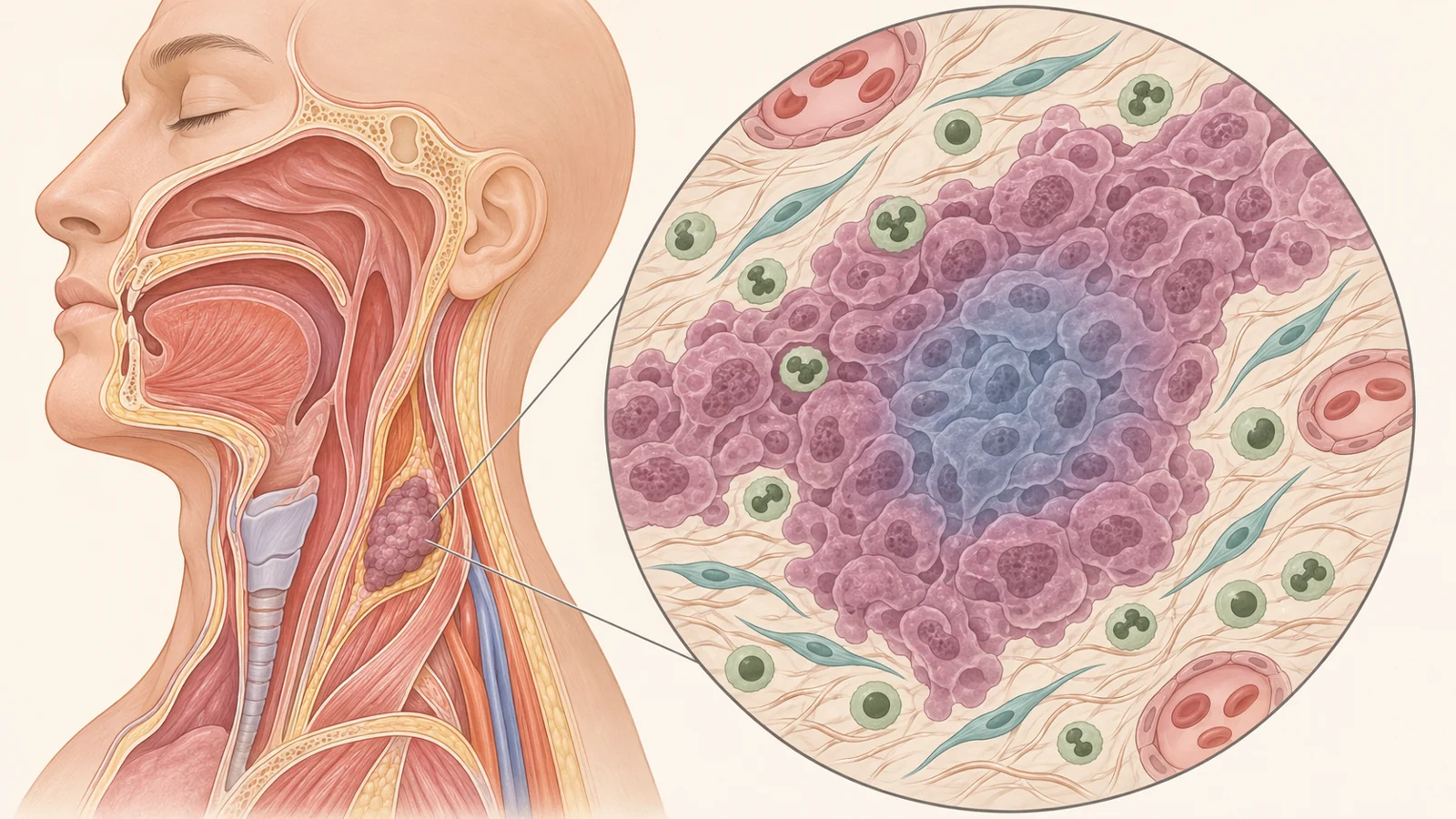
The review therefore considers the tumor microenvironment: the conditions and non-cancer cells within and around the tumor. One condition it highlights is hypoxia, meaning low oxygen. The authors discuss hypoxia in relation to intratumoral heterogeneity—the differences among cancer cells within the same tumor—and to therapy response. The abstract supports treating oxygen availability as part of the research question, but does not specify a single mechanism or quantify its effect.
Neighboring cells add another layer
The tumor’s surroundings also include cells that are not cancer cells. The review highlights cancer-associated fibroblasts, which are connective-tissue cells found in the tumor environment, as well as immune cells. Their presence matters to the question because the authors consider how these neighboring populations may relate to differences in cancer-cell behavior and response to treatment.
These categories should not be collapsed into one effect. Fibroblasts and immune cells are distinct participants in the tissue around a tumor, and the supplied summary does not establish a specific action for each named cell type. The broader point is that a tumor is not only a collection of genetically altered cancer cells: its local conditions and cellular neighbors are also being studied as possible influences on response.
Existing immunotherapy and ongoing trials are different evidence
By the review’s publication date, immune checkpoint inhibitors had entered clinical use in SCCHN. These treatments aim to increase anti-tumor immune responses, and the authors cite their implementation as an example of targeting the interaction between cancer and its environment.
The review separately describes clinical trials then in progress evaluating monoclonal antibodies and small-molecule inhibitors directed at the tumor microenvironment. Some approaches were being studied alongside surgery, radiation or chemotherapy. Those trials represent investigation, not established outcomes: the abstract does not report their results, so it cannot support a claim that these combinations improved response or survival.
This distinction matters for readers weighing promise against evidence. One microenvironment-focused treatment class was already in clinical use at the time; other strategies were still being tested. Neither fact, by itself, supplies a validated way to match an individual patient to a treatment.
A plausible influence still needs a reliable patient-level test
A factor can be biologically relevant without being ready to guide care. To select treatment, clinicians would need evidence that specified features of a patient’s tumor environment predict how that patient will respond, and that the information adds something useful beyond genomic data. The review identifies the need for reliable predictive biomarkers and discusses preclinical and clinical models as ways to study interactions between cancer cells and their surroundings. The abstract does not provide model specifications or patient-level validation results.
That gap separates a useful research direction from a clinical decision tool. Showing that low oxygen or neighboring cells may be involved in heterogeneous responses is not the same as showing that measuring them improves an individual patient’s treatment choice. The latter requires testing a defined measurement against outcomes in patients and determining whether it improves prediction over DNA information alone.
What this could change
A person with locally advanced or recurrent head and neck cancer could one day have treatment selected using a validated account of the tumor’s surroundings alongside its DNA. That would make it more feasible to choose among existing approaches based on which is better suited to a particular tumor, rather than relying on a genetic profile that does not yet provide a dependable selection marker. The review points toward low oxygen and nearby cells as factors worth investigating; it does not show that a combined guide is ready or that it would improve survival.
A nearer milestone would be a prospective study showing that specified microenvironment measurements improve prediction of response to a specified treatment beyond genomic information alone. If that result held up independently, it would provide a concrete step toward more reliable patient-level choices. Checkpoint immunotherapy was already in clinical use when this review appeared; the new capability would be knowing more dependably which approach fits which patient.
Key Sources
- Primary source: Microenvironment-driven intratumoral heterogeneity in head and neck cancers: clinical challenges and opportunities for precision medicine.
DOI or Journal Page · Review or Meta-Analysis · 2022-01-25
Keep exploring