
Research Signal – Source date 2022-01-05
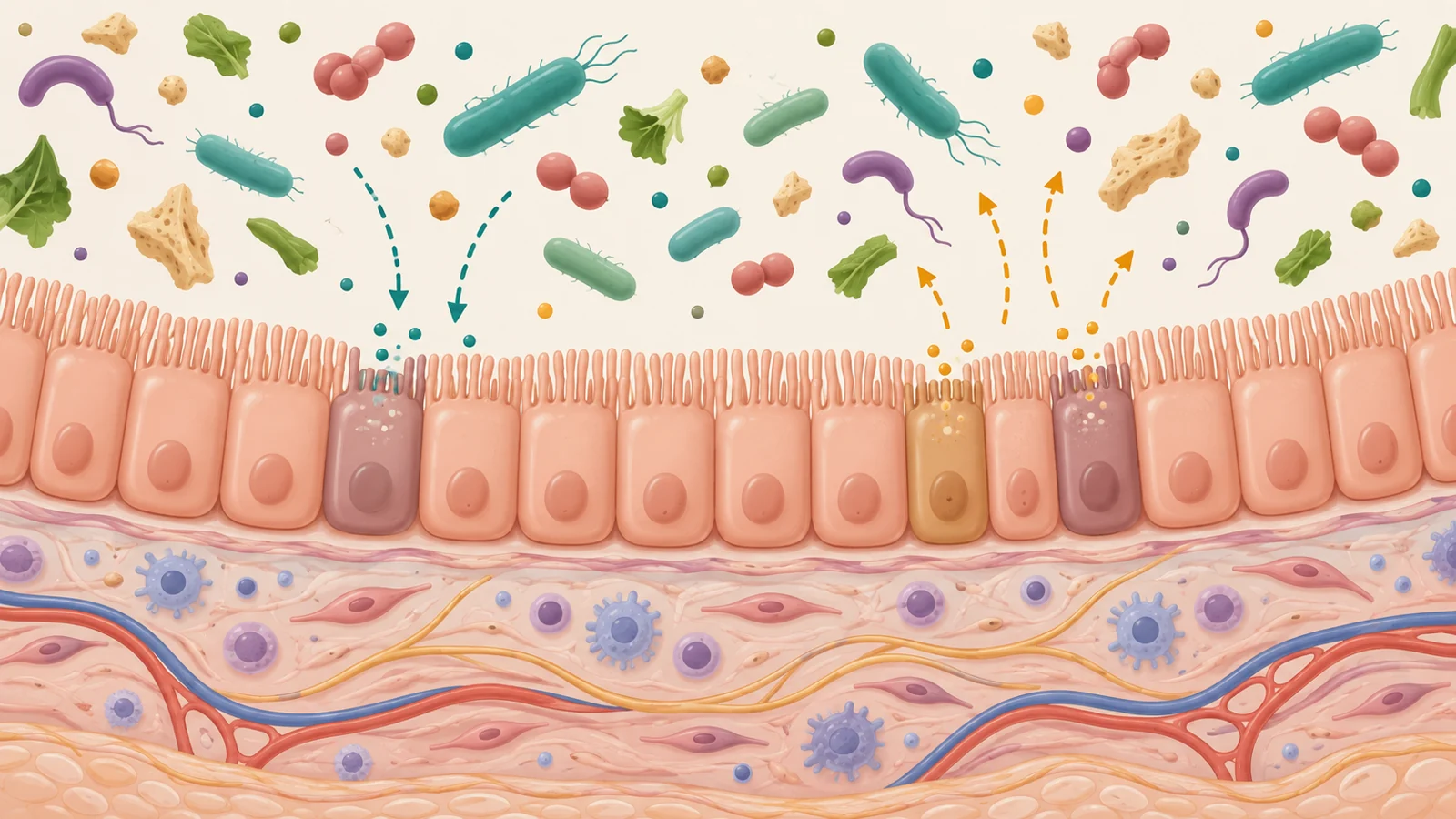
The gut changes with age in ways that involve both its microbial inhabitants and its own cells. Microbial communities can shift in composition and activity, while senescent cells—cells that have persistently stopped dividing—accumulate in some tissues. Finding both changes in older people does not establish whether one helps cause the other.
A narrative review published January 5, 2022, brings these observations together into a biological hypothesis. Microbial products could influence the stresses that push intestinal cells into senescence, while senescent cells could alter conditions in the gut. Drawing on human observations, cell experiments, and animal studies, the paper connects mechanisms studied in different settings. It does not report a new experiment demonstrating the whole relationship or establish that changing the microbiome reduces harmful senescent-cell accumulation in humans.
Why senescence can help and harm
Cellular senescence is a stress response involving a persistent halt in cell division and broader changes in cell behavior. Damage to DNA, disturbances in cellular energy production, and repeated division can contribute to its development. A senescent cell remains biologically active even though it has stopped dividing.
One important change is the senescence-associated secretory phenotype, or SASP—the mixture of substances that senescent cells release into surrounding tissue. These secretions can influence inflammation and the behavior of nearby cells. They can also attract immune cells that recognize and eliminate senescent cells.
Senescence has useful roles in development and wound healing, and stopping damaged cells from dividing can help protect against tumor formation. The problem emphasized in the paper is persistent, age-related accumulation. When senescent cells remain in tissue and continue releasing inflammatory substances, their effects can interfere with organ function. That distinction matters for any eventual intervention: reducing harmful accumulation requires attention to the useful biological work that senescence also performs.
From dietary material to cellular stress
Gut microbes process dietary material into smaller molecules called metabolites. Some act locally; others can enter the circulation and affect distant tissues. The paper discusses short-chain fatty acids and products formed when microbes break down plant compounds, among other microbial outputs. This gives the gut microbiome a chemical influence extending beyond the organisms themselves.
The proposed connection to senescence runs through cellular stress. Reactive oxygen-containing molecules are part of cell biology, but when their production overwhelms a cell’s defenses, they can damage DNA and other cellular components. This imbalance is called oxidative stress. Damaged mitochondria, the structures involved in energy production, can contribute to further oxidative pressure. Sustained damage can help activate the senescence program.
Some microbial metabolites, including products of dietary-compound processing, have anti-inflammatory or antioxidant properties in the research discussed. They could therefore affect either the stress reaching a cell or its capacity to withstand that stress. The proposed sequence is specific: dietary material becomes a microbial product, that product changes the chemical conditions experienced by host cells, and those conditions may influence the development of senescence. The evidence assembled does not establish every step of that sequence in aging humans.
This also explains why identifying which microbes are present provides only part of the answer. Plant polyphenols that are poorly absorbed in the small intestine can reach the colon, where microbes transform them into compounds with different biological effects. Understanding such activity requires examining the products being made. A microbial community’s composition alone cannot tell researchers whether its overall chemical output increases or reduces pressure on intestinal cells.
Intestinal cells help shape the microbial habitat
The cells lining the intestine form a barrier between the gut’s contents and the body’s tissues. Along with supporting cells beneath them, they also help regulate local inflammatory responses. Their condition therefore matters to the environment in which microbes live.
The paper describes observations of increasing senescence-associated markers in human colon tissue with age. It also discusses findings in normally aging mice and a mouse model of accelerated aging, including increased expression of p16 and p21, proteins associated with the cell-division arrest program. Intestinal organoids—laboratory-grown structures derived from intestinal cells—from older mice likewise showed increased senescence markers compared with those from younger animals. These observations support studying intestinal senescence as a feature of aging across several experimental settings.
The broader proposed consequence is that accumulating senescent cells and their secretions could disrupt barrier function and inflammatory regulation. Greater permeability would change the separation between gut contents and host tissue, while persistent inflammatory signaling could alter the local microbial environment. This supplies the reverse direction of the hypothesis. The observations of senescence markers do not, by themselves, demonstrate that entire sequence or identify which microbial changes would follow.
What the mouse findings can establish
An intervention discussed in the paper makes the question more concrete. In a reviewed mouse study, treatment with dasatinib plus quercetin was associated with lower expression of intestinal senescence markers, including p16 and p21, than in controls. Expression of several SASP-related inflammatory factors was also lower. Microbial populations differed across sampled intestinal regions and feces following treatment.
These findings connect an intervention with changes in both host tissue and microbes. They do not establish that the microbial changes mediated the effects on senescence. Several explanations remain possible: the intervention could act on host cells and thereby alter the microbial environment, microbial changes could contribute to the host response, or both could respond through partly separate routes. Distinguishing those explanations requires evidence about which changes are necessary for the others to occur.
The measured endpoints also set limits on interpretation. Lower expression of senescence-associated markers is not a direct count of selectively cleared senescent cells. Likewise, lower inflammatory-marker expression does not establish that the intestinal barrier functions better. Those are different biological outcomes, even when they might plausibly be connected.
Quercetin’s presence in the combination does not make the mouse finding evidence for a dietary substitute. The intervention involved two agents together, and the observations described concern mice. They provide no estimate of human benefit and do not establish that a food, supplement, probiotic, or other microbiome intervention safely reduces senescent-cell burden or extends human life.
The missing connection is causal
The January 2022 paper identifies a gap between describing microbial communities and understanding their functional effects. The gut metabolome—the collection of small molecules found in the gut—could help reveal how diet and microbial activity combine to affect host cells. But research connecting age-related metabolite changes with intestinal senescence remains limited in the evidence discussed. Associations between microbial composition and age or survival cannot resolve that gap, because they do not establish what drives the outcome.
Another unresolved question is whether proposed anti-senescence interventions depend on the microbiome at all. The paper asks whether microbial activity helps explain the effects attributed to some dietary compounds and whether probiotics have direct anti-senescence effects. These are questions for investigation, rather than established mechanisms of treatment. Evidence spanning different tissues, models, and endpoints cannot be combined into a single treatment effect, a universal healthy microbial composition, or a rule for choosing an intervention for an individual person.
What this could change
If specific microbial activities causally influence harmful senescent-cell accumulation, and those activities can be modified safely, they could become targets for preserving intestinal function with age. Changing the production of relevant metabolites might reduce sustained cellular stress, limit the development of harmful senescence, and help maintain the barrier separating gut contents from host tissues. A resulting reduction in persistent inflammation could be a meaningful benefit even without any demonstrated extension of lifespan.
Older people could eventually benefit from interventions directed at those activities, provided human studies demonstrate better intestinal function and an acceptable balance of effects. The practical opportunity raised by the paper is to connect a modifiable microbial process to a concrete tissue outcome. Establishing that connection would give researchers a basis for developing treatments aimed at maintaining the aging intestine’s ability to protect and regulate its internal environment.
Key Sources
- Primary source: Emerging Interrelationship Between the Gut Microbiome and Cellular Senescence in the Context of Aging and Disease: Perspectives and Therapeutic Opportunities.
DOI or Journal Page · Peer-Reviewed Paper · 2022-01-05
Keep exploring