
Research Signal – Source date 2024-08-15
Gut microbes could influence aging partly through their interactions with cells that have stopped dividing but remain metabolically active. These senescent cells can release substances that affect neighboring tissue and immune activity. In the intestine, changes in those cells may also alter the conditions in which microbes live, creating a possible two-way relationship.
A review published on August 15, 2024, brings together research on this connection, from cultured cells and mouse experiments to observations in people. Its central proposition is that cellular senescence and changes in the gut microbial community may reinforce one another, contributing to persistent inflammation and age-related decline. That makes the host’s own cells part of the explanation for why a microbial community changes.
The therapeutic implications reach beyond adding supposedly beneficial bacteria. Researchers are also investigating microbial products and treatments directed at senescent cells themselves. Understanding why either approach might help requires looking at the intestinal barrier, the different kinds of evidence behind the idea, and the useful functions that treatment would need to preserve.
The gut barrier is an active meeting place
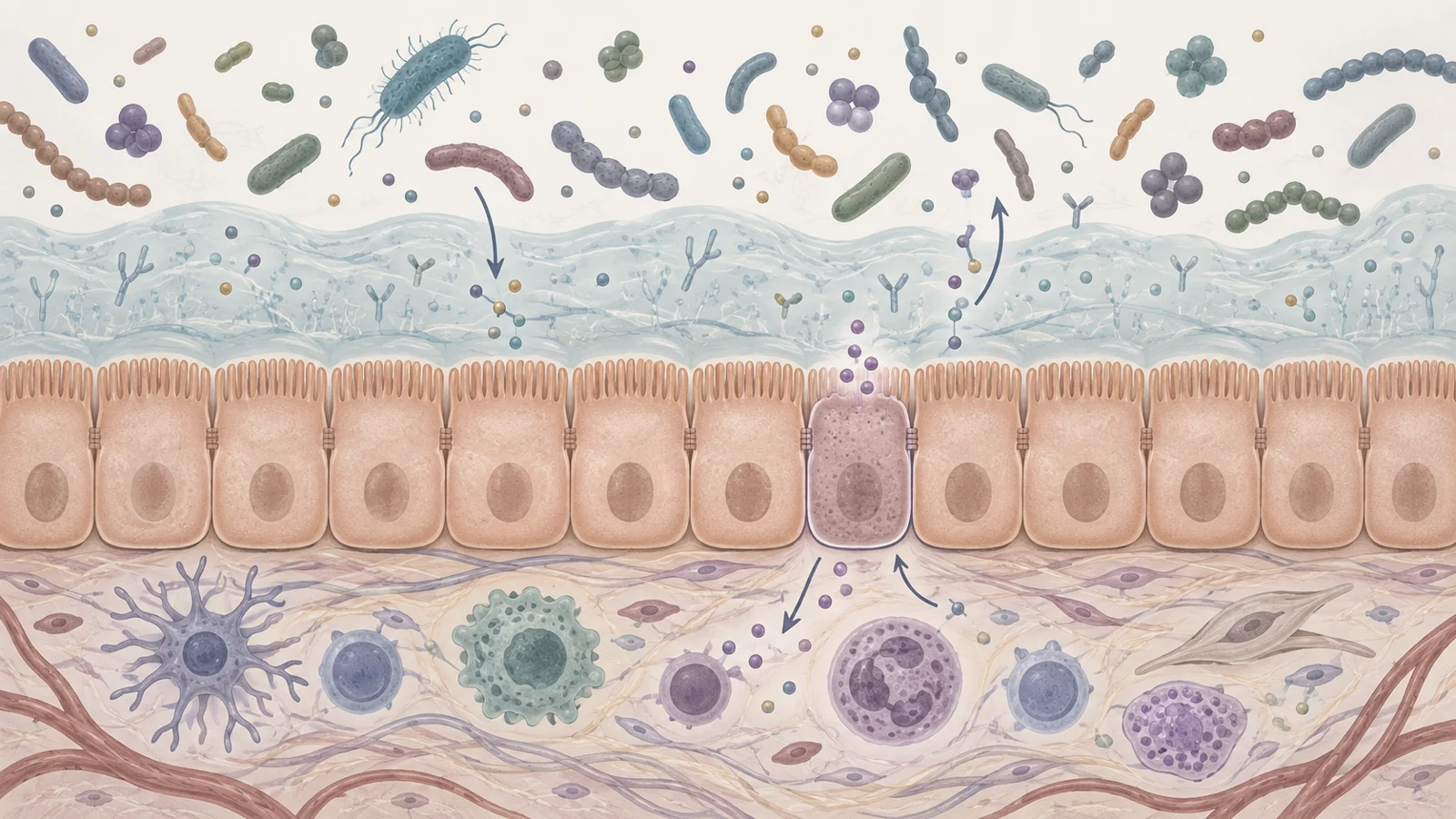
Microbes in the intestine live alongside a tissue surface with several defenses. Goblet cells produce mucus, while Paneth cells release antimicrobial substances, including lysozyme. These defenses help keep microbes separated from host tissue and regulate their access to it. Beneath the intestinal lining, immune cells respond to microbial material that crosses the barrier.
The review describes age-related changes in these defenses, drawing on findings in mice. Reduced mucus production and diminished antimicrobial secretion can weaken the separation between the microbial community and intestinal tissue. Paneth cells in aged mice also show activity involving Notum, a molecule that inhibits WNT signaling, which helps regulate intestinal tissue renewal. These examples connect aging at the cellular level to specific changes in the environment surrounding microbes.
Immune defenses add another route for influence in both directions. The review discusses research in which B cells in intestinal immune structures became senescent in a bacteria-dependent manner with age. These cells help sustain production of immunoglobulin A, or IgA, an antibody that binds gut bacteria. Reduced antibody production and diversity can change which bacteria are recognized and how the immune system interacts with the community.
In mice lacking two genes involved in cell-cycle control, p16 and p21, researchers found that age-related suppression of B-cell proliferation was alleviated, alongside smaller declines in IgA-producing cells and antibody diversity. This links a particular host-cell process to a particular microbial defense. It does not establish that every senescent intestinal cell directly changes microbial composition; some effects may arise through altered barrier function.
Senescent cells can also release a mixture of inflammatory signals and other substances known as the senescence-associated secretory phenotype. Persistent release can affect nearby cells and tissue conditions. Together, these findings make the proposed feedback physically plausible: microbial exposure can influence host cells, while host secretions, mucus and antibody responses can reshape the microbes’ surroundings.
Muscle function reveals why study design matters
The connection becomes more consequential if intestinal changes affect function elsewhere in the body. The review considers osteoporosis, sarcopenia—the age-related loss of muscle mass and function—and osteoarthritis. Its muscle examples show why an experimental intervention and an association in people answer different questions.
Mice raised without microbes, and mice treated with antibiotics, showed reduced skeletal muscle mass and function in studies discussed by the authors. Introducing microbiota from conventionally raised mice into germ-free mice increased muscle mass and reduced markers of muscle atrophy. Giving short-chain fatty acids, compounds produced by microbial metabolism, partly reversed muscle impairments in germ-free mice.
These interventions provide evidence that changing microbial inputs can affect muscle in those experimental settings. A germ-free animal, however, starts from a very different biological condition than an older person with an established microbial community.
Human observations offer a complementary view. In a Norwegian cohort of 5,196 people, the abundance of three bacterial species was positively associated with limb lean mass and bone mineral density. Other studies linked particular microbial groups with physical performance in older adults. Such associations can identify relationships worth investigating, but they cannot determine whether the bacteria caused the differences. Nor do the muscle findings, taken together, establish that senescence is the mechanism connecting microbes to every observed outcome.
Butyrate shows why context changes the meaning of an effect
A microbial product can have different consequences in different tissues. Butyrate, one of the short-chain fatty acids, makes that problem tangible.
The review describes evidence that short-chain fatty acids can support the intestinal barrier, promote mucus production and influence immune tolerance. Those functions help explain interest in microbes that produce them. Yet the authors also discuss a study in which butyrate released by Porphyromonas species promoted cellular senescence in a colorectal tumor environment and contributed to cancer development.
That finding complicates any simple division between beneficial and harmful microbial products. The same chemical name does not guarantee the same biological effect wherever it appears. The tissue receiving it and the surrounding disease processes matter. An effect that supports ordinary intestinal function cannot automatically be carried over to a tumor environment, and the tumor finding does not make all butyrate production harmful.
Two treatment routes with different targets
One experimental route changes what microbes contribute to the body. This includes studying microbial preparations and their products, rather than assuming that a live probiotic must be the active ingredient.
For example, the review describes experiments using substances secreted by Lactobacillus fermentum in cultured mouse cells that can develop into fat cells. In a model of hydrogen peroxide-induced senescence, those substances reduced senescence-associated features, including cell-cycle inhibitor signals and inflammatory secretions. In another example, heat-inactivated Bifidobacterium adolescentis improved measures of intestinal integrity and stimulated intestinal stem-cell regeneration in aging mice. These are specific cellular and tissue findings from different experimental systems.
A second route targets senescent host cells. Senolytic drugs aim to eliminate such cells selectively. In a mouse study discussed in the review, dasatinib combined with quercetin reduced the intestinal burden of senescent cells and the expression of several associated inflammatory factors. This suggests that altering the host tissue could be another way to influence the intestinal environment.
The measured endpoints are essential to interpreting these results. A reduction in cell-cycle inhibitors, inflammatory factors or senescent-cell burden is a biological change. It is not interchangeable with stronger muscles, preserved independence or longer life in people. Likewise, an experimental preparation of microbial products does not establish the effects of a commercially available probiotic. The review supports investigating these routes; it does not establish that either extends human health span through the proposed gut–senescence relationship, or that combining them improves outcomes.
Selectivity is part of the biological problem
Eliminating senescent cells indiscriminately could remove useful functions along with harmful ones. Senescence can suppress tumors by preventing cell division, and senescent cells can participate in wound healing, tissue repair and responses to infection. Their secretions can help mobilize the immune system. The review also notes mouse experiments in which eliminating cells expressing a commonly used senescence marker harmed health.
That makes the target more demanding than a simple reduction in cell numbers. Researchers need ways to distinguish harmful persistence from useful, context-dependent activity. Some proposed treatments therefore aim to suppress damaging secretions or prevent triggers of senescence, rather than remove every cell displaying a senescence-associated feature. The beneficial roles of senescence specifically within the aging intestine remain less well understood.
Microbial interventions face a related problem of selectivity. People differ in microbial composition, genetic predispositions and environmental exposures. A strain or preparation that changes one person’s intestinal chemistry may act differently in another. The review raises individualized interventions as a future possibility, while leaving the task of identifying effective targets unresolved.
Human translation also requires a causal connection between the chosen target and a useful outcome. A treatment might change the abundance of a bacterium without that change explaining its effects on tissue. It might lower a senescence marker without preserving physical function. Establishing which changes mediate benefit would help determine who could benefit and which useful defenses must remain intact.
What this could change
If researchers can identify harmful gut–senescence interactions and modify them while preserving repair and immune defenses, this work could open additional ways to protect physical function in older adults. A treatment that reliably improves intestinal function and, through a demonstrated biological pathway, helps preserve muscle strength could contribute to maintaining mobility and independence.
That possibility gives the research its practical importance. Success would mean turning a specific microbial or cellular intervention into a durable functional benefit for people, with enough selectivity to retain the protective activities on which healthy tissues depend.
Key Sources
- Primary source: The connection between aging, cellular senescence and gut microbiome alterations: A comprehensive review.
DOI or Journal Page · Peer-Reviewed Paper · 2024-08-15
Keep exploring