
Research Signal – Source date 2025-04-24
Why thinking is part of the diabetes story
Type 2 diabetes is associated with changes in brain structure and activity, as well as higher risk of cognitive impairment and dementia. The difficulties can involve memory, attention, executive functioning (such as planning and managing tasks), and the speed of processing information. That makes a practical question worth asking: can exercise training help preserve or improve thinking for people living with the condition, and does the kind of exercise matter?
A systematic review published on April 24, 2025, gathered studies that examined exercise training and cognition in people with type 2 diabetes or animal models of the disease. The authors searched research published through January 14, 2025, and included 22 studies in the systematic part of the review. Eighteen reported a significant positive cognitive finding. In two of those, improvements appeared in only a minority of the cognitive tests; four studies found no significant effect.
Those results make exercise worth investigating as a way to support brain health, but they are not a count of 22 equivalent experiments. The review combines earlier studies with different participants, training programs and ways of measuring cognition. It reports a pattern across that varied collection; it is not a new exercise trial that directly tested a single program against all the others.
Several routes showed promise
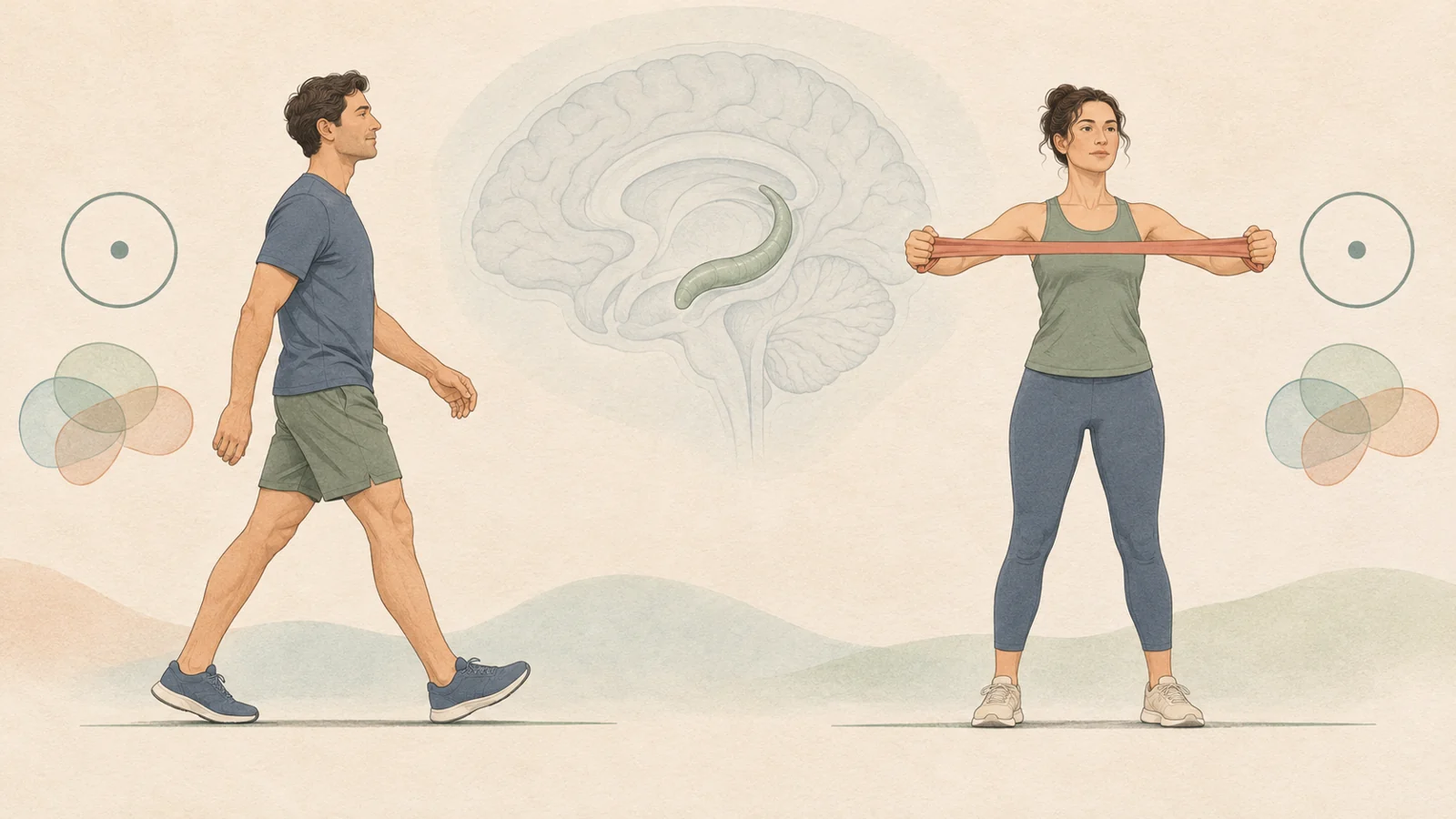
The review found cognitive gains in studies of more than one exercise form. Endurance exercise includes activities such as walking, while resistance exercise challenges muscles against a load. Some studies used combined programs that included endurance and resistance exercise, sometimes alongside flexibility or balance work. All the included studies of combined training reported significant cognitive improvements, but that pattern alone cannot show that combining forms works better than either one on its own.
Walking results help explain why the answer is not as simple as naming a winner. In one study summarized by the review, participants assigned to walk for 40 minutes three times a week improved on tests of attention and non-verbal memory. A pedometer group, averaging about 8,700 steps a day, also improved in those areas; verbal memory improved in the walking group. Yet a separate pilot study of three months of moderate-intensity walking found no significant gains in executive function, memory for events, holding information briefly in mind, or processing speed. Aquatic Nordic walking improved scores on one screening measure, while other tests in that study did not show significant change.
The reported difference between walking studies might reflect how the activity was performed or other features of the studies, but the review cannot resolve the reason. The intensity of the successful walking program was not disclosed in the account, so it cannot be used to set a specific target. Similar session schedules and study lengths in two studies did not produce matching results.
The comparison between endurance and resistance exercise is especially narrow: the review identified only one study that directly compared them, and it found similar results. That supports the possibility that either form can be useful for cognitive goals, while leaving too little direct comparison to decide whether one is better. The authors also noted a tentative pattern within resistance training: machine-based power training seemed more effective for cognitive improvement than body-weight exercises or elastic bands. More evidence is needed to know whether that difference holds up.
The test can change the result
“Cognition” covers several abilities, and a change in one score does not stand in for every kind of thinking. Attention, memory, executive function and processing speed can respond differently, even within the same study. This is one reason that a study reporting improvement on some tests and another finding no significant change can both be accurately described by the review.
Some studies used the Montreal Cognitive Assessment or Mini-Mental State Examination. These tools are designed mainly to screen for possible cognitive impairment, not to detect subtle shifts in performance over time. A change on a screening score and a change on a test focused on a specific skill are therefore not interchangeable signals. The range of tests used across studies makes their results harder to compare and makes it difficult to identify a program tailored to a particular cognitive goal.
The human study populations differed in age, medication use and ethnicity; future comparisons should also account for disease stage. Those differences can affect how comparable the results are. More consistent cognitive testing, together with better accounting for participant characteristics, would make it easier to tell whether one exercise approach has a distinct effect and for whom.
From test scores to brain changes
Some human studies in the review reported changes in the hippocampus, a brain structure involved in memory. One year of endurance training in people with type 2 diabetes and normal cognition was associated with increased hippocampal volume, alongside prevention of a decline in screening scores. A separate pilot study of a progressive endurance-and-resistance program reported improvements in hippocampal and total brain volumes and white matter integrity, as well as less decline in white matter volume compared with the control group. These are structural observations from particular studies, not proof that a volume change explains a person’s test result or everyday abilities.
The review’s second part describes possible biological links between exercise and brain changes. One example is BDNF, a protein involved in the survival and adaptability of nerve cells. In animal studies discussed by the review, exercise-related increases in BDNF in memory-related brain regions appeared alongside better memory performance. This makes BDNF a plausible candidate for helping connect exercise with brain plasticity, the brain’s capacity to adjust its connections and function.
Other proposed links include signals involved in energy use, insulin sensitivity and inflammation. Together, the animal findings suggest possible routes by which exercise could support brain function under diabetic conditions. But most of the review’s mediator evidence came from rodents. Those biological pathways remain hypotheses for explaining human cognitive findings, not confirmed explanations of how exercise changes human thinking.
How this could shape the future
A useful future capability would be a diabetes-care visit where a person and clinician could choose and adjust familiar walking or strength training around a measured goal, such as attention or memory. The review offers an early bridge toward that possibility: studies reported cognitive findings across several exercise forms, and some human studies also observed changes in brain structures involved in memory. If those patterns hold up in stronger comparisons, exercise selection could eventually become more cognition-focused, rather than relying on a general assumption that any program fits every goal.
The nearer milestone is direct comparison of programs with similar, clearly described exercise plans and the same sensitive tests of attention and memory. Studies would also need to account for factors such as age, medication use and disease stage. Reliable evidence about how different people respond would be needed before clinicians could offer tailored exercise choices as a demonstrated cognitive benefit. Until then, the review points to promising possibilities, not a dependable prescription for a particular type, intensity or schedule.
Key Sources
- Primary source: The Impact of Exercise Training on the Brain and Cognition in Type 2 Diabetes, and its Physiological Mediators: A Systematic Review.
DOI or Journal Page · Review or Meta-Analysis · 2025-04-24
Keep exploring