
Research Signal – Source date 2025-11-05
As people live longer, preserving the ability to remember, plan, and manage everyday tasks becomes more than a matter of comfort. It can shape how long people remain independent. The challenge is that cognitive aging is not one uniform process. Some abilities change with age, while others remain stable or even improve, and more serious decline can involve neurodegenerative or vascular disease.
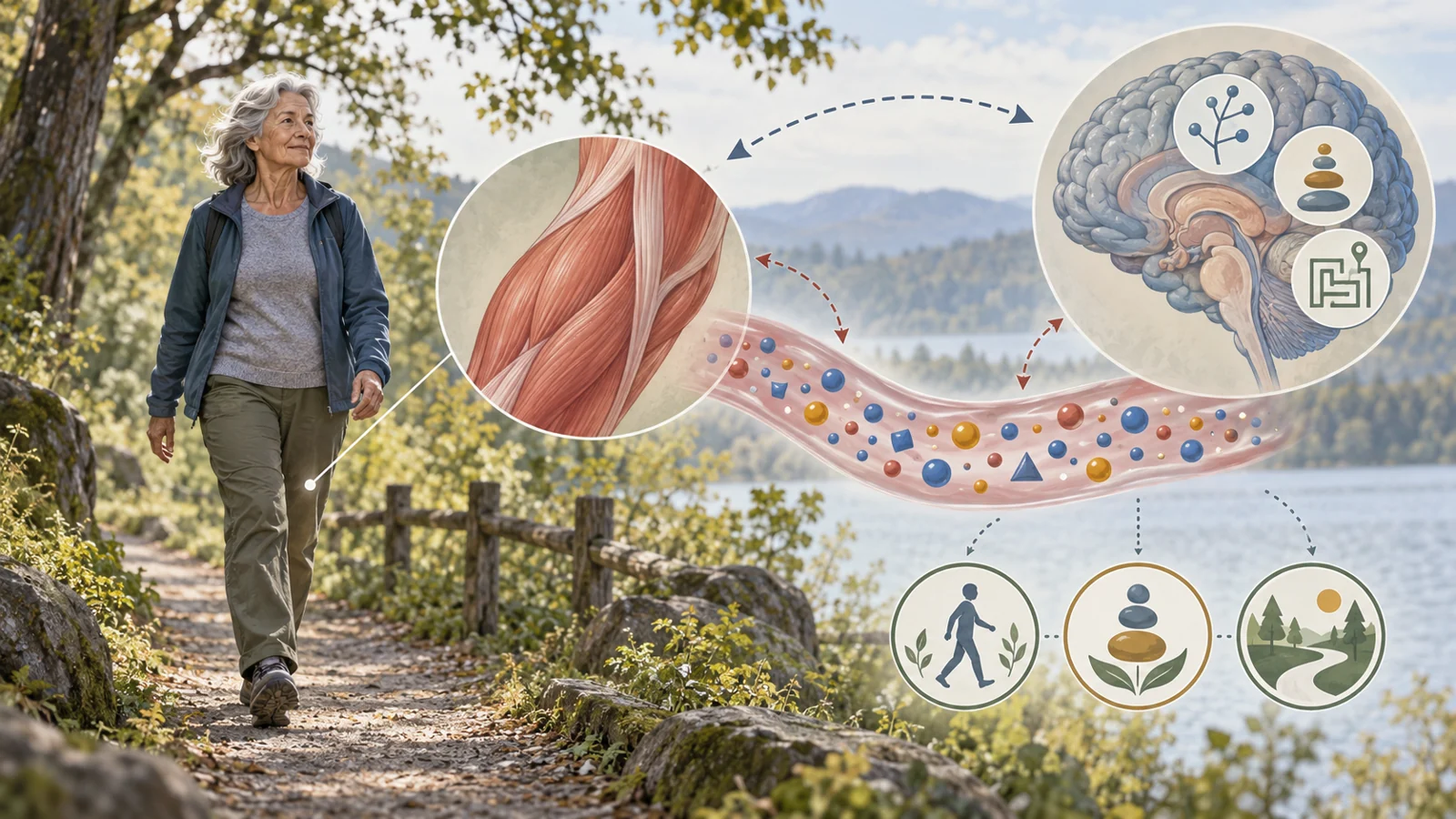
A narrative review published on November 5, 2025, asks how physical activity and exercise might support brain health in later life. Its central idea is both familiar and unexpectedly biological: working muscles may communicate with the brain. The review brings together human observations, exercise interventions, brain imaging, and animal research. It offers a plausible account of how movement could help, while leaving a practical question unresolved. What kind of program might help a particular older person?
The evidence is broader than one memory test
Physical activity and exercise are related, but they are not interchangeable terms. Physical activity includes any movement produced by skeletal muscles, including household tasks, work, sport, and ordinary daily movement. Exercise is the more specific category: planned, structured, and repetitive activity intended to maintain or improve fitness.
The review describes several kinds of findings. Observational studies generally compare older adults who are more or less physically active. Across these studies, more active participants are reported to perform better in areas such as memory, attention, executive function, and processing speed. Executive function means the mental skills involved in planning, organizing, switching between tasks, and managing goals.
Structured exercise studies address a different question. The review reports that randomized interventions, particularly aerobic and multicomponent programs, have produced improvements in global cognition and particular cognitive abilities among healthy older adults and some people with mild impairment. These findings are more informative about what happened after an exercise program than an observational comparison is, although the programs and participants varied considerably.
Brain imaging adds another layer rather than a single confirmation. The review discusses reported changes involving hippocampal volume, white matter integrity, and functional connectivity in cognitive networks. An imaging result describes a feature of brain structure or communication; a cognitive test describes performance on a task. A change in one does not automatically measure the other. Neither category, by itself, shows that a particular routine will prevent dementia or preserve independence for decades.
Muscles may be part of the brain story
The proposed biology begins with contraction. Skeletal muscle is not only a structure that moves the body; the review describes it as an endocrine organ that releases signaling molecules during exercise. These molecules, called myokines, enter the circulation and can act locally or communicate with other tissues. This creates a possible muscle–brain axis, in which activity in muscle influences the environment in which the brain functions.
The review places this muscle signaling alongside processes involved in neuroplasticity, the brain’s ability to adapt. It discusses neurotrophic factors such as brain-derived neurotrophic factor and insulin-like growth factor-1, as well as the myokine irisin. These pathways are presented as possible contributors to changes in synaptic function, blood flow, and brain networks, rather than as a single established chain that explains every cognitive result.
Irisin offers a concrete example of why the evidence needs careful handling. In mouse experiments described by the review, exercise-related changes involving FNDC5 and irisin were associated with higher hippocampal BDNF expression and improved cognitive performance. The animal setting matters. These experiments provide a mechanistic lead about how muscle activity might influence the brain, but they are not equivalent to demonstrating the same causal pathway in older humans.
Other muscle-derived signals may act indirectly. The review describes exercise-related effects on inflammatory and vascular conditions that could influence the central nervous system. It discusses an acute exercise response involving interleukin-6 and anti-inflammatory signaling, along with other myokines connected to immune regulation. The useful point is not a catalogue of molecules. It is that muscle-to-brain communication may involve several routes, some direct and some mediated by the body’s broader inflammatory or vascular state.
Why a promising mechanism does not choose a program
A biological explanation can make a result more intelligible without telling a person exactly what to do. The review identifies exercise type, intensity, frequency, duration, age, sex, baseline fitness, cognitive status, and chronotype as factors that may alter the response. It also highlights variation in myokine responsiveness related to genetic, epigenetic, and metabolic differences.
That variability creates a practical attribution problem. If two older adults complete the same program and experience different cognitive changes, the difference may reflect the program, the person, or both. The review’s evidence does not supply a universal dose, an optimal time of day, or a clinically validated way to match a routine to genotype.
The FINGER study illustrates a second problem. In the review’s account, APOE ε4 carriers benefited from a multidomain intervention that combined physical activity with diet, cognitive training, and vascular-risk control. They showed equal or greater gains in executive function and processing speed than non-carriers in the reported analysis. This is important because inherited risk did not appear to eliminate the possibility of cognitive benefit.
It is not, however, an isolated exercise experiment. The result cannot identify how much of the change came from physical activity, how much came from the other components, or whether the same package would work in the same way for every group. Personalization is therefore a research direction, not an available genetic matching service.
The limits sit between benefit and prevention
The authors describe their work as a narrative review designed to integrate heterogeneous human and animal findings across molecular, neural, behavioral, and population levels. That breadth is useful for connecting mechanisms with outcomes, but it also makes the final picture less precise than a single standardized intervention trial.
Exercise protocols differed in type, intensity, duration, frequency, supervision, and participant characteristics. Such variation makes universal recommendations difficult. The authors also acknowledge that a narrative synthesis can be influenced by selection issues, and that publication bias may make positive findings appear more consistent than the full body of work would be.
Animal studies add mechanistic detail that is difficult to obtain in people. They can suggest how irisin, BDNF, inflammation, or vascular changes might be involved, but biological complexity and lived conditions differ across species. Human confirmation remains necessary.
These constraints matter because reported gains on memory, planning, or processing-speed tests are not the same as durable protection from neurodegenerative disease. The review supports continued interest in exercise as a non-pharmacological strategy for cognitive health. It does not settle whether a particular program prevents dementia, preserves independence over the long term, or produces the same benefit for every older adult.
What this could change
A successful next stage would make exercise support more practical and more reachable. If sustained cognitive benefits are confirmed in human studies, and programs can be adapted to different abilities and delivered accessibly, primary-care and community settings could use physical activity as one part of support for the memory and planning skills that help older adults manage daily life.
That possibility is especially meaningful where specialist cognitive rehabilitation or medication-based options are difficult to reach. Accessible exercise programs could give more people a practical route into brain-health support, but any broader public benefit would depend on benefits lasting in real-world settings and on programs being matched to people’s capabilities rather than offered as one universal prescription. The muscle–brain idea may eventually help explain who responds and why; it does not yet provide that answer.
Key Sources
- Primary source: Move to Remember: The Role of Physical Activity and Exercise in Preserving and Enhancing Cognitive Function in Aging-A Narrative Review.
DOI or Journal Page · Peer-Reviewed Paper · 2025-11-05
Keep exploring