
Research Signal – Source date 2026-01-28
Aging research is moving toward a question more precise than whether the body can simply be made “younger.” Could immune cells be directed toward harmful changes in aging tissues while leaving useful repair processes intact?
A review published on January 28, 2026, brings together research exploring that possibility. It describes immune-cell strategies aimed at clearing damaged cells, calming inflammatory environments and supporting tissue recovery. The studies do not all test the same intervention or measure the same outcome. Results in aged mice, preliminary human biomarker observations and a small clinical study in rheumatoid arthritis therefore represent different steps in a research pathway, not one combined demonstration that immune cells reverse human aging.
Aging tissues can accumulate cells that no longer divide
Senescent cells have stopped dividing permanently. Their presence is not necessarily harmful in every setting, but the review focuses on what can happen when these cells accumulate or remain active for too long. They can release a mixture of cytokines, chemokines and enzymes known as the senescence-associated secretory phenotype, or SASP. This secretory activity can disturb nearby cells, sustain inflammation and interfere with tissue balance.
The immune system normally helps identify and remove some unwanted cells. Natural killer cells, for example, can recognize stress-related surface signals on senescent cells and use cytotoxic mechanisms to destroy them. Aging can weaken this surveillance, allowing more senescent cells to persist. The therapeutic idea is to strengthen or redirect immune-cell activity so that harmful cellular changes become easier to find.
That does not mean every cell carrying a senescence-associated marker should be removed. A useful target must be sufficiently concentrated on harmful cells, and the resulting treatment must preserve ordinary immune activity, migration and repair. The central engineering problem is therefore selective action, not simply greater cell-killing power.
Giving immune cells different jobs in damaged tissue
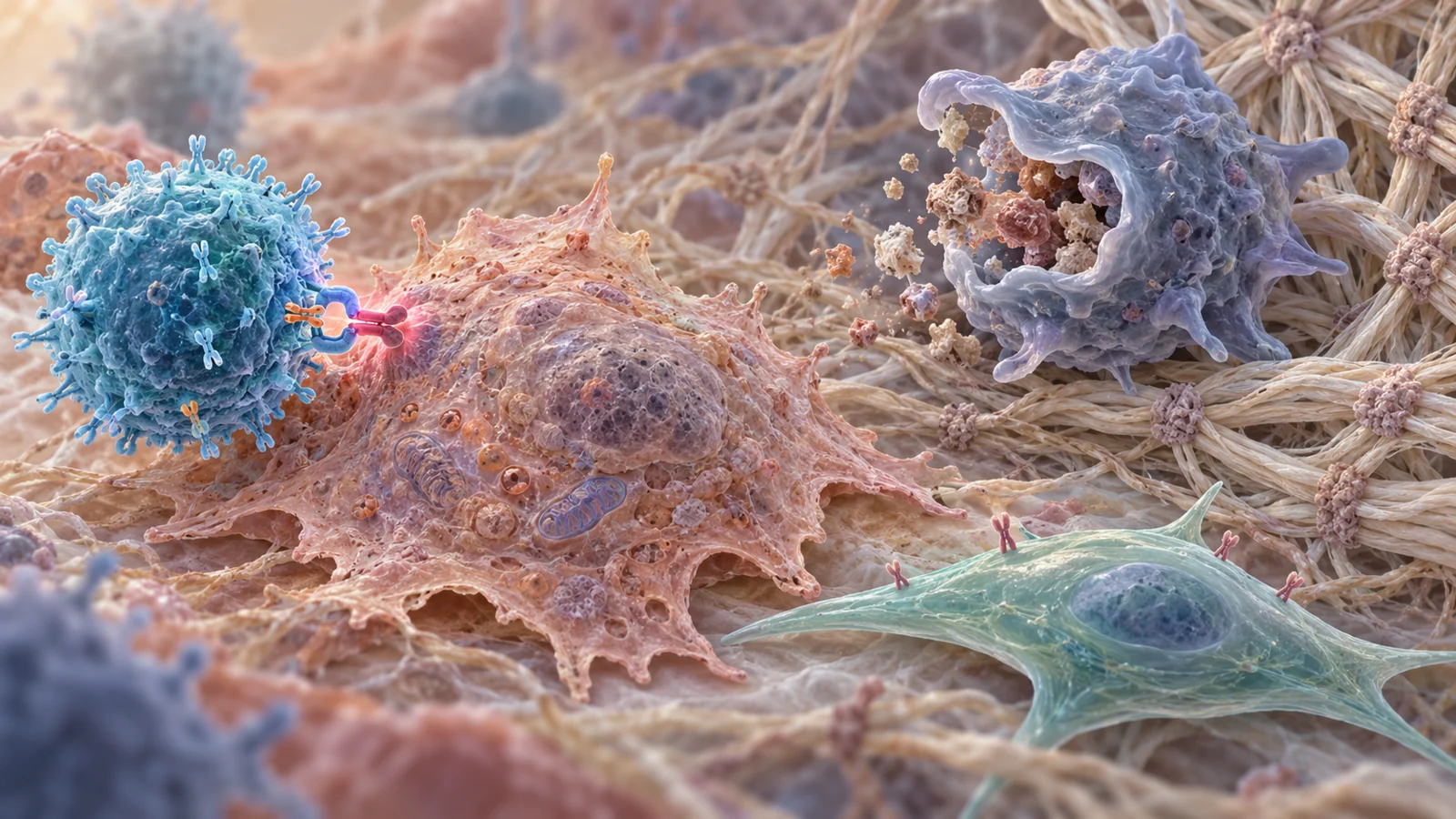
One strategy uses a chimeric antigen receptor, or CAR, to give an immune cell an additional recognition system. The receptor is designed to bind a surface marker found on a target cell. uPAR is one of the review’s leading examples because it is reported to be increased on senescent cells in several biological settings.
A uPAR-directed CAR-T cell is intended to recognize and kill cells carrying that marker. An engineered macrophage can approach the same problem differently. Instead of relying mainly on cytotoxicity, a CAR-macrophage may engulf target cells, help remodel abnormal extracellular matrix and recruit other immune cells. In the review’s discussion of fibrotic disease, this combination is relevant because removing a profibrotic cell and changing the surrounding tissue are related but separate biological tasks.
Engineered immune cells can also be designed to respond to the local environment rather than only to a surface marker. The review describes inflammation-sensing CAR-macrophages that detect tumor necrosis factor and activate an interleukin-4 signaling program inside the cell. The intended result is to shift an inflammatory macrophage state toward a more regenerative one. Mesenchymal stem cells are discussed as another route for reducing inflammatory signaling through secreted factors and vesicle-delivered microRNAs.
These examples broaden the concept beyond “find and destroy.” A future treatment might need to remove a harmful cell, reduce the signals that keep surrounding tissue inflamed and support repair. The supplied research does not show that all of those functions have already been combined successfully in one therapy.
What studies in mice and people show
The review gives particular attention to uPAR-directed CAR-T cells in models of natural aging and metabolic disease. In aged mice, the treatment was associated with improved metabolic function and physical performance. The review also reports that a single administration produced protective effects lasting up to a year in the animal experiments it describes.
Those findings answer an important preclinical question: can a targeted immune-cell intervention alter measurable aspects of aging-related tissue dysfunction in an animal? They do not answer whether the same intervention would improve health in older people, how it would behave across human tissues or whether it would be safe for broad preventive use. A mouse result can show that a biological route is plausible without establishing a human treatment.
The review also describes NKG2D-CAR-T cells in animal models. NKG2D recognizes a group of stress-induced ligands rather than one single marker, and the reported studies linked this approach with lower senescence-related measures, improved physiological outcomes and, in some models, lifespan extension. Those observations remain animal evidence, with different targets and experimental settings from the uPAR work.
The human examples address different questions. Expanded autologous natural killer cells are described as producing preliminary reductions in markers associated with senescence and inflammation in human subjects. Such biomarker changes can indicate that a biological process has shifted, but they are not equivalent to restored organ function or longer life.
The review separately discusses a pilot involving three people with refractory rheumatoid arthritis who received CD19-targeted CAR-T therapy. The reported outcomes included rapid B-cell depletion, later B-cell reconstitution, reduced disease activity and normalization of certain autoantibodies. This is a disease-specific clinical observation involving removal of pathogenic B cells. It is not the same achievement as clearing senescent cells in aging tissues, and it cannot be used as an efficacy estimate for anti-aging treatment.
Keeping these examples separate matters. Engineered cells, expanded natural killer cells, animal performance, human biomarkers and disease scores each describe a different intervention or endpoint. Their coexistence in one review shows the breadth of the field, not a single proven route to rejuvenation.
A marker can identify risk as well as opportunity
Target selection is one of the field’s most difficult practical problems. The review’s table notes that uPAR is also expressed in activated immune cells and in normal cells involved in migration or repair. A therapy that treats uPAR as a simple label for senescence could therefore damage cells performing useful work.
The consequences would extend beyond an inaccurate laboratory classification. Immune cells move through tissues during inflammation, and repair-related cells may temporarily display molecules that are also found in diseased or senescent settings. A receptor-directed treatment would need to distinguish harmful context from normal biological activity well enough to avoid impairing immune function or wound healing.
Recognition is only one part of the problem. Even when an engineered cell reaches the intended target, aged tissues may send inhibitory signals that reduce immune-cell activity. The review points to PD-L1 on some senescent cells as one mechanism that can engage PD-1 on immune effectors and help senescent cells persist. Combining several recognition signals may improve specificity, but it may also increase design and manufacturing complexity.
A useful therapy would therefore need both accurate targeting and reliable action in the tissue. It would have to reach the right cells, remain active in an inflammatory or suppressive environment and stop causing damage when the intended task is complete. The supplied evidence does not establish durable safety for treating otherwise healthy older people preventively.
Making the cells is part of the treatment problem
Laboratory demonstrations often begin with cell lines because they are easier to grow and manipulate. The review emphasizes that these research tools cannot simply become clinical products. Some immortalized lines have properties that make them useful for proof-of-concept experiments but unsuitable for direct human treatment, including concerns about tumorigenic potential.
Clinical development would require primary cells from sources such as peripheral blood, cord blood or induced pluripotent stem cells, produced under appropriate manufacturing controls. The practical challenges include expanding enough cells, maintaining their intended function, checking quality, achieving consistent batches and controlling cost. A treatment that works in a carefully prepared experiment still needs a reproducible production process before it can become broadly usable.
The review describes a different delivery concept in a mouse model of cardiac fibrosis. FAP-directed CAR-T cells are designed to target activated fibroblasts associated with fibrosis. Rather than manufacturing a large cell population outside the body and infusing it, messenger RNA carried in lipid nanoparticles was used to temporarily program circulating T cells inside the animal. This “hit-and-run” approach generated a transient CAR-T population and reduced fibrosis in the model described.
Temporary programming could reduce some manufacturing and persistence concerns, but it introduces its own questions about delivery, control and consistency. The mouse findings do not establish clinical affordability, scalable access or superior human safety. They show how delivery design may become as important as the receptor itself.
What this could mean for aging organs
If selective targeting, functional improvement and practical production can all be demonstrated in people, immune-cell treatments could eventually offer a more direct way to address age-related fibrotic disease. A therapy might remove cells that sustain tissue damage while helping the surrounding environment recover. For patients whose organs are losing function because fibrosis and chronic inflammation reinforce one another, preserving working tissue could become a concrete clinical goal.
That possibility remains conditional on solving the field’s central problems: identifying targets that spare useful repair, overcoming inhibitory signals in aged tissues, measuring meaningful human improvement and manufacturing the treatment consistently enough to use in practice. The review supports a future in which engineered immune cells are tools for protecting organ function, not a general claim that human aging has already been reversed or that lifespan can be extended.
Key Sources
- Primary source: Engineering Immune Cell to Counteract Aging and Aging-Associated Diseases.
DOI or Journal Page · Review or Meta-Analysis · 2026-01-28
Keep exploring