
Research Signal – Source date 2025-06-12
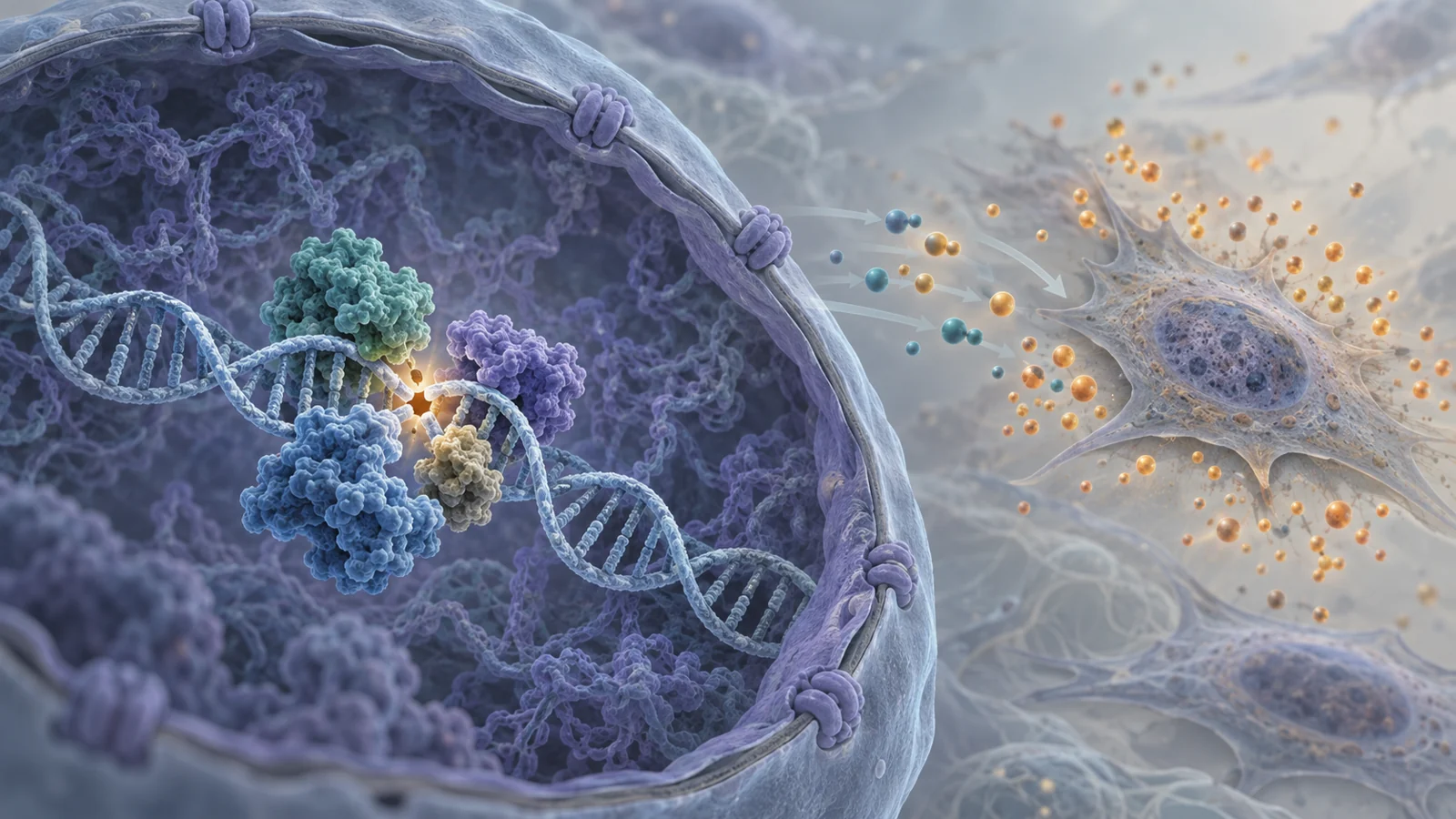
Ageing cells face a maintenance problem: damage can accumulate in the DNA that carries their instructions. Helping cells repair that damage could preserve their ability to work. But the systems that respond to damaged DNA also stop compromised cells from multiplying, remove cells beyond repair, and help tissues renew themselves. Pushing repair or its surrounding responses in one direction could therefore have consequences elsewhere.
A Perspective published June 12, 2025, in Nature Reviews Drug Discovery surveys proposed ways to address DNA damage and its effects. It brings together mechanisms, experiments in cells and animals, and observations from trials aimed at particular diseases. It is not a report of one new treatment tested to slow ordinary human ageing. Its central challenge is practical: how might repair be strengthened without weakening the safeguards that contain damaged cells?
A lesion can disrupt a cell before it is repaired
DNA damage is not one uniform problem. Lesions can arise from processes inside the body, including spontaneous chemical changes and oxidation, or from outside exposures such as ultraviolet light and ionizing radiation. They range from changes to a single DNA building block to breaks and crosslinks. The type and location of a lesion affect what happens next.
If damage blocks transcription, the cell may struggle to read genes needed for its normal work. If it blocks replication, a dividing cell may be unable to copy its DNA and proceed with cell division. A cell’s response to damage can pause the cell cycle, giving repair systems time to act. When damage is severe, the response may instead lead to senescence, in which the cell permanently stops dividing, or apoptosis, a form of cell death.
Those outcomes have different effects on a tissue. A pause can protect against copying damaged DNA while repair is underway. Removing a severely damaged cell can limit the chance that it passes along mutations. But tissues also depend on cell division to replace cells and maintain function. Too many cells that cannot divide, or too much cell death, can impair that renewal. DNA damage can also contribute to mutations and inflammatory responses, with consequences that extend beyond the original lesion.
The response is therefore part of the biology to be managed, not merely a switch to turn up. Senescence and cell death can help guard against cancer, yet persistent senescent cells can release signals associated with inflammation and disease. The same protective machinery can help preserve tissue integrity in one circumstance and add to dysfunction in another.
Repair works as a coordinated team
Increasing the amount of a single repair protein sounds simpler than changing a whole system. Experiments reviewed in the Perspective have tried overexpressing individual DNA repair genes, with mixed outcomes: some found benefits, while others found no significant effect or even harmful ones. Repair pathways rely on multiple proteins working together. In one example, nucleotide excision repair involves more than 30 proteins. Raising one component out of proportion to the others could upset the balance, particularly when that component has DNA-cutting activity.
The Perspective describes another idea: release a coordinated set of repair genes from repression. In Caenorhabditis elegans, the DREAM complex helps keep several DNA repair genes switched off in somatic cells. Removing DREAM activity in the worms increased expression of genes from multiple repair pathways and improved resistance to several tested kinds of DNA damage.
Researchers then examined a related regulatory route in human cells. In quiescent human cells, two compounds that inhibit DYRK1A—harmine and INDY—were associated with DREAM de-repression of repair genes and greater resistance to ultraviolet and alkylation damage. This is evidence from cells under experimental conditions, not a demonstration that either compound safely boosts repair throughout a person’s body.
A separate result came from mice with an Ercc1 mutation that impairs DNA repair. Harmine treatment reduced DNA damage in the retina and photoreceptor loss in that model. The finding connects a regulatory approach with a tissue outcome in a repair-deficient animal; it does not establish an effective treatment for normal ageing or human eye disease. The human-cell and mouse observations are distinct experiments, and neither settles how broadly the approach could be used.
Some approaches address the aftermath
Repairing a lesion is one possible intervention point. Other strategies try to manage what damaged cells do after repair has failed or damage has persisted. Senolytics aim to eliminate senescent cells, while senomorphics aim to alter features of those cells, including their secretion of inflammatory molecules. These approaches address the consequences of damage rather than fixing the original DNA lesion.
The distinction matters because senescent cells are diverse. Their secretions, often described as the senescence-associated secretory phenotype, can contribute to inflammation, but senescence itself also serves as a barrier to the continued growth of compromised cells and can take part in tissue remodelling. The Perspective notes that no single senotherapeutic is known to target every type of senescent cell. Removing such cells and changing their behaviour are also different strategies, with different possible effects on surrounding tissue.
Inflammation can arise through another route: damaged DNA, or DNA–RNA structures associated with stalled transcription, can activate inflammatory signalling. Dampening such signals could matter even if the underlying lesion remains, by addressing one consequence of persistent damage. But it would not amount to repair. These routes broaden the therapeutic possibilities while making clear that “treating DNA damage” can mean acting on the lesion, on the cell’s response, or on downstream inflammation.
Disease-directed evidence answers narrower questions
Inherited disorders caused by defective repair offer a way to study what happens when genome maintenance is seriously impaired. The Perspective describes gene-editing work in models of Hutchinson–Gilford progeria syndrome, including mice treated with an adenine base-editing approach aimed at the disease-causing LMNA mutation. Treated mice were healthier and lived more than twice as long as the comparison animals in the reported experiments. It also describes patient-derived cells with Cockayne or Werner syndrome mutations corrected using CRISPR–Cas9; these cells showed improvements in several measures in laboratory or animal settings.
Such results concern specific genetic defects and experimental systems. They do not show that a repair-boosting intervention can safely slow the gradual changes of ordinary human ageing, which involve many tissues and cell types.
The human trial observations discussed in the Perspective address particular diseases and use different interventions and endpoints. Nicotinamide was tested in a phase III trial involving people with nonmelanoma skin cancer; the Perspective reports lower rates of cancer recurrence and actinic keratoses. A phase II trial of nicotinic acid or vitamin B3 in Alzheimer disease did not show improved cognitive performance. In a phase II study, people with ataxia–telangiectasia who received nicotinamide riboside for two years showed improved coordination. A trial in chronic obstructive pulmonary disease reported reduced inflammatory markers after nicotinamide riboside treatment.
These observations do not combine into a single finding that enhanced DNA repair caused better outcomes: they involve different diseases, compounds and measured results. Nor do they test whether a general repair-enhancing treatment slows ageing in healthy people. They are disease-directed evidence, not a human lifespan result.
Safety depends on which cells respond
A useful intervention would need to work in the cells that benefit while preserving protective responses in others. DNA damage checkpoints can halt cell division, and stronger checkpoint activity has protected mice against cancer. Yet an overactive form of p53 in mice accelerated ageing, likely by interfering with the renewal of cells needed to maintain tissues. Apoptosis can remove damaged cells and help prevent tumours, while excessive cell death can contribute to degenerative disease or immune deficiency.
Senescence carries a similar tension. It can prevent damaged cells from proliferating, but senescent cells may also release inflammatory signals. Telomeres—the protective ends of chromosomes—show another example of a tradeoff: extending them could support the division of some cells, while telomerase activity also supports tumour growth. These are not interchangeable repair strategies, but they illustrate why a system-wide push toward growth or survival can carry costs.
Cell types also differ in how much repair they need and which repair pathways they use. The Perspective highlights the challenge of moving from a result in quiescent cultured cells, a repair-deficient mouse, or a specific disease population to a treatment that acts safely across the body. The balance matters in fast-renewing tissues as well as in cells that rarely divide. How increased repair capacity would interact with cancer treatment, tumour protection and long-term tissue renewal remains unresolved.
What safer DNA repair could mean for later-life health
If researchers can preserve genome function safely in the human tissues most affected by age-related disease, better maintenance might help delay functional decline and reduce more than one disease burden. That possibility depends on achieving a controlled benefit across different cell types while retaining the responses that stop damaged cells from causing harm. The Perspective describes promising routes to investigate, but establishing that balance in people remains essential before broader health benefits can be claimed.
Key Sources
- Primary source: Targeting DNA damage in ageing: towards supercharging DNA repair.
DOI or Journal Page · Review or Meta-Analysis · 2025-06-12
Keep exploring