
Research Signal – Source date 2023-06-01
An experimental aging treatment can change selected biological measures without producing a broad improvement in body composition or metabolism. A June 1, 2023 study in middle-aged monkeys offers a useful example. Dasatinib plus quercetin, a combination intended to clear senescent cells that can release pro-inflammatory factors, shifted several immune, intestinal and kidney-related measures. The larger changes in weight, fat and blood sugar appeared after the animals also began eating less.
The study therefore asks a more precise question than whether the treatment “worked.” Which changes followed the drug combination itself? Which followed calorie restriction? And what do either pattern reveal about healthier aging?
The experiment was built around a late diet change
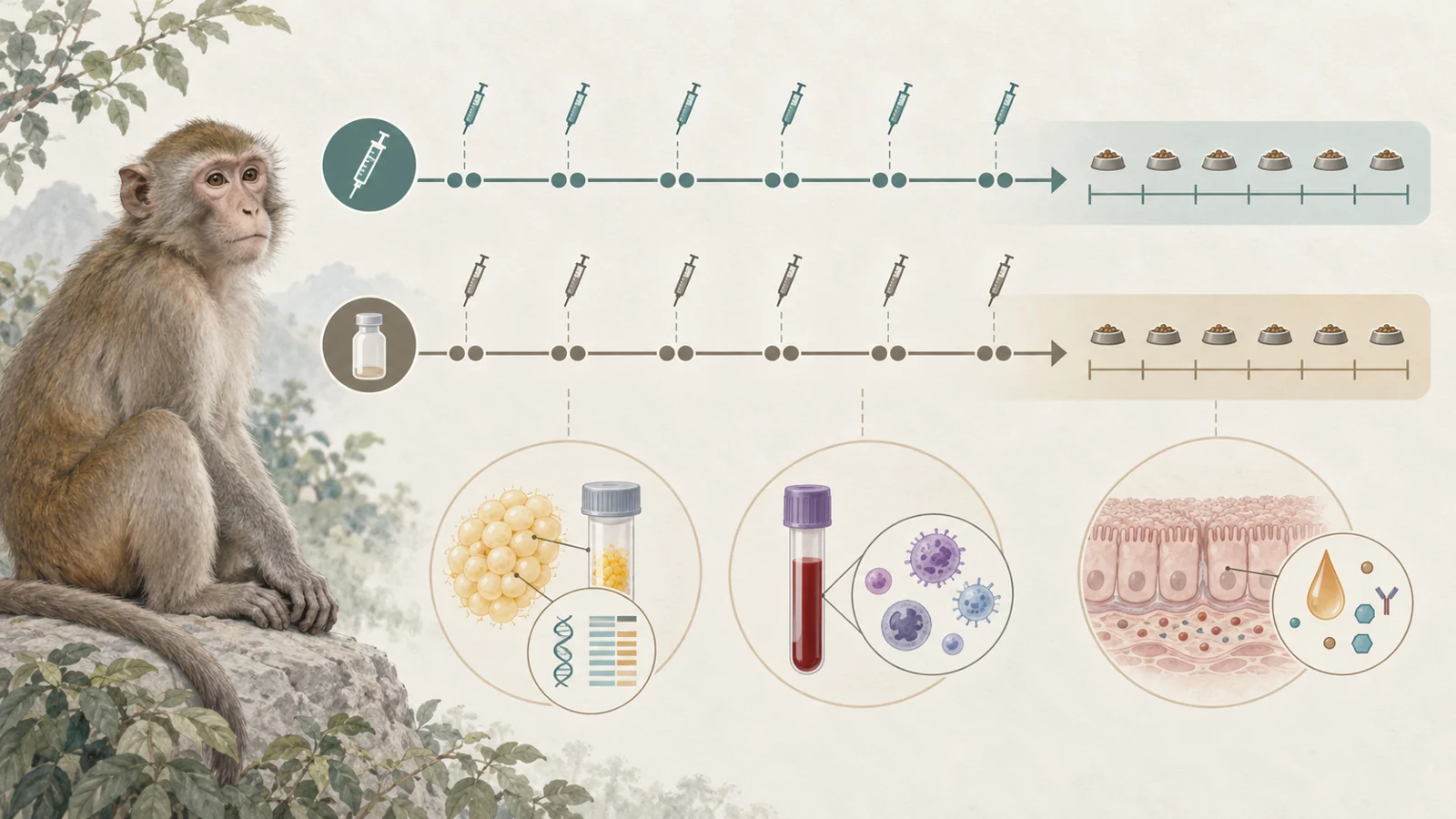
The researchers studied 16 cynomolgus macaques, roughly middle-aged in human-equivalent terms. Nine received dasatinib plus quercetin and seven received a vehicle control. The groups were matched on age, sex, body weight, glycemic control and metabolic-syndrome risk factors. The animals ranged from lean to obese, and some had type 2 diabetes, making the cohort more representative of metabolic variation than a group of uniformly healthy laboratory animals.
Treatment was intermittent rather than daily. The monkeys received oral dasatinib and quercetin on two consecutive days each month for six months. After the sixth dose, at about five months into the study, both the treated animals and the vehicle controls began a 10% calorie restriction for six weeks. The restriction was calculated from each animal’s usual intake, and both groups lost about 5% of body weight on average.
This sequence matters. The experiment did not begin with four permanently separate groups receiving drug, diet, both or neither. It first compared the treatment with a vehicle under usual feeding conditions. Only later did both groups undergo the same reduction in food intake. That design makes it possible to ask whether a result was already visible before restriction and whether the drug changed the response to the diet, but it also means the late comparison cannot answer every question a full four-arm trial would address.
Gene expression and tissue staining gave different answers
Senescent cells are associated with changes in gene activity and inflammatory signaling, so the investigators looked for several kinds of evidence rather than relying on one marker. In subcutaneous fat, p16 and p21 gene expression fell after three months of intermittent treatment. The reductions were statistically significant, and earlier measurements in a small subset showed decreases of roughly 30% to 90% one month after treatment.
Other measurements were less aligned. Before calorie restriction, staining for senescence-associated beta-galactosidase did not change significantly, and p21 protein staining also did not show a significant difference. Calorie restriction unexpectedly increased p21 protein expression, adding another reminder that a gene transcript, a protein stain and a tissue-level senescence assay are not interchangeable readouts.
Agreement across these methods would have made a stronger case that the treatment had reduced senescent-cell burden in the sampled fat. The actual pattern is narrower: some senescence-associated genes changed, while the specified staining measures did not. Reduced p16 and p21 gene expression is therefore evidence of a biological response in one tissue and at one measurement level. It is not a direct count of cells removed throughout the body, nor does it establish that the animals experienced a generalized improvement in aging.
The strongest responses were selective
The treatment also shifted immune-cell profiles. After several months, the treated monkeys showed trends toward lower total white blood cells, neutrophils, basophils and B cells. Some of these findings were close to, rather than below, the study’s conventional significance threshold. Monocyte patterns shifted as well, including movement away from more classical phenotypes toward intermediate and non-classical forms. When calorie restriction was added, immune-cell numbers changed in both groups, making the timing of each effect important.
The broader inflammatory picture was not uniformly changed. Circulating cytokine measures did not show corresponding significant differences. In adipose tissue, the combination of treatment and calorie restriction changed the ratio of M2 to M1 macrophages, which the authors interpreted as a shift in macrophage polarization. These results describe altered immune-cell composition and tissue markers. They do not show that the monkeys became more resistant to infection or that a particular immune pathway caused the other health-related findings.
The intestine provides a similarly mixed picture. Lipopolysaccharide-binding protein, fatty-acid-binding protein and circulating immunoglobulin A all supported an improvement in biomarkers related to intestinal barrier function. At the same time, measured diversity in the mucosal and fecal microbiomes remained comparable between groups and did not change with treatment. A barrier-related blood marker can move without a detectable change in measured microbial diversity. The findings are compatible with different parts of the gut system responding differently; they do not demonstrate a causal gut-to-immune pathway or microbiome replacement.
Kidney-related measurements also separated rather than moved as a package. Dasatinib plus quercetin reduced blood urea nitrogen after five months. Creatinine remained unchanged, as did the urinary protein-to-creatinine ratio. Blood urea nitrogen can be useful in assessing kidney-related physiology, but its reduction alongside unchanged companion measures is not evidence that kidney function was restored or that kidney disease was prevented.
Eating less explained most of the body change
Dasatinib plus quercetin alone produced only limited body-composition and metabolic findings. There was a trend toward a lower abdominal visceral-to-subcutaneous fat ratio, driven partly by a trend toward more abdominal subcutaneous fat, but other measured body-composition and metabolic-syndrome outcomes did not change significantly before calorie restriction.
The six-week calorie-restriction phase produced the more substantial physical changes in both groups. Body weight, waist circumference, total fat mass and abdominal fat mass fell, while the percentage of lean mass increased. Triglycerides and fasting blood glucose also decreased, with a trend toward lower HbA1c, a measure that reflects longer-term blood sugar.
One result did point to a treatment-specific contribution to the dietary response. The interaction between dasatinib plus quercetin and calorie restriction was significant for HbA1c, with a reported decrease of about 0.5 percentage points over the six-week restriction period. An interaction means the change associated with the diet differed depending on whether the animals had also received the drug combination. It is more specific than saying the drug improved metabolism generally. No comparable interaction was reported across all the body-composition and metabolic measures.
This is the central attribution problem in the study. Weight loss and several metabolic improvements followed reduced food intake in treated and control animals alike. The drug combination may have added something to the blood-sugar response, but the data do not support assigning the broader calorie-restriction benefits to dasatinib plus quercetin.
The dose was not the same as exposure
The administered amount gives only part of the pharmacological picture. Dasatinib was detectable in seven of the nine treated animals, with an average measured concentration of about 0.12 micromolar in the reported samples. Dasatinib N-oxide was detected in four of nine. Quercetin and its measured metabolites were below the assay’s detection limits.
A below-detection measurement does not prove that quercetin never reached the animals or contributed nothing biologically. It does show that the investigators could not quantify it with that assay under the sampling conditions used. This uncertainty matters when researchers try to connect a nominal dose with a biological effect, compare animal exposure with human exposure, or decide how an intermittent regimen should be tested clinically.
The authors described the six-month experience as preliminary evidence of safety in this nonhuman-primate study. They reported transient nausea after dosing, consistent with an acute tolerability issue rather than a demonstrated long-term outcome. Liver enzyme evaluations and other clinical measures did not reveal a broad safety signal in the reported study period, but a small cohort observed for six months cannot establish that prolonged treatment will be safe for older people. It also provides no basis for a self-treatment regimen.
A useful trial-design result rather than an aging verdict
The study’s value lies partly in how many systems it measured at once, but that breadth comes with interpretive costs. Sixteen animals can reveal large, coherent effects, yet it is also possible for a multi-system experiment to produce a mixture of significant findings, trends and unchanged measures. The cohort included metabolic disease and obesity, which may improve relevance to some future participants while making the biological responses more variable.
The design gives future investigators several practical comparisons. They can ask whether changes appear before weight loss, whether a treatment modifies the response to a controlled dietary intervention, and whether a candidate effect is visible in more than one kind of assay. They can also plan exposure measurements rather than assuming that an administered dose represents the concentration reaching every relevant tissue.
What it cannot provide is evidence that the monkeys lived longer, that aging was reversed, or that older patients would receive a clinical benefit. The study measured gene expression, tissue staining, immune phenotypes, circulating markers, drug concentrations and body composition over a limited period. Those are informative intermediate outcomes, not a demonstration of longer healthy life. The reported immune shifts do not establish better host defense, and the intestinal and kidney findings do not establish restored organ function.
What this could change
For older people with metabolic ill health, the most concrete future possibility is an intermittent treatment that targets selected age-associated inflammatory processes and adds a measurable blood-sugar benefit to a carefully managed dietary intervention. That would be a clinically meaningful use if it translated into better health rather than merely more favorable laboratory values.
The path to that possibility depends on several conditions holding at once. The selective responses seen in monkeys would need to produce meaningful human benefit, the exposure to both compounds would need to be reproducible and tolerable, and the treatment–diet interaction for longer-term blood sugar would need to survive larger controlled trials. Until then, this experiment is best read as a precise design signal: an aging intervention may affect some biological systems while calorie restriction drives much of the visible metabolic change.
Key Sources
- Primary source: Long-term dasatinib plus quercetin effects on aging outcomes and inflammation in nonhuman primates: implications for senolytic clinical trial design.
DOI or Journal Page · Peer-Reviewed Paper · 2023-06-01
Keep exploring