
Research Signal – Source date 2024-10-08
A dance video game may sound like entertainment, but in long-term care it can also become a structured test of movement and everyday function. The ClinicalTrials.gov record discussed here describes a pilot randomized human study of exergaming for residents with major neurocognitive disorders, including Alzheimer disease, Parkinson disease, Lewy body dementia, and mixed dementias.
The historical anchor for this article is the registry entry dated October 8, 2024. The same record lists an actual study start of September 27, 2024. Its question is practical rather than revolutionary: can a short, repeatable activity be added to dementia care in a way that helps residents move and function better? The supplied record describes the design and planned measurements, not a demonstrated treatment effect.
How the residents would experience the intervention
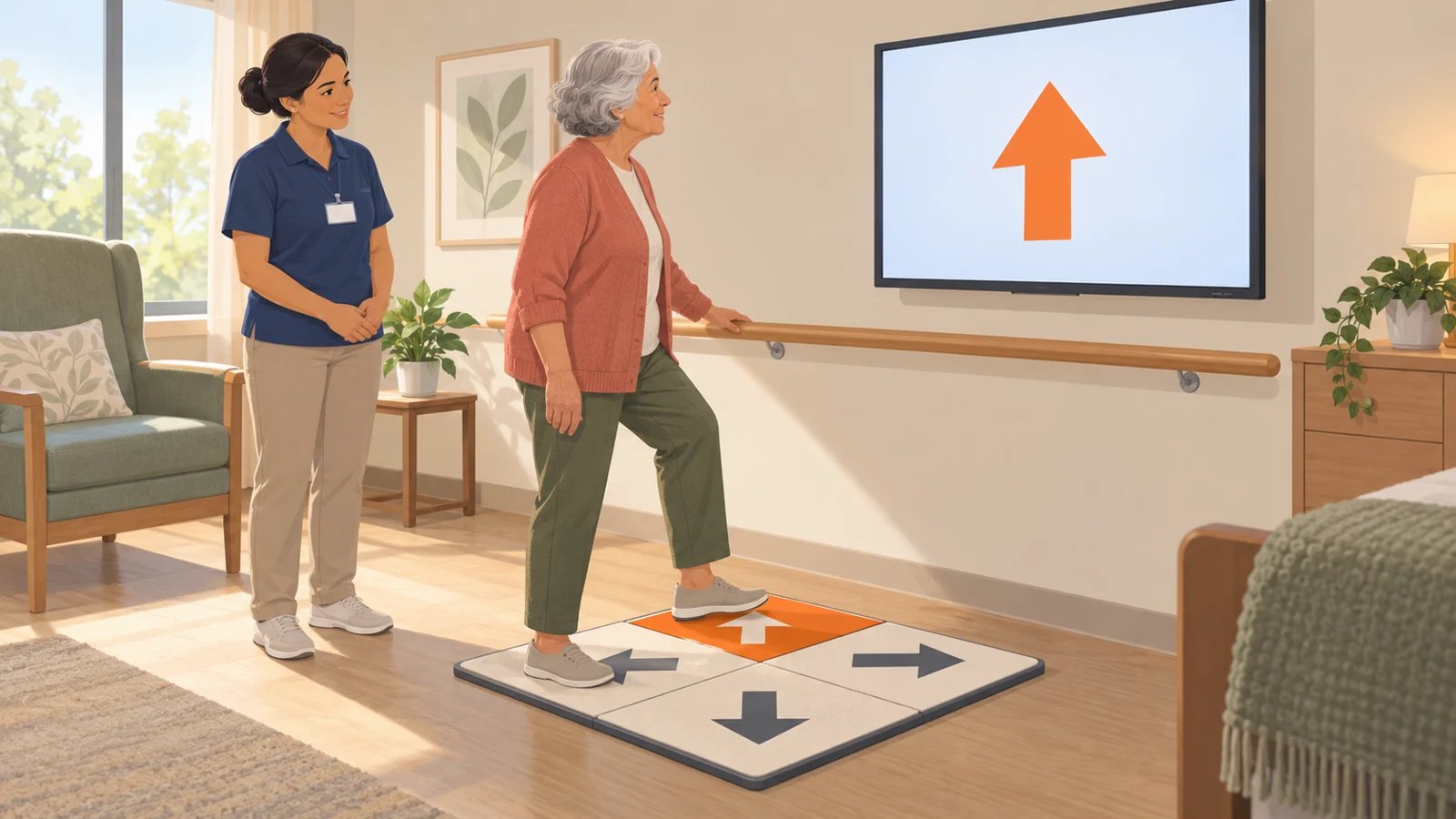
Exergaming means playing a video game through physical exercise. In this study, the current registry record describes individual active dance-game training on the Dividat Senso platform. A large screen directs the participant toward one of four arrows, and the participant steps on the matching part of a floor platform. The system provides auditory, visual, and somatosensory feedback as the person responds.
The planned dose is three 15-minute sessions each week for 12 weeks. Investigators plan to randomly allocate an estimated 48 long-term-care residents either to the exergaming programme or to usual care. Usual care is not necessarily inactivity. The record describes meals, individualized support, and activities that can include walking, exercise groups, gardening, singing, painting, handicrafts, or other care suited to the resident.
That comparison matters because the trial is testing a care package against what residents would otherwise receive. Any difference could reflect the stepping practice, the feedback, the regular schedule, the novelty of the game, or a combination of those elements. The design is useful for asking whether the package makes a practical difference in care, while leaving a narrower question for later work: whether the game itself adds something beyond similarly structured exercise or attention.
What the trial would measure
The primary physical-performance assessment is the Short Physical Performance Battery. It brings together walking, rising from a chair, and balance tasks, producing a picture of lower-limb function and mobility rather than relying on a single movement. Those tasks connect closely to the everyday capabilities that can affect how independently a resident moves through a care setting.
The secondary measures widen the view. A cognitive assessment asks about abilities such as memory, attention, language, orientation, and related domains. Other structured ratings and questionnaires address behavioral symptoms, depressive symptoms, quality of life, and activities of daily living. A falls count adds a concrete safety-related observation from the preceding period. These measures are planned at baseline and after the 12-week intervention, so the investigators can compare change over the study period.
Activity and sleep are approached differently from a questionnaire score. The record describes motion-sensor measurements from GENEActiv and sleep measurements from the contactless Sleepiz sensor box. These devices are intended to capture patterns of movement and sleep alongside the human-rated assessments. The combination could show whether a change in a test score is accompanied by a broader shift in how residents move or rest, although the registry design alone cannot say what those measurements will show.
What the design can and cannot show
The supplied registry record has no posted results. It therefore supports an explanation of what investigators planned to test, not an estimate of whether residents walked faster, scored better cognitively, felt less depressed, slept differently, or became more independent. The absence of posted registry results also does not establish that investigators have no data or that findings could not exist elsewhere.
An estimated enrollment of 48 participants gives the study a pilot scale. That can make the results useful for judging feasibility and for identifying patterns worth testing in larger research, while leaving less room for firm conclusions across different dementia diagnoses, levels of impairment, or care environments. The 12-week assessment period is long enough to examine short-term change, but it cannot by itself establish lasting benefit or slowed neurodegeneration.
The number of planned outcomes creates another interpretive challenge. Mobility is the primary focus, while cognition, behavior, mood, quality of life, daily independence, falls, physical activity, and sleep address different questions. Looking across all of them may help describe how a programme fits residents’ lives, but an apparent change in one secondary measure would need careful interpretation alongside the rest of the evidence.
The study also does not, from this design alone, establish safety for every resident or suitability across all long-term-care settings. Nor does it separate the effects of a game-specific feature from the wider package of scheduled movement and feedback. Those are limits on what the trial could establish, not evidence that the intervention will fail.
What movement-based games could add to dementia care
A meaningful result could give long-term-care teams another structured activity for residents with major neurocognitive disorders. If the programme improves physical performance or supports everyday functioning, and if residents can use it comfortably within ordinary care routines, the value would be practical: a brief activity that combines movement, prompts, and feedback could become one more supportive-care option for maintaining participation and mobility.
The supplied registry record does not establish that practical benefit. The activity would need to show a meaningful difference against usual care and prove workable for the people and settings meant to use it. Until those questions are answered, the registered trial is best understood as a focused test of whether an exercise-based game can contribute to dementia care, not as evidence of a cure or a revolution.
Key Sources
- Primary source: Exergaming Revolution in Dementia
Government or Regulator · Clinical Trial · 2024-10-08
Keep exploring