
Since the previous research note · Earlier expectation not tested
Track continuity
Since the previous research note: Similar symptoms and a low brain-creatine signal can point to different disorders
Previous expectation: A subtype-aware prospective study could show whether biochemical changes accompany meaningful developmental or communication gains.
What this study adds: A GAMT-deficient mouse experiment linked creatine supplementation to an AGAT-associated fall in guanidinoacetate, while brain levels remained elevated and the liver responded differently.
What changed in this study
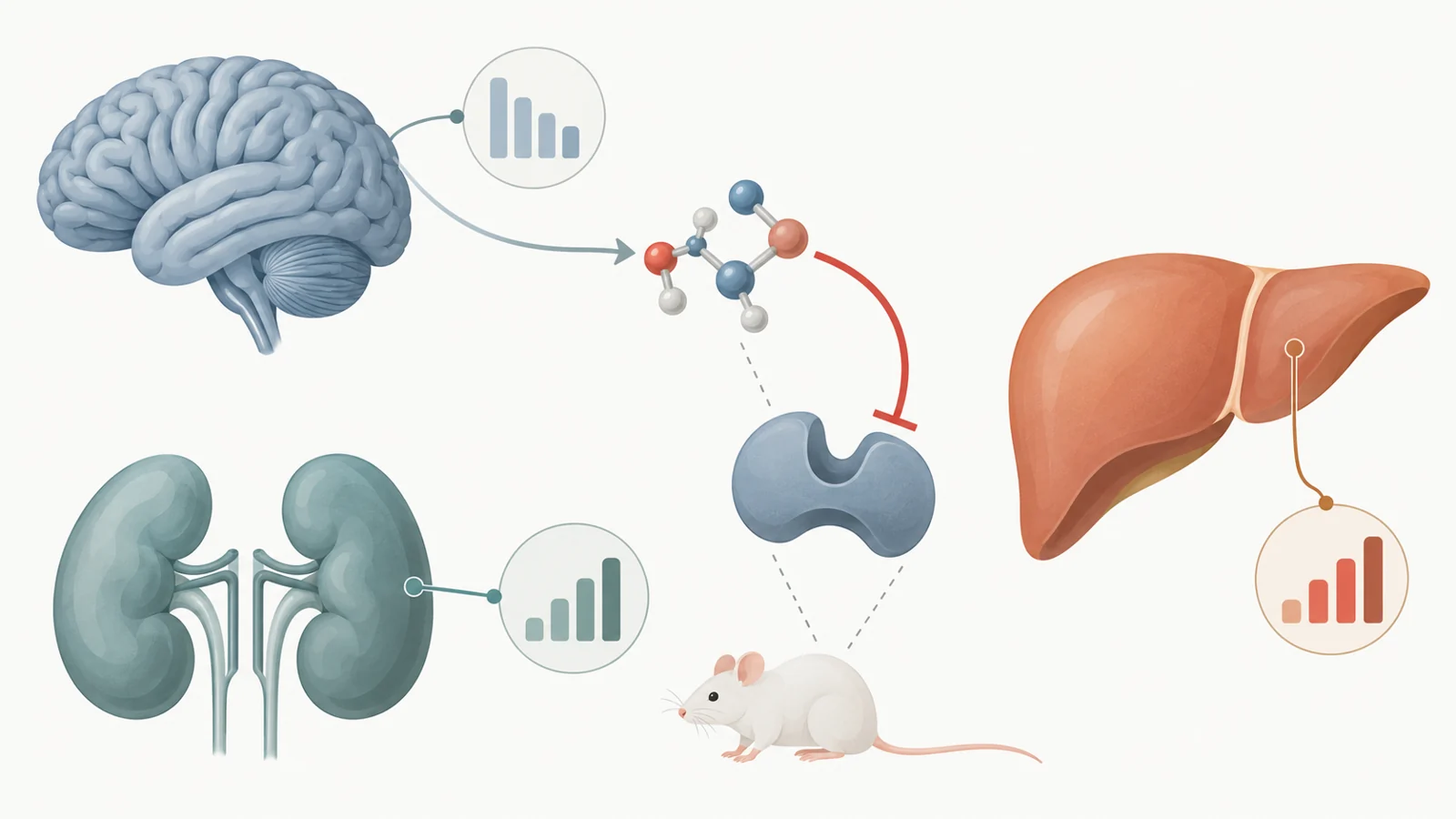
GAMT deficiency, a rare defect in making creatine, leaves the body short of creatine and unable to convert guanidinoacetate (GAA) into it. GAA is a precursor in the creatine-making process; when it accumulates, it can be neurotoxic. In a mouse study, dietary creatine restored depleted brain creatine, yet GAA in the brain remained far above the level in unaffected mice. More creatine helped correct one imbalance without clearing the other.
The researchers traced this response to changes in AGAT, an enzyme involved in making GAA. The results support a feedback explanation for why creatine supplementation can lower GAA, but they also show that organs respond differently. The work clarifies a biochemical effect in mice; it does not show whether that effect improves health or daily function in people with GAMT deficiency.
Ten weeks of feeding showed a clear biochemical response
At 10 weeks of age, mice with no altered GAMT copies, one altered copy or two altered copies were assigned chow with no added creatine, 2% creatine or 4% creatine. They ate those diets for 10 weeks. Researchers measured creatine and GAA in fluids and organs, and assessed AGAT messenger RNA, protein and enzyme activity in selected organs.
One plasma result shows the scale of the change: in mutant mice, supplementation was associated with a 93% drop in plasma GAA, to about 15.5 micromoles per liter with either creatine diet. The 4% chow did not produce a larger plasma reduction than the 2% chow. That fluid measurement captures a substantial response, but tissue results show why it cannot stand in for every organ.
Creatine supplementation corrected the mutant mice’s creatine deficiency across the organs measured. Brain, heart and skeletal muscle reached levels seen in wild-type mice, while kidney and liver levels rose above that range. In the brain, however, GAA fell only partway: after treatment it remained 31 to 48 times the wild-type level. The biochemical response was real, but it did not normalize every measurement.
An enzyme may help explain why GAA fell
GAMT normally converts GAA into creatine. When that step is impaired, GAA can build up. AGAT acts earlier in the pathway and contributes to GAA production. The researchers’ proposed explanation is that added creatine feeds back on this supply route: as creatine becomes available, AGAT activity goes down, potentially slowing the production of more GAA even though the GAMT block remains.
The organ measurements fit parts of that account. In mutant kidneys, AGAT messenger RNA fell by more than 90% with creatine supplementation, alongside reductions in AGAT protein and enzyme activity. In the brain, AGAT protein and activity also fell, but its messenger RNA, which carries instructions for making the enzyme, showed no discernible change. So the brain response appeared in the amount of enzyme and its measured activity, not in a matching change in the RNA measurement.
These patterns support an AGAT-associated feedback mechanism, but the experiment did not independently alter AGAT to establish that it alone caused the GAA reduction. The distinction matters: the study connects creatine, lower AGAT measurements and lower GAA, while leaving open how much of the effect depends on AGAT versus other processes.
Wild-type mice did not store extra creatine everywhere
The comparison with unaffected mice adds context. After 10 weeks of creatine chow, wild-type mice had higher creatine concentrations in kidney and liver, with larger increases on the 4% diet. The researchers did not observe an increase in brain, heart or skeletal muscle creatine. Extra dietary creatine therefore did not produce the same tissue change throughout the body, even without GAMT deficiency.
This contrast helps separate replenishing a shortage from raising a level that was already maintained. In mutant mice, supplementation brought depleted brain, heart and muscle creatine up to wild-type levels. In wild-type mice, those same tissues did not show higher creatine concentrations after supplementation. The organ response depended on the starting condition as well as the tissue being measured.
The liver followed a different pattern
The liver was the clearest exception to GAA lowering in mutant mice. Despite creatine supplementation, its GAA concentration showed no ascertainable reduction. Liver AGAT messenger RNA did not change discernibly, and protein and enzyme activity showed only small reductions. This differs from the substantial GAA reductions measured in several other organs, including the brain, where GAA fell but remained markedly elevated.
The liver measurements also need care in interpretation. AGAT expression is low in mouse liver, and the researchers noted greater variability when measuring it in organs with low expression. The liver result still underscores that a mechanism observed across some tissues cannot be assumed to operate equally in every organ.
A biochemical change is not yet a patient outcome
This study examined mice, not children or adults receiving care for GAMT deficiency. It cannot establish whether lowering GAA with creatine improves seizures, development, communication or daily function in patients. The mouse chow percentages also do not establish a human dose or predict an equivalent response in the human brain. Some organ analyses involved small groups, so the results are best read as a mechanistic pattern that needs further study, not as a precise forecast of human effects.
Creatine supplementation is already part of treatment for creatine synthesis defects. The remaining clinical question is whether lowering the GAA that persists despite creatine would improve outcomes for patients. A change in a metabolite is not itself evidence of a change in a person’s symptoms or abilities.
Where this research could lead
A future clinic visit for a child with GAMT deficiency could consider two separate goals: restoring creatine and limiting the GAA that remains. Creatine supplementation already addresses the first. A dependable, separately validated way to address residual GAA could add a second capability, if further treatment development shows it can lower GAA and human outcome studies show that doing so helps patients.
The mouse results give researchers a reason to investigate AGAT-associated feedback, while the different brain, kidney and liver responses caution that the effect may not be uniform across tissues. A nearer measurable milestone would be an independent AGAT-targeted intervention in GAMT-mutant mice that lowers residual brain GAA while preserving restored creatine. That would test whether AGAT can be used as a separate lever; it would still take human evidence to establish a benefit for children.
Key Sources
- Primary source: Creatine Supplementation Reduces Guanidinoacetate via Downregulation of AGAT in a Mouse Model of GAMT Deficiency.
DOI or Journal Page · Peer-Reviewed Paper · 2026-09-01