
Since the previous research note · Earlier expectation not tested
Track continuity
Since the previous research note: How families helped choose what future trials should measure in two brain creatine disorders
Previous expectation: Future trials might prespecify family-valued communication and daily-function outcomes alongside biomarkers so treatment results can be compared.
What this study adds: This 2026 retrospective series adds patient-level clinical, genetic, and brain-spectroscopy observations, including follow-up scans in six patients. It does not report a trial protocol adopting that outcome set.
What changed in this study
All eight patients in a new case series had developmental and speech delay. Six had seizures, and five had behavioural disorders that included autistic features. Those signs can prompt clinicians to investigate rare metabolic conditions, but they overlap with many other causes of developmental difficulty. On their own, they cannot identify a creatine deficiency syndrome or tell clinicians which kind of disorder is present.
The retrospective study followed eight patients at two pediatric metabolic departments between 2014 and 2024. Two had AGAT deficiency, four had GAMT deficiency and two had creatine transporter deficiency. The series offers a small, detailed look at how symptoms, genetic findings and brain imaging appeared across these different conditions.
Similar symptoms do not point to one diagnosis
Creatine deficiency syndromes are rare inherited disorders that affect the brain’s supply of creatine. In some, the body has trouble making creatine; in another, a transport defect affects how it reaches the brain. These different routes can produce overlapping signs, including developmental and speech delay, seizures and behavioural changes.
In this group, seizures were reported in six patients and were controlled with anti-seizure medication. The overlap in symptoms makes the possibility worth considering during a specialist evaluation, but it does not make any one symptom a diagnostic test. The study’s genetic and imaging findings help show why a more specific investigation matters.
The scan can show a chemical shortage
A conventional brain MRI mainly shows structure. It can help identify visible lesions, but in creatine deficiency syndromes, structural imaging may be normal or nonspecific. Magnetic resonance spectroscopy, or MRS, adds a different kind of information: it estimates chemical signals in a selected area of brain tissue.
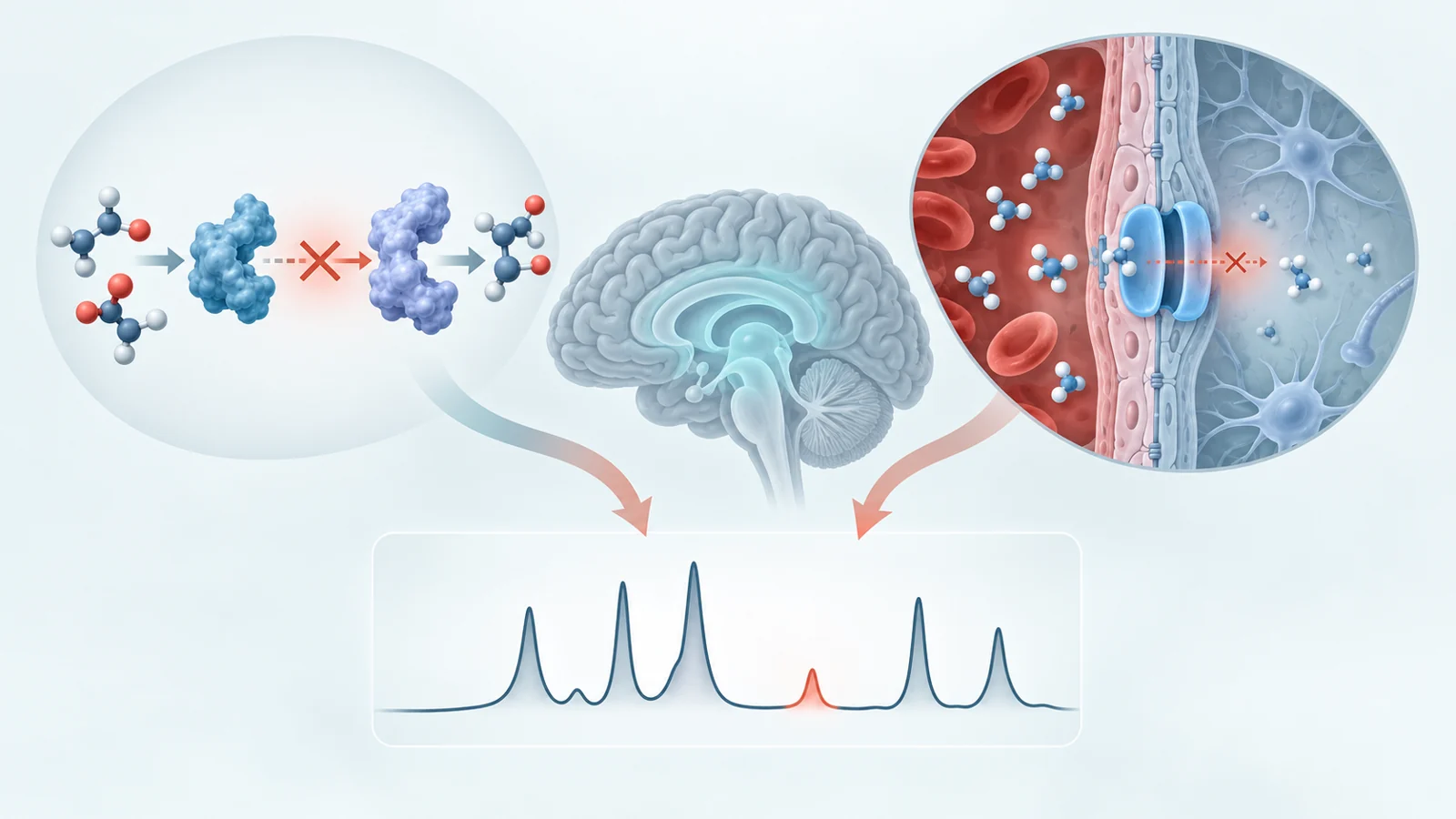
The study’s radiologists examined spectra from the basal ganglia and assessed the prominence of the creatine peak qualitatively. In the patients evaluated, that peak was reduced. The finding is useful as a clue to low brain creatine, even when a structural MRI does not point to a cause. But a low peak alone does not distinguish the underlying disorder, and it is not a direct measure of a person’s communication or daily abilities.
Three routes lead to the same low peak
AGAT and GAMT deficiencies disrupt the steps that make creatine. AGAT acts at the start of the pathway, producing guanidinoacetate, or GAA, an intermediate. GAMT then converts GAA into creatine. A defect at either step can leave the brain with too little creatine.
Creatine transporter deficiency is different. It involves SLC6A8, the transporter that carries creatine into the brain. The same reduced brain-creatine peak can therefore appear when the problem is making creatine and when the problem is moving it into the brain.
That difference changes the treatment question. The paper describes AGAT and GAMT deficiencies as treatable. In this series, the two patients with AGAT deficiency received creatine; the four with GAMT deficiency received creatine, L-ornithine and a low-protein diet. The two patients with transporter deficiency received creatine with L-arginine and L-glycine. The authors describe treatment prospects for transporter deficiency as less promising, reflecting that a supply of creatine does not by itself correct the transport defect.
Follow-up scans show biochemical change
Six patients had MRS about 12 months after treatment began. Comparing follow-up scans with baseline scans from the same brain region, the researchers saw a larger creatine peak in three patients. This is an observed change in a brain-chemistry measure, not proof that treatment caused a clinical improvement.
Two patients were noted to have poor treatment adherence during follow-up, so treatment exposure was not uniform across the group. The scans were also assessed qualitatively rather than through a quantitative comparison. These details matter when interpreting a small series in which patients had different diagnoses and different treatment approaches.
Cardiac evaluations found no abnormalities among the eight patients. That result describes this group; it cannot rule out cardiac involvement in other people with these disorders.
Function needs a different measure
A question for families is whether a higher creatine peak goes along with better speech, learning or day-to-day function. The authors reported improvement on developmental tests among patients with GAMT deficiency, an encouraging clinical observation. But standardized neurodevelopmental assessments could not be completed for every patient, in part because of severe behavioural impairment or difficulty cooperating with testing. Biochemical markers were also unavailable for some patients.
As a result, this series cannot establish whether a changed MRS peak coincided with meaningful communication or functional gains across the group. Nor can eight retrospectively observed cases show that earlier diagnosis caused better outcomes or reliably compare treatment effectiveness between the three disorders. The study adds useful clinical detail, while leaving the relationship between brain chemistry and everyday progress unresolved.
Where this research could lead
A child with unexplained speech delay and seizures could reach specialist care and receive a dependable distinction between a defect in creatine synthesis and one in transport. Genetic diagnosis, spectroscopy and some treatments already exist. A more consistent connection between early subtype recognition, biochemical change and meaningful communication or daily function could help families and clinicians follow cause-matched care with clearer expectations.
The series gives that possibility a concrete starting point: it included three different defects, and three of six follow-up scans showed larger creatine peaks. Those observations do not prove clinical benefit. A better treatment for transporter deficiency would require separate progress, because the underlying transport problem remains different from a synthesis defect.
A nearer milestone would be a prospective study that groups patients by subtype and prespecifies quantitative spectroscopy alongside standardized developmental or communication outcomes. Reporting whether those measures change together would help establish whether a biochemical shift tracks with abilities that matter in everyday life.
Key Sources
- Primary source: Creatine Deficiency Syndromes: Clinical Spectrum, Neuroimaging Features and Treatment Response.
DOI or Journal Page · Peer-Reviewed Paper · 2026-08-01