
Evidence date · 2026-08-11 · Research note 2 of 2
1 2
See current Track status →
Since the previous research note · Partly supported
Track continuity
Since the previous research note: A creatine combination changed tissue and movement measures in older adults
Previous expectation: A supplementation approach might help older people preserve mobility and independence if functional benefits prove reproducible and sustained use is acceptably safe.
What this study adds: This 12-week creatine trial adds body-composition and laboratory-strength findings in healthy adults aged 45–65, including participants pursuing exercise and diet-induced weight loss. Those intermediate findings support part of the rationale, while everyday mobility, independence and sustained safety remain unestablished by the supplied evidence.
What changed in this study
Losing body fat can create an awkward trade-off. Weight-loss efforts may reduce fat, but they can also reduce lean tissue, the broader body compartment that includes muscle and other non-fat mass. For adults trying to stay strong as they age, the practical question is not simply whether the scale moves downward. It is whether fat loss can happen while preserving the physical capacity needed for ordinary life.
A study published on August 11, 2026, tested whether creatine monohydrate could add something useful to that effort. The 12-week trial examined body composition, strength, cognitive tests, blood markers, and reported side effects in healthy adults aged 45 to 65. Its results offer support for part of the rationale behind using creatine during weight management, while leaving everyday mobility, independence, and long-term safety unresolved.
Four paths made the comparison possible
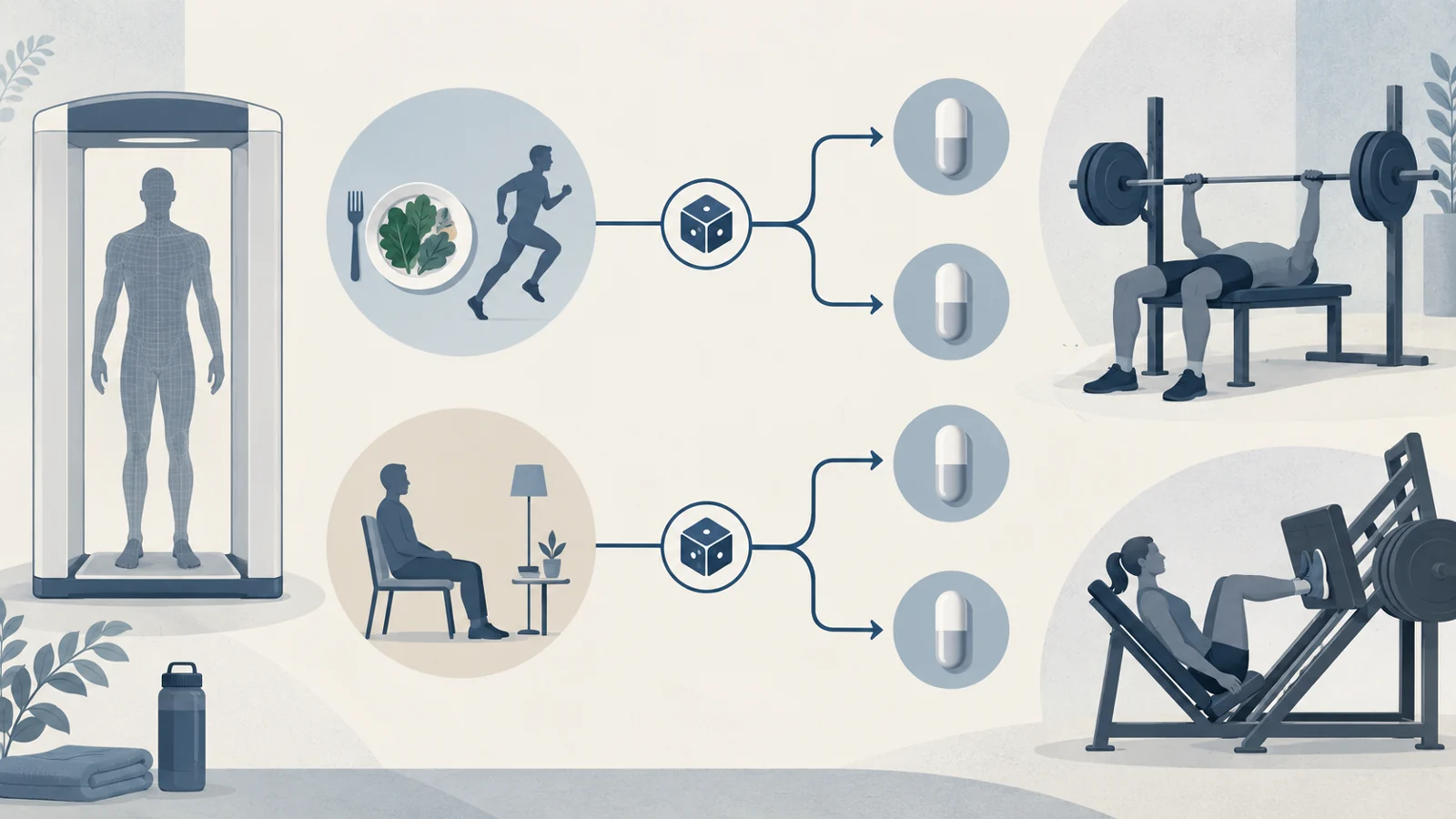
Seventy-three adults entered the trial, and 64 completed the 12-week intervention and were included in the repeated-measures analysis. Participants first chose between two broad paths. One involved a structured exercise and diet program intended to promote weight loss. The other involved no structured exercise and diet intervention.
Within each path, participants were matched and then randomly assigned in a double-blind fashion to either creatine monohydrate or a maltodextrin placebo. The creatine dose was 10 grams per day, divided into two 5-gram servings. The four resulting groups were therefore exercise plus diet with creatine, exercise plus diet with placebo, no structured intervention with creatine, and no structured intervention with placebo.
The supplement comparison is the strongest causal part of this design. Because creatine or placebo was assigned randomly within each exercise-status group, differences between those supplement groups can be interpreted more directly as evidence about the supplement under those conditions. Comparisons between the exercise-and-diet groups and the no-intervention groups are different. Exercise participation was self-selected rather than randomized, and the exercise path also bundled diet changes with training. Those cross-group results show how the paths differed, but they cannot isolate the independent effect of exercise alone.
The trial was registered after the first participant had enrolled. That timing does not erase the randomized supplement allocation, but it is part of the study’s context when assessing how the work was planned and reported.
The body-composition result was not just about the scale
Participants who selected the exercise and diet program showed the clearest overall changes in body composition. They lost more total weight, fat mass, and body fat than participants who selected no structured intervention. Within the exercise-and-diet stratum, the randomized supplement comparison also favored creatine on selected body-composition measures.
The creatine groups gained fat-free mass relative to the placebo groups. In the exercise-and-diet groups, the creatine group also had a greater reduction in body-fat percentage than the exercise-and-diet placebo group and the two no-intervention groups. The reported change in body-fat percentage was about 3.24 percentage points in the exercise-plus-creatine group, compared with about 1.87 percentage points in the exercise-plus-placebo group.
Those measurements describe related but different things. Fat mass is the measured amount of body fat. Fat-free mass is everything measured as non-fat tissue in the body-composition assessment; it should not automatically be translated into newly formed skeletal muscle. Body-fat percentage is the proportion of total body mass represented by fat. It can fall because fat mass decreases, because fat-free mass increases, or because both occur. A lower percentage therefore is not interchangeable with a specific number of kilograms of fat lost.
The randomized supplement comparisons support a benefit for measured fat-free mass under the trial conditions. Greater fat loss was observed among participants who chose exercise and dieting, but that comparison cannot separate the intervention from participant selection. These measurements do not establish how much of the fat-free-mass change represented new skeletal muscle. A favorable body-composition result therefore does not by itself demonstrate muscle growth.
Bone mineral content, area, and density did not show statistically significant differences among the groups. The body-composition findings therefore center on fat, fat-free mass, and percentage body fat rather than improvements across all measured components.
Strength improved in the laboratory
The trial also asked what participants could do under standardized testing conditions. Investigators measured maximal strength with one-repetition maximum tests for the bench press and leg press. They assessed muscular endurance by asking participants to perform repeated movements at 70 percent of their one-repetition maximum until volitional fatigue. An incremental treadmill test provided information about exercise tolerance and aerobic capacity.
The study reported that maximal leg-press and bench-press strength changed differently across the four groups over time. Its discussion describes greater strength and endurance gains with creatine during training, while the results explicitly report a bench-press benefit over placebo in participants outside the structured exercise and diet program. These findings support a role for creatine in laboratory performance; comparisons across the self-selected exercise paths cannot establish how much training itself contributed.
Aerobic capacity is a separate question. The study did not find statistically significant differences in aerobic capacity, even though some exercise-related measures, such as treadmill time to exhaustion, moved in a favorable direction. A stronger one-repetition maximum does not mean that every form of physical capacity improved, and a laboratory strength result is not the same as a direct demonstration of easier walking, safer stair climbing, or greater independence.
Memory findings point in several directions
The cognitive results are harder to summarize because the tasks did not move together. In a delayed word-recall measure, the no-exercise creatine group had more correct responses after six weeks than placebo groups in the change-from-baseline comparison. But the overall group-by-time interaction for the word-recall assessment was not statistically significant.
Picture recognition provided a different result. The study found no statistically significant improvement in correct responses or reaction time, and its overall time and group-by-time analyses were also not statistically significant. Some self-reported memory measures favored creatine groups for remembering names, purchased items, and high-school events. Another measure of forgetfulness pointed in an unfavorable direction for the no-exercise creatine group. The exercise-plus-creatine group also had higher scores on a general cognitive screening measure after 12 weeks than the no-exercise groups, but that result sits within the broader pattern of mixed findings.
These outcomes were individual exploratory cognitive analyses, not separately powered confirmatory tests for a general memory benefit. Repeated testing can also introduce practice effects, even when participants receive familiarization. The study therefore raises a question about whether creatine might affect selected cognitive measures in this population; it does not establish a general improvement in memory, protection from dementia, or a change in everyday cognitive function.
A creatinine change needs careful reading
Blood testing produced one of the study’s most important interpretive complications. Creatinine increased in both creatine groups, with the larger increase in the exercise group. The change was small, under 0.15 milligrams per deciliter. Because the estimated glomerular filtration rate in this study was calculated from creatinine, the creatine groups also showed a decline in that estimate. The reported values remained above 60 milliliters per minute per 1.73 square meters and within the authors’ stated normal clinical limits.
A creatinine-based estimate is therefore sensitive to the creatinine value being used. The observed rise and related fall in the calculated estimate should not be treated as proof of kidney injury, but neither does this short study establish universal kidney safety. The participants were healthy adults, the intervention lasted 12 weeks, and the findings do not answer how people with kidney disease or other clinical conditions would respond.
Other blood results were favorable in selected comparisons. The no-exercise creatine group had more favorable changes in triglycerides, HDL cholesterol, VLDL cholesterol, and the cholesterol-to-HDL ratio than the no-exercise placebo group. HbA1c decreased in the exercise groups and in the no-exercise creatine group, without a corresponding change in fasting glucose. These metabolic findings were exploratory and should not be treated as established disease-prevention effects.
Reported side effects were infrequent, minimal to slight, and similar across groups. Complaints often diminished during the study, and no participant withdrew because of the supplement. That supports short-term tolerability in this sample, not a conclusion about sustained use across all older adults.
What the trial clarifies and what remains open
This study gives creatine a specific, bounded role in the weight-management conversation. At 10 grams per day, it was associated with gains in measured fat-free mass and strength, and it accompanied a greater reduction in body-fat percentage when participants followed the exercise and diet program. Those results are relevant to adults who want to reduce fat without giving up as much lean-tissue-related capacity.
The design also prevents a simpler claim that creatine alone caused every favorable difference between the exercise and no-exercise groups. Participants chose their path, and the structured path combined resistance and endurance exercise with dietary change. The randomized comparison tells us more about creatine within each path than about exercise itself.
The study was small, with 13 to 20 completers in each group, and lasted only 12 weeks. Its participants were healthy and aged 45 to 65. The findings therefore do not establish effects in frail older adults, people with dementia, or people with kidney disease, and they do not establish long-term tolerability. A non-significant result is not proof that an effect is absent, but the mixed cognitive pattern means a broad memory claim would go beyond what these measurements can support.
What this could change
For adults pursuing weight loss, the practical opportunity is a possible adjunct that helps retain measured lean tissue and physical capacity while body fat decreases. If these results are reproduced over longer periods, remain tolerable, and translate from controlled strength tests into meaningful daily activities, creatine could make weight management less costly to the physical reserve people rely on for movement and independence.
That possibility depends on several links holding at once. The body-composition pattern must persist, strength gains must prove relevant outside the laboratory, and safety must remain acceptable across a wider range of adults and health conditions. The current trial strengthens the case for studying that pathway; it does not yet complete it.
Key Sources
- Primary source: Effects of creatine supplementation with and without exercise and diet intervention on body composition, cognitive function, and markers of health in middle-aged and older adults.
DOI or Journal Page · Clinical Trial · 2026-08-11