
Research Signal – Source date 2025-05-19
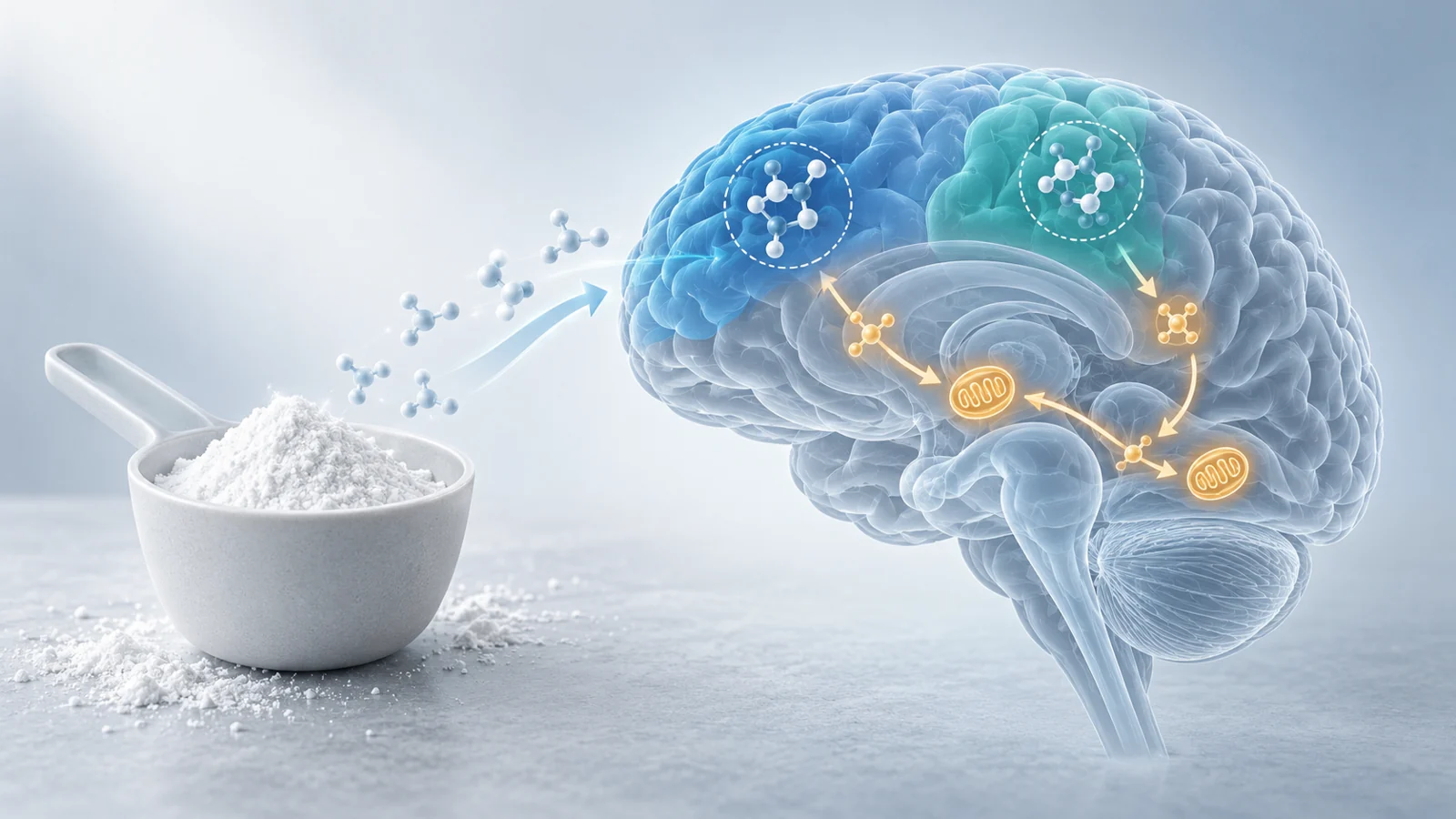
Creatine monohydrate is a compound involved in supplying energy inside cells. In the brain, that role makes it an intriguing candidate for Alzheimer’s research. The question is whether increasing the brain’s creatine stores can translate into better thinking for people who already have Alzheimer’s dementia.
A study published on May 19, 2025, offers an early human answer, but not a treatment verdict. The Creatine to Augment Bioenergetics in Alzheimer’s trial, known as CABA, gave 20 participants 20 grams of creatine monohydrate daily for eight weeks. The average amount of total creatine measured in selected brain regions rose by 11%, and several cognitive test scores improved. Because the study had one treatment group and measured people before and after supplementation, it could show that the regimen was workable and worth investigating further. It could not determine whether creatine caused the cognitive changes.
The pilot was designed to test whether people could follow the regimen
The CABA trial was a single-arm feasibility study. Participants took two 10-gram doses each day, mixing the powder into a beverage of their choice. They were not simply handed a supplement and left to manage the schedule alone. Each participant had a study partner, such as a spouse, family member or close friend. A trained research dietitian provided written and oral instructions, and the study team called the study partner weekly to encourage adherence.
All 20 participants who entered the intervention completed the eight weeks. Nineteen met the study’s protocol-compliance threshold of consuming at least 80% of the expected doses. One participant was counted as non-compliant because the tracking records were incomplete, although that person remained in the compliance analyses. Across the group, mean self-reported dose compliance was 90%.
Those figures establish feasibility under a highly supported research arrangement. They show that people with Alzheimer’s dementia were able to complete this dose and schedule when a study partner, dietitian and research team helped maintain the routine. They do not show that the same adherence would be easy without that support, or that the tested schedule should be adopted outside a clinical study.
The short-term tolerability picture was shaped by screening
The study enrolled 22 people over 17 months to obtain the 20 participants who received creatine. Two people were excluded at safety screening because of elevated renal laboratory results. The treated participants were 60 to 90 years old, met the study’s criteria for dementia due to Alzheimer’s disease and were taking stable doses of Alzheimer’s-related medication. They also needed to be able to undergo magnetic resonance imaging and complete the study assessments.
Study partners reported 13 adverse events during the intervention. These were mild and included cramping or muscle pain, diarrhea, constipation, nausea, facial flushing and sleep disturbance. The count refers to reported events, not necessarily to 13 different people. Laboratory testing showed a slight increase in serum creatinine. Apart from that change, the paper reported no significant baseline-to-eight-week changes in the comprehensive metabolic panel.
This is a short-term tolerability observation in a screened group, not a universal safety conclusion. In particular, people excluded because of renal laboratory findings were not part of the treated sample. The study also does not establish how the regimen would be tolerated over a longer period.
The brain scans measured a creatine pool, not energy use itself
Creatine helps cells manage high-energy molecules. Inside cells, free creatine can participate in a system that carries energy from mitochondria to places where energy is needed, including the cytosol. This gives the brain-creatine system a plausible connection to cognition, but the CABA study measured only part of that biology.
Participants underwent proton magnetic resonance spectroscopic imaging before supplementation and again after eight weeks. The scans sampled an axial region above the lateral ventricle that included frontal and parietal brain areas. The researchers quantified brain total creatine, or tCr, using the creatine signal in those sampled regions.
On average, tCr increased by 11%, and 85% of participants showed an increase. The size of the change varied across participants. That variability may reflect differences in how creatine is transported into the brain, but the study did not establish why individuals responded differently.
The result is important because it shows that the intervention was associated with a measurable rise in the brain’s total creatine pool in people with Alzheimer’s dementia. It is more limited than a direct demonstration that brain cells were using energy more effectively. The spectroscopy method measured total creatine rather than separately measuring free creatine and phosphocreatine, the form involved in immediate energy transfer. A larger total pool therefore should not be read as proof that cellular energy utilization improved.
Several cognitive scores improved over eight weeks
Cognitive testing used the NIH Toolbox Cognition Battery, administered by trained personnel on an iPad, along with the Mini-Mental State Examination. The battery samples abilities including attention, switching, episodic memory, working memory, processing speed and language, and produces broader composite scores.
From baseline to eight weeks, the study reported improvements in total cognition and fluid cognition. Participants also improved on a list-sorting task that measures working memory and on oral reading recognition. Performance on a flanker task involving inhibitory control and attention showed a borderline trend rather than a clear result. Crystallized cognition and the other individual cognitive tests did not improve uniformly.
The pattern is interesting, especially because Alzheimer’s disease is associated with progressive cognitive impairment. But the design leaves several explanations open. Participants took the supplement knowing they were receiving the intervention, and they repeated cognitive tests after only eight weeks. Familiarity with the testing process, expectations about treatment, placebo effects or ordinary variation could contribute to better scores. With no untreated comparison group, the study cannot separate those possibilities from a true creatine effect.
The brain and cognitive findings also do not establish sustained clinical benefit. An eight-week change on a test is not evidence that participants regained everyday functioning, slowed the underlying progression of Alzheimer’s disease or would continue improving with longer use. The paper reported positive correlations between the change in brain tCr and changes in oral reading recognition and crystallized cognition, but those limited associations do not prove that the rise in total creatine produced the test-score changes.
The authors therefore describe the cognitive findings as preliminary and explicitly say the trial is insufficient for efficacy conclusions. The tested 20-gram daily dose is a study protocol, not an established optimal treatment dose or a recommendation for self-treatment. The supplied findings also do not support claiming that supplementation reduced amyloid or tau pathology in these participants.
What a creatine add-on could mean for Alzheimer’s care
For people living with Alzheimer’s and the families supporting them, an affordable add-on treatment that could help preserve cognition alongside existing care would be valuable. Creatine monohydrate is appealing in that role because the CABA pilot found that participants could complete the regimen with structured support, and because the intervention was accompanied by a measurable increase in total creatine in the sampled brain regions.
That possibility remains conditional. Controlled studies would need to show that creatine produces meaningful and sustained benefits beyond repeated testing or placebo effects, while also clarifying an appropriate dose and longer-term tolerability. If those questions were answered positively, creatine could become a practical additional care option aimed at supporting cognition alongside established Alzheimer’s treatment.
Key Sources
- Primary source: Creatine monohydrate pilot in Alzheimer's: Feasibility, brain creatine, and cognition.
DOI or Journal Page · Peer-Reviewed Paper · 2025-05-19
Keep exploring