
Evidence date · 2021-01-19 · Research note 1 of 3
1 2 3
See current Track status →
A molecule linked to tumor growth can also help restrain the immune cells that might attack a tumor. A 2021 review describes both roles for CD155, a cell-adhesion molecule, and focuses on its interaction with TIGIT, an inhibitory receptor on immune cells. The two effects involve different cells, so the review’s discussion of TIGIT blockade raises a specific question: could interrupting the immune brake help immune cells do their work, even if it does not directly undo CD155’s reported effects on cancer cells?
CD155 has roles on both sides of the tumor–immune interaction
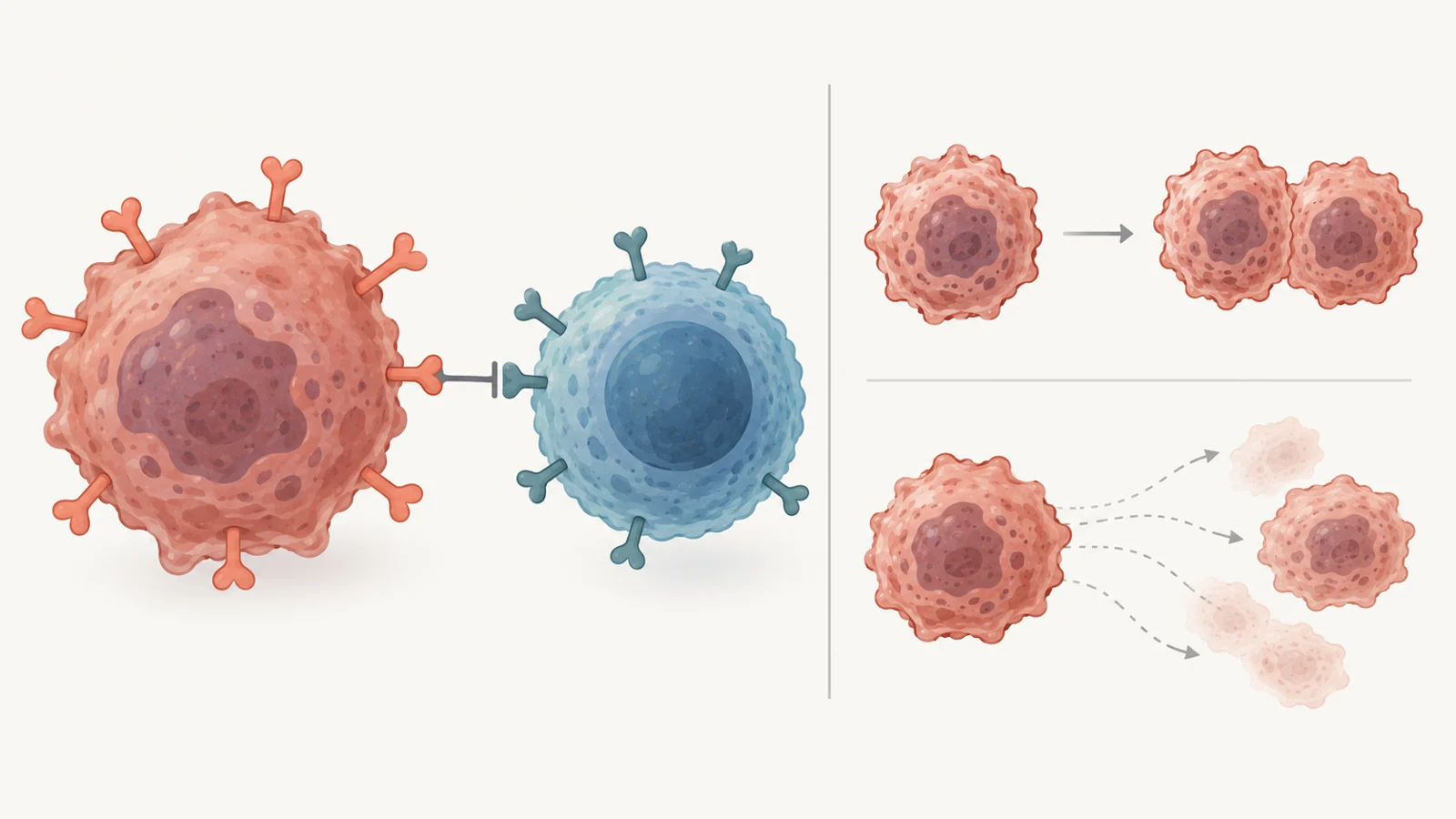
The review describes CD155 as becoming more abundant during tumor progression. It says CD155 can promote tumor-cell proliferation—the increase in cancer-cell numbers—and migration, the movement of those cells, through various pathways. These are reported effects on tumor cells.
The immune-cell effect involves a different partner. TIGIT is an inhibitory receptor reported mainly on natural killer (NK) cells and several kinds of T cells. When CD155 interacts with TIGIT, the review says, the interaction inhibits T-cell and NK-cell function.
This account links CD155 to tumor-cell behavior and to an immune brake, but it does not make those effects interchangeable. The review’s explanation of TIGIT blockade concerns the inhibitory interaction with immune cells; the abstract does not establish that blocking TIGIT directly reverses CD155’s reported effects on tumor-cell growth or movement.
Why researchers considered blocking TIGIT
If CD155–TIGIT interaction can inhibit T cells and NK cells, blocking TIGIT offers a way to investigate whether that inhibition can be relieved. The review points to preclinical studies that supported studying TIGIT blockade on its own or alongside other immune checkpoint inhibitors in advanced solid tumors. Checkpoint inhibitors are treatments intended to affect inhibitory signals in the immune system; here, the proposed rationale is to interfere with a signal that can limit immune-cell function.
That rationale is a research direction, not a clinical result. The verified abstract provides no effect sizes, safety findings, specific study designs, or comparison showing that combining checkpoint inhibitors works better than TIGIT blockade alone. It also does not establish improved tumor response, survival, or symptoms in patients. Those details would be needed to judge the size of any effect and whether the approach benefits people.
What blocking TIGIT could add to cancer therapy
The possibility raised by the 2021 review is another immunotherapy option for people with advanced solid tumors: TIGIT blockade might be studied alone or alongside other checkpoint inhibitors. That possibility depends on whether the approach can produce useful immune activity safely and lead to patient benefit. The review’s mechanism and preclinical rationale make the question worth investigating, but they do not yet make that treatment conclusion.
Key Sources
- Primary source: CD155/TIGIT, a novel immune checkpoint in human cancers (Review).
DOI or Journal Page · Review or Meta-Analysis · 2021-01-19