
Research Signal – Source date 2025-08-08
CAR-T cells are T cells engineered with a receptor that helps them recognize cancer. They have produced strong results in some blood cancers, yet early tests against solid tumors have often looked more promising than the later clinical experience. A review published on 8 August 2025 examines why that gap can arise and what preclinical testing can—and cannot—represent.
The review is a synthesis of experimental models and previously reported preclinical and clinical examples. It is not a new trial comparing a test system with patient outcomes. Its central point is that killing cancer cells in a dish captures only part of the task facing a CAR-T cell inside a person: it must find the tumor, recognize enough of its cells, remain active, and do so without damaging vital normal tissue.
Recognition is only the start of the response
A CAR’s outer region recognizes a target on a tumor cell. That recognition activates the T cell through the receptor’s signaling machinery. Additional costimulatory signals shape how fully the cell functions, while cytokine signals contribute to an effective response. Once activated, CAR-T cells can kill through perforin and granzymes, which help trigger cell death, and through the FAS pathway.
A model that shows tumor-cell killing therefore demonstrates one important capability, but not necessarily whether the cells will expand, persist, reach tumors, or keep working in a patient. The review describes early CAR designs that produced antitumor effects in laboratory and animal models but showed limited clinical responses and short persistence in early trials. Later designs added signaling components in an effort to improve activation and durability. More elaborate receptors may address one weakness while creating new questions about how to evaluate their behavior.
Each model leaves a different part of the tumor out
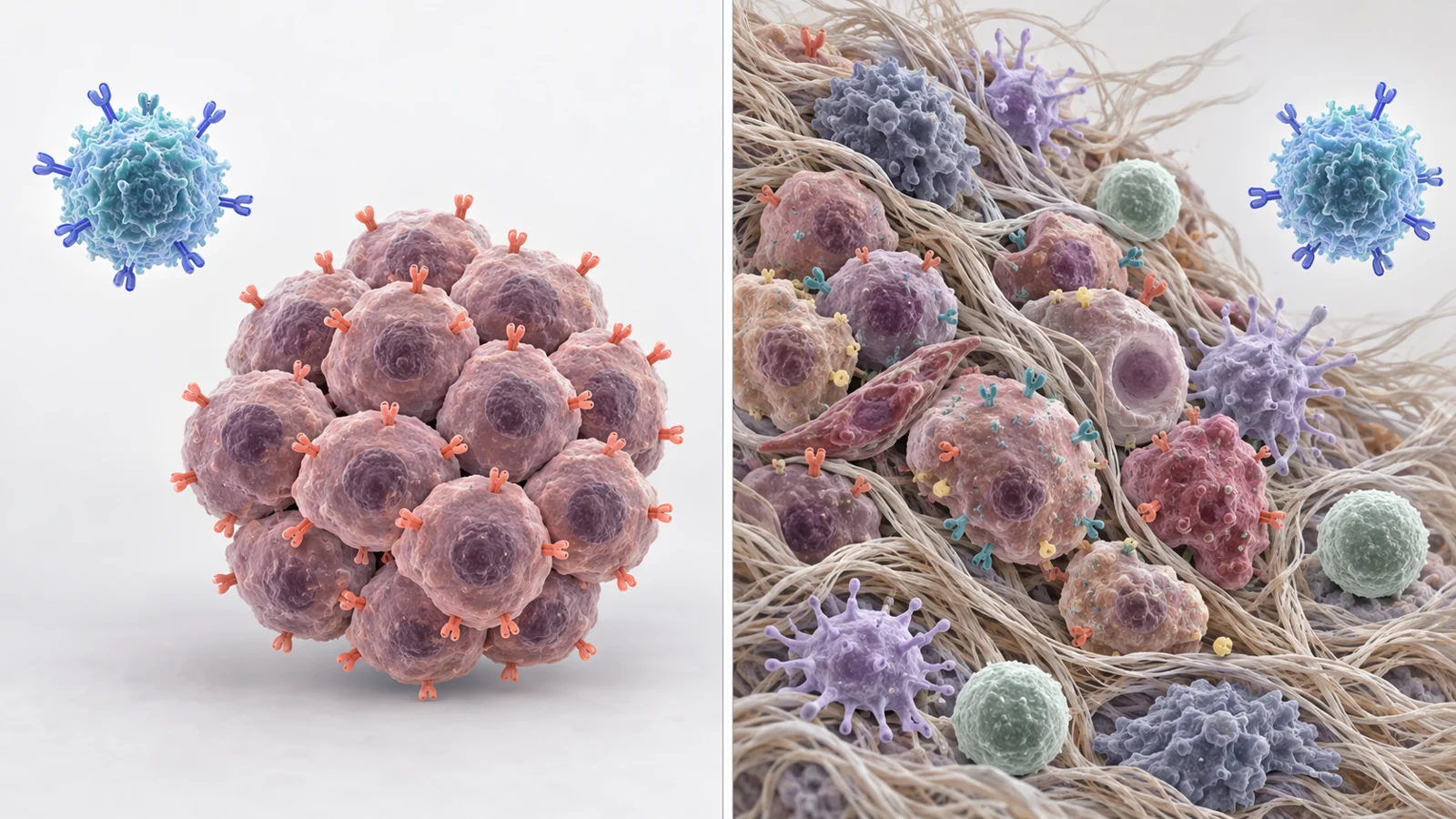
Immortalized cancer cell lines are convenient for repeatable, high-throughput tests. They can help researchers compare CAR designs and measure responses to tumor cells, but they lack the variation found among tumors and among cells within a tumor. A strong result in a uniform cell line may not reveal how a treatment will handle regions with different target levels or other features of a patient’s cancer.
Patient-derived tumor cultures and organotypic structures can preserve more of that variation. The review discusses patient-derived organotypic spheroids as a way to represent spatial differences within tumor tissue. These models still cannot reproduce the whole body: they do not show whether CAR-T cells persist over time or how they interact with a functioning immune system. Tumor cultures can also change as they grow, so the cells under study may drift from the original tumor.
Mouse models can bring in features absent from a dish, but the type of mouse matters. Immunodeficient mice bearing human tumors allow study of human cancer cells, yet they leave out much of the immune environment that shapes tumor survival and treatment resistance. This matters because suppressive cells in the tumor environment, including tumor-associated macrophages, can limit CAR-T activity.
Immune-competent, syngeneic mouse models contain a functioning immune system and can represent aspects of the tumor environment, lymphodepletion before treatment, and toxicities such as cytokine release syndrome or recognition of a target in normal tissue. Their tradeoff is that both the tumor and CAR-T cells are murine, with differences from humans in immune-cell and cytokine function and in which targets are present. Humanized mice offer another approach, but no single model captures all the relevant features without limitations, and these systems can be costly or difficult to use.
The practical implication is to combine models that answer different questions. Cell lines can support controlled comparisons; patient-derived structures can expose some tumor variation; and mouse models can add information about persistence, immune context, or toxicity, depending on their design. The review argues for integrated, tiered testing, while noting that a collection of models still does not establish a reliable prediction for every solid tumor or patient.
A target must cover cancer cells without endangering normal tissue
A promising CAR target needs to be present broadly and consistently on cancer cells, including cancer stem cells, while being sufficiently absent from vital normal tissues. Few targets meet every part of that ideal. Some proteins targeted in blood cancers are shared with healthy cells of the same lineage; solid tumors more often present markers that are overexpressed in cancer but also found in normal tissues.
Target expression can differ between patients, across regions of one tumor, and over time. If some cancer cells display little or none of the target, CAR-T cells may remove the cells they recognize while leaving others behind. Those target-negative cells can then contribute to antigen escape. This is one reason a model made from a uniform cell population can give an incomplete picture of whether a target will cover the range of cells in a real tumor.
There is also a threshold and safety tradeoff. CAR-T cells generally need more target antigen on a cell to activate than T cells using their natural receptor. Increasing receptor expression can help only up to a point: very high CAR levels can cause activation without the intended antigen and contribute to exhaustion. A stronger-affinity receptor may recognize cells with less target, but it can also increase the chance of attacking normal tissue that carries the same antigen.
The review cites serious examples of this risk. In trials targeting CAIX, CAR-T cells entered bile ducts expressing the antigen and caused liver toxicity; a CEACAM5-targeting trial reported severe respiratory toxicity and was closed. These cases show why target testing must examine where an antigen appears, not only whether it is abundant on tumor cells.
Reaching a tumor is a separate challenge from recognizing it
Solid tumors can be difficult for circulating T cells to enter. Tumor blood vessels may have reduced expression of molecules that support lymphocyte attachment and passage into tissue. Dense stroma and extracellular matrix produced by fibroblasts add a physical barrier around tumor cells. A CAR-T cell can have an appropriate target and still fail to reach enough of the tumor to act on it.
Entry alone is not enough. Signals in the tumor microenvironment can suppress or exhaust T cells, including signaling through PD-1 and PD-L1. CAR structure itself can also drive excessive signaling, sometimes called tonic signaling, that contributes to exhaustion. As a result, finding CAR-T cells inside a tumor does not by itself show that they remain capable of killing its cells.
Local delivery is one proposed way to address access by placing CAR-T cells closer to a tumor. The review describes preclinical examples of delivery into the brain’s ventricles for brain tumors and brain metastases, into the pleural space for mesothelioma, and through a transdermal microneedle patch in solid-tumor models. These approaches have shown benefits in particular preclinical models. They do not establish a general route that will work across tumor locations or patients, and they do not remove the challenge of keeping cells functional after they arrive.
More powerful designs bring new questions for testing
Some engineered CAR-T cells are designed to release cytokines that recruit or influence other immune cells in the tumor. The review describes IL-12 designs that increased antitumor activity in experimental settings but also raised toxicity concerns because of IL-12’s potent inflammatory effects. In one reported study, IL-12-producing cells brought macrophages into tumors, alongside a decrease in CD8-positive CAR-T cells that may have involved immune-suppressive IL-10. IL-18-producing designs have also been reported to strengthen antitumor effects and recruit inflammatory cells without severe toxicity in the cited studies. These results illustrate why a test needs to measure both the intended immune effect and the possibility that the added signals alter the surrounding environment in harmful ways.
Other strategies focus on the T cells themselves. Selecting naïve or stem-like memory cells for manufacturing, or engineering cells to express membrane-bound IL-15, has been used to encourage a memory-like phenotype associated with expansion and persistence. But obtaining and expanding those subsets can be technically demanding, and growth conditions need careful control. The review also points to differences in T-cell quality between donors and between manufacturing batches. A promising design must therefore be assessed alongside the consistency of the cells that can actually be produced.
These approaches change what counts as a useful preclinical result. A test of tumor killing alone cannot answer whether a cytokine-enhanced design creates harmful inflammation, whether a memory-oriented product can be made consistently, or whether either approach holds up in a suppressive tumor environment. The models and measurements have to match the design’s intended advantage and its potential liabilities.
Early clinical signs are encouraging but specific
The review places reports of limited or absent responses in solid-tumor trials alongside more encouraging results in selected early-phase settings, including gastrointestinal cancers and pediatric neuroblastoma. It also describes a colon-cancer trial in which CAR-T cells were detectable in one patient far longer than in the others; the patient with the longest survival had the greatest lymphocyte expansion. Such observations help explain why persistence remains a focus, but they do not establish that prolonged detection caused a clinical benefit.
These examples come from different cancers, targets, and treatment settings. Some show that activity in a solid tumor is possible; others expose limits in response, persistence, or safety. Taken as a group in this review, they offer neither a general verdict for solid-tumor CAR-T treatment nor evidence that a particular preclinical model predicts which patients will respond.
What better tumor models could mean for cancer treatment
If better matched models and more carefully designed CAR-T cells can address target variation, tumor entry, persistence, and suppression without unacceptable toxicity, patients with solid tumors could eventually have access to cell therapies that are more durable and useful across a wider range of cancers. Reaching that point depends on translating capabilities observed in models into safe, consistent activity in people. The review describes approaches that could help with that work, while the clinical examples available to it remain specific rather than proof of broad benefit.
Key Sources
- Primary source: Challenges in the preclinical design and assessment of CAR-T cells.
DOI or Journal Page · Review or Meta-Analysis · 2025-08-08
Keep exploring