
Research Signal – Source date 2021-02-01
Finishing cancer treatment does not necessarily end the health burden. A review arising from a National Cancer Institute think tank reports that up to 85% of adult cancer survivors and 99% of adult survivors of childhood cancer live with an accumulation of chronic conditions, frailty, and/or cognitive impairments linked to cancer or its treatment. These problems can appear as an accelerated development of several geriatric syndromes rather than as one isolated late effect.
The review, published on February 1, 2021, does not present a new treatment trial. Its contribution is to organize a research agenda for preventing, slowing, or remediating the aging-related consequences of cancer and cancer therapy. The agenda brings together aging biology, nutrition, exercise, biomarkers, survivor assessment, care delivery, and education. Its central question is practical: how can researchers tell whether an intervention is helping people remain capable in daily life, rather than merely changing a laboratory measurement?
A survivorship problem beyond the original cancer
Cancer follow-up is often discussed in terms of recurrence, but the review emphasizes another dimension of long-term health. Chronic illness, frailty, and cognitive impairment can accumulate after cancer and its treatment, affecting the physical and mental reserves that make ordinary activities possible. A person may therefore need care that considers vulnerability, function, and cognition alongside disease surveillance.
This is where geroscience enters the discussion. Instead of treating each late problem as unrelated, researchers are asking whether several outcomes share biological processes associated with aging. That approach could make it possible to study interventions aimed at more than one consequence at a time. It also raises a standard that is easy to miss: a plausible aging pathway is a reason to investigate an intervention, not evidence that the intervention already improves survivorship.
The review calls for clinical trials guided by aging biology and for assessments that can identify functional, cognitive, and psychosocial vulnerabilities. Those assessments are meant to help researchers understand who is at risk, how risks develop, and which outcomes matter most to survivors.
Senescent cells offer two different biological ideas
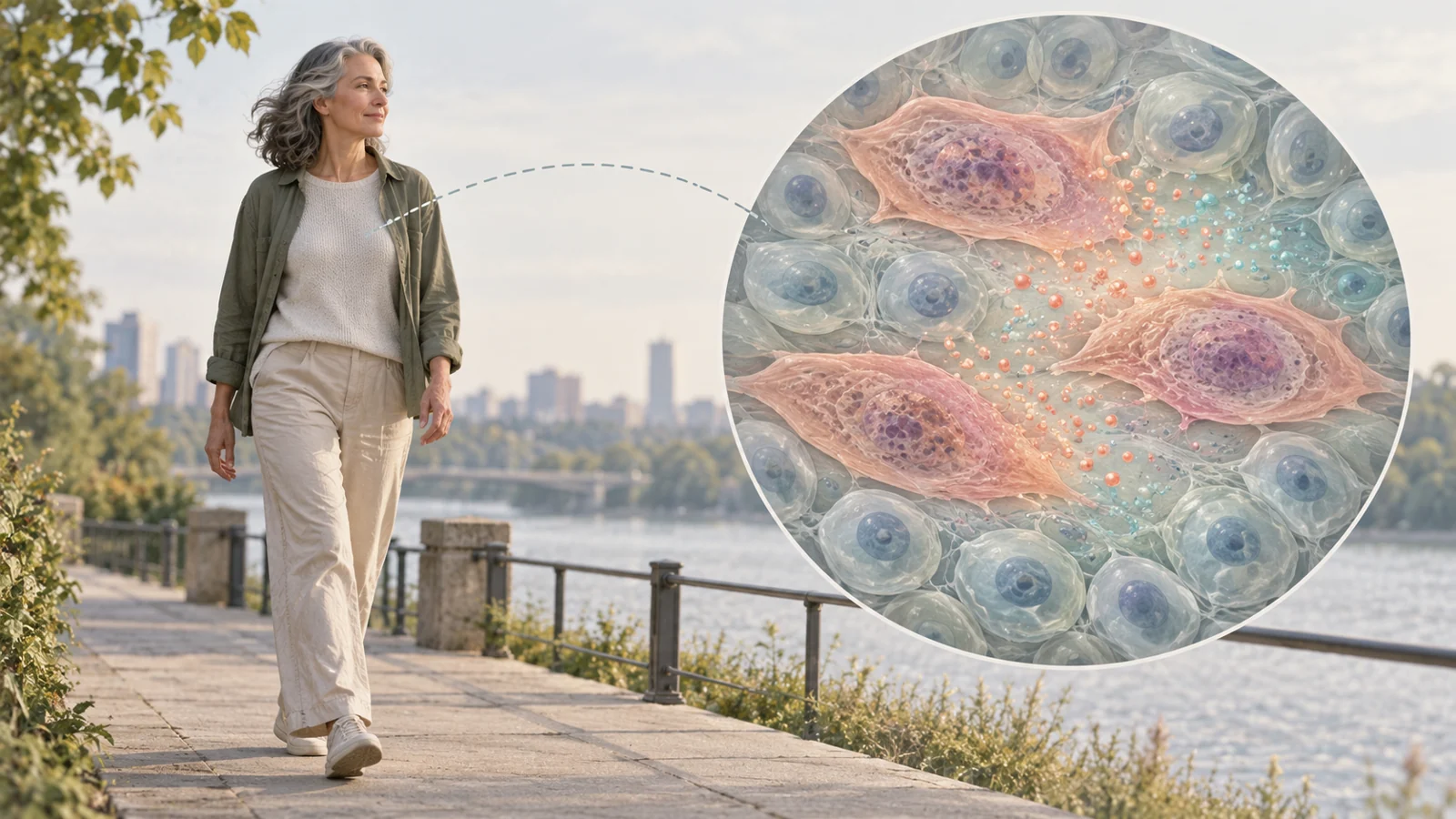
One focus is cellular senescence. A senescent cell has entered a state of permanent proliferative arrest: it no longer divides. That does not necessarily make it harmless. Senescent cells can accumulate in tissues and release a group of inflammatory signals known as the senescence-associated secretory phenotype. These secretions can disrupt tissue and immune function and may create an environment that is more permissive to cancer growth.
The review points to experimental evidence that helps explain the interest. In animal work, transplanting small numbers of senescent cells into young animals induced frailty and age-related disease. This finding provides a biological rationale for studying senescence, but it remains an experimental result in animals rather than a demonstration that removing senescent cells improves outcomes for human cancer survivors.
There are at least two distinct intervention concepts here. A senolytic approach would aim to eliminate senescent cells, potentially through intermittent dosing. Another approach would modify the inflammatory secretions those cells produce without necessarily removing the cells themselves. The difference matters because eliminating a cell population and changing its behavior involve different risks, targets, and measures of success.
The review also discusses broader aging pathways and pharmacologic candidates, while calling for preclinical and clinical research to determine appropriate dosing. Behavioral interventions require the same discipline. Exercise and dietary strategies may influence several aging-related processes, but the useful dose and outcome cannot be assumed from the existence of a biological rationale.
Nutrition has to account for muscle
Dietary restriction is an especially clear example of why cancer survivorship cannot simply borrow an aging intervention unchanged. Nutrition affects cancer risk, progression, and treatment response through pathways that also influence aging. Animal studies have suggested that caloric restriction can delay tumor progression and extend lifespan, and rodent models have explored intermittent fasting and related regimens.
Yet cancer populations may already be vulnerable to sarcopenia, or loss of muscle, and to sarcopenic obesity, in which muscle loss occurs alongside excess body fat. That makes the goal more complicated than reducing calories or changing a metabolic marker. A dietary strategy would need to be studied in relation to treatment tolerance, body composition, strength, and longer-term function. The review identifies this as an area where the benefits and risks of nutrition require specific investigation in cancer settings.
Preclinical work has also suggested that fasting around treatment might reduce toxicity or make some cancer cells more sensitive to therapy. Those findings help explain why diet has entered the research agenda, but they do not establish a fasting regimen suitable for individual survivors. The authors call for studies of diet quality, caloric restriction, fasting-mimicking approaches, and their mechanisms before such strategies can be matched confidently to particular people or treatment contexts.
Exercise presents a related lesson. Preserving muscle mass, supporting vascular remodeling, and protecting cardiovascular function are not identical goals. They may require different intensities, modes, durations, or biological responses. The review therefore frames exercise as an intervention whose dose must be connected to the outcome researchers want to preserve, rather than as a universal prescription for reversing treatment-related aging.
Biomarkers can move sooner than lived outcomes
Frailty, cognitive decline, comorbidities, and survival may take years to accumulate or change. A long trial that waits only for those outcomes could be difficult to conduct and slow to interpret. Researchers are consequently interested in accessible biological measurements that might show whether an intervention is affecting an aging-related process sooner.
The review highlights blood and other readily collected biofluids, including urine or saliva, as useful settings for large observational studies and clinical trials. It discusses DNA methylation and physiology-based measures as possible ways to study biological aging, and notes that some epigenetic changes are plastic. Biomarkers could therefore serve as intermediate endpoints: an earlier indication that a biological process may be shifting while participants continue to be followed for meaningful health outcomes.
That role is narrower than replacing those outcomes. A change in DNA methylation, inflammatory activity, or another aging-related measure would not by itself show that a survivor has retained mobility, experienced less cognitive decline, avoided illness, or lived longer. The review notes that no standard set of aging biomarkers had yet been established for this work. The useful measurement is the one that can be connected convincingly to the functions and health events that matter to survivors.
This is also why the authors call for biomarkers that can identify people at risk of treatment intolerance or accelerated aging-related consequences. A risk marker could help researchers design better trials and more targeted follow-up, but its value would still depend on whether it improves decisions about people rather than simply producing an attractive number.
Care has to fit the person and the setting
A molecular target is only one part of survivorship care. The proposed research agenda includes comprehensive assessments of functional, cognitive, and psychosocial vulnerabilities because those factors shape how an intervention can be used and what benefit would count in everyday life.
The review also identifies integrated cancer care delivery as a research question. That means studying how different aspects of follow-up can work together, how interventions are implemented, and whether survivors and providers can take them up in practice. Education is part of the same effort. Patients need clearer information about late and long-term effects, while clinicians need ways to recognize and address them.
These are not administrative extras attached to a biological discovery. They determine whether a promising intervention reaches the people it was designed to help, whether its burden is manageable, and whether a trial result can translate into ordinary survivorship care. A therapy that changes an aging pathway but cannot be fitted to a survivor’s functional, cognitive, or psychosocial needs would have limited practical value.
What this could change
The practical possibility is survivorship care that treats lasting function as an outcome alongside cancer control. People who have completed treatment could receive follow-up designed to identify aging-related vulnerabilities early, test interventions against meaningful measures, and support mobility, cognitive function, and everyday independence for longer.
That future depends on several links holding together. Behavioral or pharmacologic strategies would need to demonstrate safe, meaningful benefits for cancer survivors, not only plausible effects on aging biology. Biomarkers would need to help identify risk or response without displacing the outcomes people actually experience. Care systems would also need to assess vulnerabilities, educate patients and providers, and deliver interventions in a workable way. The review’s agenda is therefore broader than finding an anti-aging drug: it is an attempt to make healthy survivorship a measurable and deliverable goal.
Key Sources
- Primary source: Strategies to Prevent or Remediate Cancer and Treatment-Related Aging.
DOI or Journal Page · Review or Meta-Analysis · 2021-02-01
Keep exploring