
Research Signal – Source date 2025-01-01
Aging is closely tied to many of the conditions that cause illness and disability, from heart disease and cancer to arthritis and neurodegenerative disease. But age brings more than diagnoses. Physical function can decline, and people may lose the ability to live independently. A review published in 2025 considers whether research into the biology of aging could address several of these problems at once—and what would have to be demonstrated before that promise applies to people.
The idea, known as geroscience, is that some biological mechanisms associated with aging contribute to multiple chronic diseases and to functional decline. If those mechanisms can be changed, an intervention might influence several outcomes together. The review brings together mechanistic arguments, animal research, limited human observations and questions about clinical trials. Each kind of evidence answers a different question; the collection does not establish that an aging intervention has prevented several diseases or preserved independence in people.
Aging reaches beyond diagnoses
The review describes aging as a relatively recent experience at population scale. Nearly half of the gains in median life expectancy have occurred over the last two to three centuries. Longer lives, however, do not automatically mean more years in good health. Disease, frailty and loss of function can accompany added years, shortening the portion of life spent healthy, capable and independent.
This broader view helps explain why geroscience researchers look beyond the presence or absence of a particular disease. Aging involves changes at molecular and cellular levels as well as in organs and the body’s integrated functioning. The review notes that measures of physiology, frailty and resilience can be strong predictors of life expectancy among older adults. Walking speed at age 65, for example, is associated with later survival: a decline of 0.1 meters per second predicts a reduction in life expectancy of about three years for men and three and a half years for women in the studies cited by the review. The relationship is not a simple path to a longer maximum lifespan. The review describes maximum lifespan as relatively fixed so far, while median life expectancy can rise as more people survive to older ages.
That distinction shapes the goal. Extending life without preserving health and function could add years marked by illness or disability. Geroscience instead asks whether the processes associated with aging can be influenced in ways that extend healthy, functional years.
One set of mechanisms, several possible effects
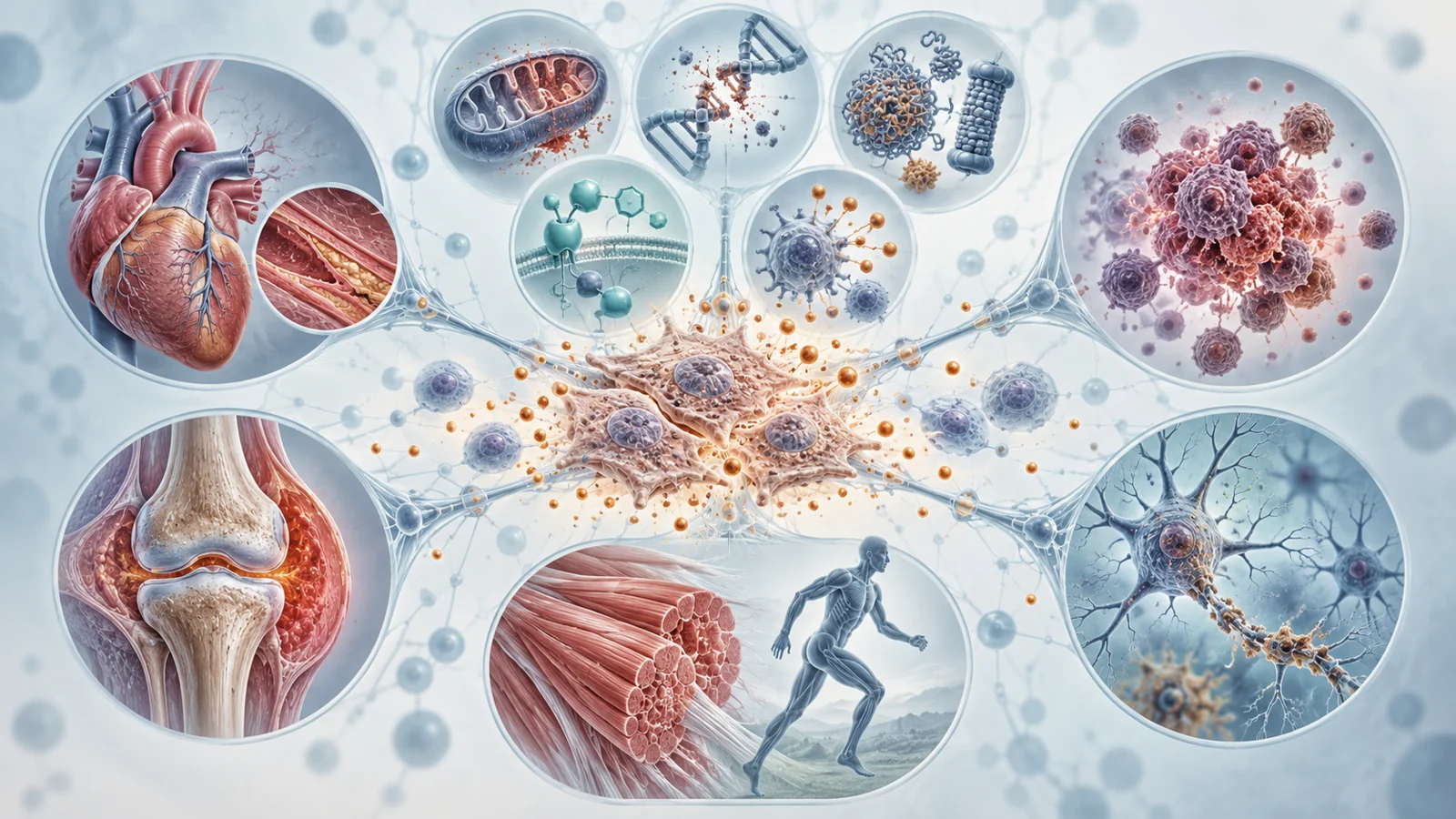
The geroscience hypothesis proposes that some aging-related mechanisms help drive more than one chronic illness, alongside functional decline. The review groups these mechanisms into 12 “hallmarks” or “pillars,” including changes in genomic stability, telomeres, epigenetics, protein maintenance, cellular cleanup, nutrient sensing, mitochondria, senescent cells, stem-cell regeneration, communication between cells, inflammation and the microbiome.
These are pathways associated with aging, not a list of proven treatment targets. The hypothesis is that changing a shared contributor could affect multiple conditions at once, much as one upstream influence can shape several downstream processes. But a pathway may turn out to matter for only one disease, or its effects may differ across conditions and people. Evidence for causal links between these mechanisms and age-related outcomes is becoming more robust, according to the review; that does not settle whether modifying them can produce broad clinical benefits in humans.
The attraction is practical as well as biological. Treating each disease separately may leave common contributors and functional decline untouched. If an intervention could reduce illness burden while preserving function, it might offer benefits beyond managing one diagnosis at a time. The difficult question is whether that possibility can be shown in human studies under real clinical conditions.
Senescent cells offer one example
Cellular senescence illustrates how a proposed shared mechanism might work. Senescent cells have stopped dividing and do not function normally. They can also release inflammatory signals, a pattern called the senescence-associated secretory phenotype. Those signals may impair nearby healthy cells, so the proposed chain is that removing senescent cells could reduce this inflammatory influence and allow surrounding tissue to function better.
In animal models, researchers have cleared these cells through immune-system approaches or reduced their numbers with drugs called senolytics. The review describes improvements in several age-related diseases and in physical and cognitive function in aged animals. This is evidence for the proposed mechanism in those models, not proof that the same intervention will help people. Human use would also need careful attention to toxicity. The review points to early trials as promising in tolerability, while emphasizing that further attention is needed before the approach can be judged as a way to address aging broadly.
A different example comes from calorie restriction. The review reports that two years of 25% calorie restriction corresponded to 2–3% slower aging on some surrogate measures in human studies, but not on others. Those observations show why measuring a biological marker is not the same as demonstrating fewer illnesses, better function or longer healthy life.
The human test is a demanding one
Evidence from shorter-lived animal models can help researchers study survival and health span under controlled conditions. Human trials face a different task. People vary widely, and meaningful effects on longevity could take many years to assess. Participants also receive established care to prevent and treat disease. A geroscience intervention would therefore need to add quality years beyond that standard care.
A useful trial would need outcomes that matter to people, not only a longer lifespan. The review raises disease outcomes, geriatric syndromes and measures of physical function as possible ways to assess health span. Choosing a higher-risk group could make it possible to detect changes in disease, limitation or disability before a lifespan difference becomes measurable. Those choices are part of a broader challenge: aging itself is not classified as a disease, so studying interventions aimed at its pace raises questions about trial design, regulatory oversight and suitable endpoints.
Biomarkers create another hurdle. Proposed biological clocks estimate “biological age” relative to chronological age, but they can vary by organ system and by the pathway being measured. A marker may correlate with age or predict future risk without serving as a validated substitute for a clinical outcome. To use a clock or other marker to select participants or stand in for health outcomes, researchers would need validation showing that it reliably predicts something important to patients. The review describes several blood-based measures as promising but imperfect candidates; none should be read as a direct measure of healthy years gained.
The calorie-restriction observations illustrate the gap. A change in some markers may be scientifically informative, but it does not by itself show that people avoided disease or maintained independence. Human trials have to connect biological changes to outcomes such as illness, disability and function, while comparing results with the care participants would otherwise receive.
Longer lives would reshape public choices
The review also considers what could follow if aging were delayed at a population level. Its fiscal scenario models a 20% decline in the rate of aging over 30 years, from 2020 to 2050, with average life expectancy increasing by 2.2 years. Under those modeled conditions, government spending on Medicare, Medicaid and Social Security rises because more people receive benefits, even as projected health care costs fall. The model finds that a gradual increase in eligibility ages could substantially reduce that spending increase. These are scenario results, not observed future costs or a recommendation to adopt a particular policy.
The broader point is that additional years would affect more than health budgets. Many societies organize life around extended education, decades of work and retirement. If healthy life became longer for many people, the timing and shape of those stages might need to change. How that change should happen is a social choice; the model does not determine the answer.
What healthier years could change
A treatment that preserved function while delaying several age-related illnesses could help more people remain independent for longer. That benefit remains conditional on human evidence showing meaningful gains beyond standard care, across varied people and over follow-up long enough to capture health and function—not just shifts in proposed aging markers. If longer healthy lives became common, health systems, public programs and life-course arrangements would also need to adapt. The science’s promise therefore reaches from cells and clinical outcomes to the institutions that shape how people live longer lives.
Key Sources
- Primary source: HEALTHY AGING: THE PROMISE, AND PERILS, OF GEROSCIENCE.
DOI or Journal Page · Review or Meta-Analysis · 2025-01-01
Keep exploring