
Research Signal – Source date 2026-01-20
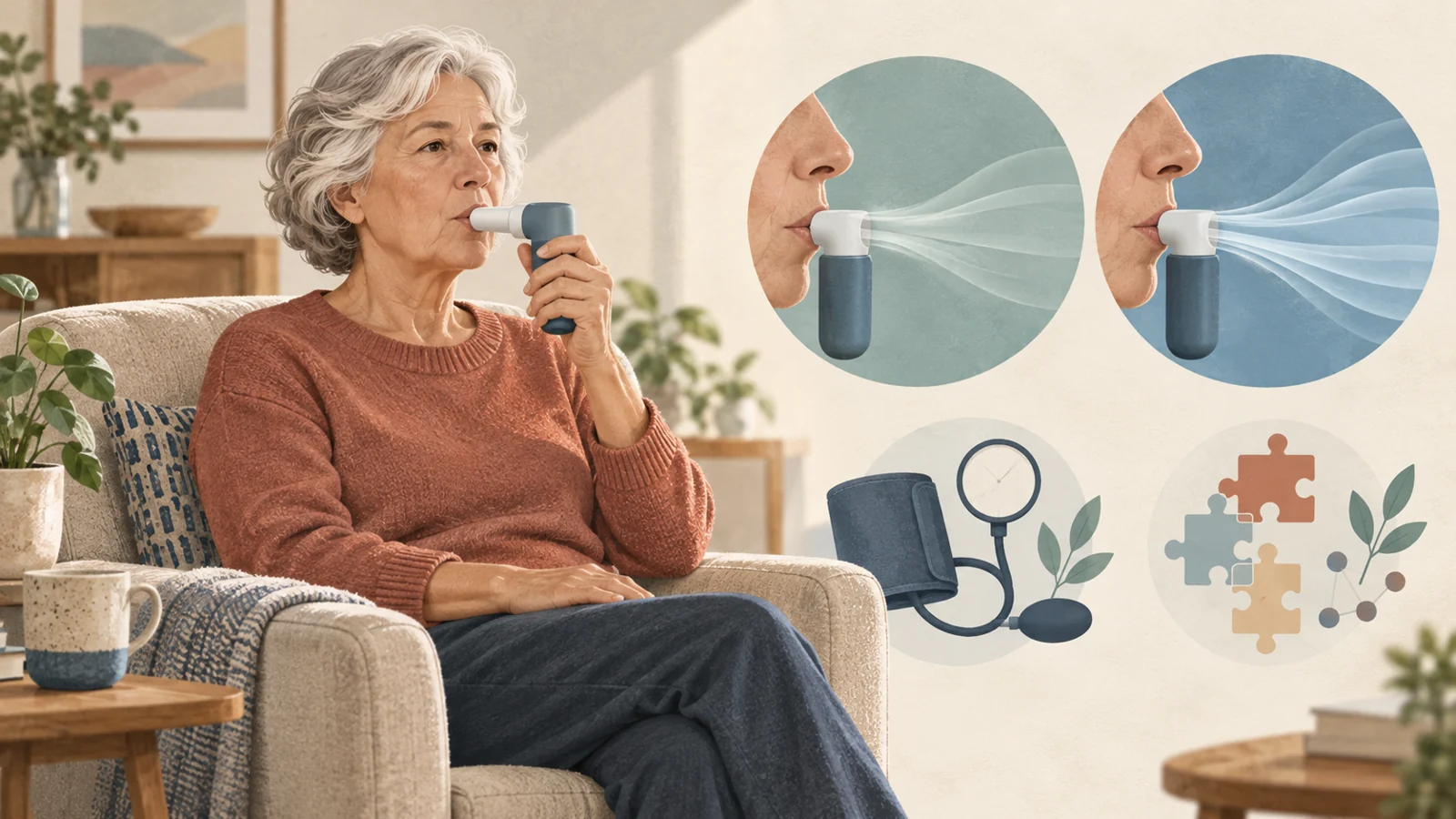
A small randomized trial is testing whether strengthening the muscles used to breathe could influence two markers linked to dementia risk in older adults: blood pressure and cognitive performance. The intervention is called inspiratory muscle strength training, or IMST. It uses a handheld resistance device that makes breathing in more demanding.
The study is aimed at adults aged 60 to 80 with cardiovascular risks for dementia. Its planned enrollment is 30 people. The ClinicalTrials.gov entry dated January 20, 2026 provides the time anchor for this research signal. The current registry record lists an actual start date of November 17, 2025 and recruiting status, along with estimated primary completion in October 2026 and overall completion in December 2026.
Those dates describe the study schedule, not available findings. The record is designed to ask whether an eight-week home routine can produce measurable short-term changes and whether participants can maintain it. It is not yet evidence that the routine prevents dementia.
Why the comparison uses two resistance levels
Participants are randomly assigned to one of two groups. Both groups use the same type of handheld breathing-training device, complete 30 breaths at home each day, and follow the routine for eight weeks. The planned sessions last at least five minutes.
The difference is the resistance applied to each breath. The high-resistance group is assigned a setting equal to 75% of each participant’s maximal inspiratory pressure. The lower-resistance comparison group is assigned 15%. Maximal inspiratory pressure is a measure of how forcefully a person can breathe in, so the settings are individualized rather than being a single identical load for everyone.
This design gives the investigators a comparison that preserves the basic routine while changing its difficulty. A difference between the groups after eight weeks would be easier to interpret than a change observed in people who all received the same training, because the lower-resistance group provides a structured comparator. It still would not show what happens over years or whether the intervention changes the chance of developing dementia.
The trial is therefore testing a specific version of a breathing exercise, not asking participants to diagnose or treat themselves. The device, resistance settings, daily breath count, and monitoring schedule belong to the study protocol.
What eight weeks can measure
The two primary outcomes are assessed at baseline and again after eight weeks. One is systolic blood pressure, measured in millimeters of mercury using the average of two seated readings taken after consecutive five-minute rest periods. The other is executive cognitive functioning, assessed with the Fluid Composite Score from the NIH Toolbox Cognition Battery.
The cognitive measure is broader than the phrase executive function may suggest. The composite draws on tasks involving executive function, attention, working memory, episodic memory, and processing speed. A change in the score would indicate a difference in performance on those assessments between the beginning and end of the intervention. It would not be the same as observing a change in dementia incidence or a durable reduction in cognitive decline.
The secondary measurements widen the picture without turning the protocol into a promise of many benefits. Mood is assessed through measures of depressive and anxiety symptoms. Sleep is assessed through participant reports and objective activity data collected with actigraphy devices. Blood samples are used to measure inflammatory markers including CRP, IL-6, and TNF-α. Physical function is examined through grip strength, gait speed, and a sit-to-stand test.
Together, these measures allow the pilot to examine whether the intervention is associated with changes across several relevant domains. They also create a demanding interpretation problem: with only 30 planned participants and an eight-week follow-up, a result in any one measure would be preliminary and would need confirmation in larger, longer studies.
The unanswered question behind the title
“Dementia risk reduction” describes the prevention question motivating the study, but the registered outcomes are nearer-term indicators. Blood pressure can be measured over eight weeks. Cognitive performance can be compared between two assessment points. Mood, sleep, inflammation, and physical function can also be tracked over that interval.
Dementia prevention is a much larger claim. It would require evidence about whether fewer people develop dementia, whether cognitive decline is delayed or reduced over a meaningful period, and whether any benefit persists after the intervention ends. The current record does not provide those observations. It lists hypotheses about preliminary efficacy, not demonstrated effects.
The supplied record explicitly states that no results have been posted. Estimated enrollment does not tell us how many people have entered the study, completed the training, or contributed analyzable data. The estimated completion dates are scheduling projections rather than completed milestones or dates when results are guaranteed to be available.
That boundary is the central point of the research signal. A favorable change in systolic blood pressure or a cognitive composite would justify further investigation, but it would answer a narrower question than whether IMST reduces dementia risk. A null or inconclusive pilot result would also need careful interpretation because a small feasibility study may be limited in its ability to detect modest differences.
A short routine still has to work at home
The study treats participation as an outcome in its own right. Thirty breaths may fit into a brief daily session, but feasibility depends on whether participants can use the device correctly, return to the routine repeatedly, and tolerate the assigned resistance across eight weeks. Acceptability asks whether the experience is workable and reasonable from the participant’s perspective; it is not interchangeable with a blood-pressure or cognitive result.
Investigators hypothesize that at least 80% of prescribed training sessions will be completed. That threshold is a planned benchmark, not an achieved adherence rate. The record also describes a diverse older-adult sample as an aim of recruitment. A planned sample description is not the same as demonstrated representativeness, and this pilot cannot by itself establish how well the findings would apply to older adults with different health circumstances.
The supplied evidence also does not establish adverse-event rates, affordability, broad accessibility, or effectiveness outside the study population. Those unknowns do not imply that the protocol lacks safety procedures; they mark questions that the registered description does not answer. For a home intervention, sustained use and practical fit will matter alongside any change in a measured outcome.
What home breathing training could offer older adults
A brief home routine that meaningfully improves cardiovascular risk markers while supporting cognitive health could eventually give older adults another practical option to consider alongside established care. Its value would depend on more than a change at the end of eight weeks: benefits would need to be durable, safety would need to be acceptable, and people would need to be able and willing to keep using the approach.
The current trial is an early test of whether that possibility deserves larger, longer evaluation. Its results may clarify how the higher-resistance routine compares with the lower-resistance assignment and whether participants can sustain the schedule. Until those findings are available and independently confirmed, the most accurate conclusion is that IMST is being studied as a possible tool for risk-related health changes, not that it has been shown to prevent dementia.
Key Sources
- Primary source: IMST for Dementia Risk Reduction
Government or Regulator · Clinical Trial · 2026-01-20
Keep exploring