
Research Signal – Source date 2021-06-24
Triple-negative breast cancer can respond strongly to initial chemotherapy and still return later in a more difficult-to-treat form. The puzzle is not simply that some cancer cells survive. It is that treatment may change the surviving cells and their surroundings in ways that help resistant disease emerge.
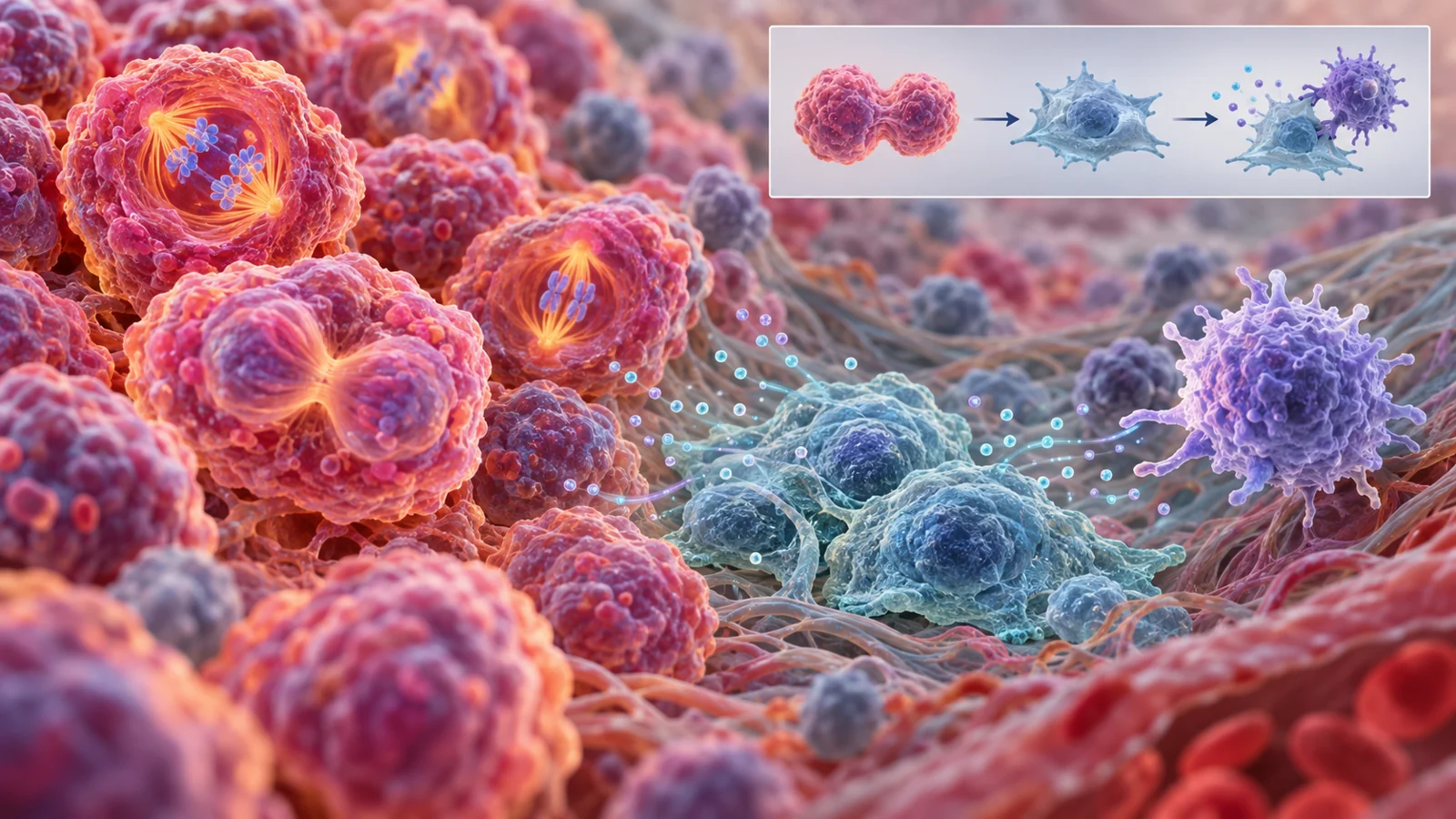
A review published on June 24, 2021, examines one possible contributor: senescence, a stress-associated state in which a cell stops dividing. The review focuses on therapy-induced senescence in triple-negative breast cancer and connects it with experiments testing whether treatment order could matter. Its proposals remain preclinical and evolutionary in nature, but they offer a useful way to think about why killing tumor cells may not be the only relevant treatment goal.
The treatment puzzle in triple-negative breast cancer
Triple-negative breast cancer is defined by the absence of three commonly used treatment markers: the estrogen receptor, the progesterone receptor and amplification or overexpression of the HER2 protein. These tumors are diverse and often have a high rate of cell division, advanced grade or stage, immune-cell infiltration and a tendency toward recurrence or distant spread.
Because the usual receptor-directed options are not available for this group, chemotherapy has traditionally been central to treatment. Anthracyclines and taxanes are commonly used before surgery, while other combinations may be used after surgery. Some patients have a complete pathological response after treatment, particularly in the neoadjuvant setting, yet resistance remains a frequent reason for poor outcomes.
The review does not present senescence as the sole explanation. Rather, it describes therapy-induced senescence as one route by which a treatment-stressed cancer cell may stop proliferating without necessarily being eliminated. That pause can be temporary or more durable depending on the context. The important question is what happens while the cell remains alive and what signals it sends to its neighbors.
Senescence can pause growth without ending the story
Senescent cells are not defined by a single feature. They commonly show increased activity of cell-cycle inhibitors such as p16, p15 and p21, along with persistent signs of DNA-damage response. They may also become unusually resistant to programmed cell death. These features help explain why a cell can appear to have stopped growing while remaining biologically active.
The cells can release a mixture of growth factors, cytokines, chemokines and enzymes that alter the surrounding tissue. Researchers call this collection the senescence-associated secretory phenotype, or SASP. In everyday terms, it is a changing set of chemical messages released by a stressed, growth-arrested cell. Senescent cells can also communicate through small extracellular vesicles carrying proteins, lipids and nucleic acids.
In healthy settings, these signals can help attract immune cells that identify and clear senescent cells. Macrophages, T cells, B cells, natural killer cells and other immune populations may participate in this surveillance. In cancer, however, the same broad process can become more complicated. Senescent cells may persist, and their secretions may influence nearby non-senescent tumor cells and the surrounding microenvironment.
One possible consequence is a shift toward stem-like behavior. Here, “stem-like” refers to a set of properties associated with persistence, adaptability and renewed tumor growth, not proof that an ordinary tumor cell has become a normal stem cell. The review discusses both cell-intrinsic signaling and SASP-driven effects on neighboring cells as possible routes to this change. Some cells may therefore survive treatment in a quiet state while helping create conditions in which more aggressive descendants or neighbors gain an advantage.
What the breast cancer samples showed
The review separates observations in human breast cancer tissue from mechanistic findings in laboratory models. A study of 17 matched pairs of breast cancer biopsies compared samples obtained before and after chemotherapy. The treated samples showed enrichment of signatures associated with cancer stem cells and TGF-beta signaling, a pathway linked in the cited work to breast cancer stem-cell behavior.
That observation matters because it shows that treatment was followed by a measurable shift in the properties represented in the tumor samples. It does not, by itself, show that therapy-induced senescence caused the shift. The review explicitly notes that the biopsy study did not establish a connection between TIS and the enrichment of stem-cell signatures.
Other mechanistic evidence discussed in the review comes from different settings. In models of B-cell lymphoma, chemotherapy-induced senescent populations showed increased stem-cell signatures, activated Wnt signaling and markers associated with stemness. Similar effects were discussed for replicative and other forms of stress-induced senescence. These findings help develop a biological hypothesis, but lymphoma models and other cancer systems cannot independently establish the same mechanism or treatment effect in human triple-negative breast cancer.
For TNBC specifically, the review highlights preclinical work reporting a causal relationship between therapy-induced senescence and the generation of a chemoresistant, stem-like population. The significance of that evidence is its experimental setting: it supports a mechanism in a TNBC model, while still stopping short of demonstrating that the same sequence drives recurrence in patients.
Two-step experiments target the survivors
The most concrete treatment idea in the review is sequential. First, a therapy induces or increases senescence in tumor cells. Later, a second treatment aims to remove the senescent cells. Drugs intended to kill senescent cells are called senolytics.
One example used an immunocompetent mouse model of advanced TNBC. The researchers first used palbociclib to induce a senescent state, then followed it with nano-encapsulated navitoclax, the senolytic component. The review reports tumor-growth inhibition and reduced metastasis in this setting. Because the model was immunocompetent, the experiment also allowed treatment to operate in the presence of an intact immune system, although it remained an animal study rather than a clinical test.
A separate experiment used TNBC cell lines. It paired a senescence-inducing BET-domain inhibitor with navitoclax in a later step and reported inhibition of the cell lines. This result provides a different kind of evidence from the mouse study. Cell-line experiments can reveal how tumor cells respond under controlled conditions, but they do not reproduce the full tumor, immune and tissue environment of an animal or a patient.
The two-step logic is therefore more specific than the broad idea of combining treatments. The first intervention changes the state or composition of the tumor; the second is timed to exploit a vulnerability created by that change. The review presents the approach as a way to reduce the chance that treatment-surviving senescent cells will remain in place and influence the next phase of tumor evolution.
Evolution changes the treatment question
The review also frames resistance as a population problem. Cancer contains varied cell populations with different traits. A highly destructive treatment may remove many sensitive cells while leaving rare cells that tolerate the treatment. Once competitors are eliminated, those resistant cells may face less competition for space and resources. Evolutionary biologists call this changing advantage competitive release.
From this perspective, a treatment can have an unintended population effect even when it kills many cancer cells. The surviving population is not just smaller; its internal balance may have changed. Senescence could be one way cells improve their fitness under treatment pressure, particularly if survival in that state is paired with signals that alter nearby cells.
The authors propose adapting a “first strike, second strike” idea to this problem. In their proposed sequence, an initial treatment would reduce tumor size and diversity. A later intervention could promote immune clearance of senescent cells, followed by treatment aimed at stem-like cancer cells. The intended effect would be to push a smaller and less diverse surviving population toward extinction through several pressures applied in a deliberate order.
This evolutionary proposal is not the same as the two TNBC experiments already described. The mouse and cell-line studies tested particular senescence-inducing and senolytic combinations. The first-strike, second-strike concept adds a broader population-level design involving tumor reduction, immune clearance and targeting of stem-like properties. The review presents treatment order as a hypothesis for changing cellular fitness, not as a demonstrated optimal TNBC regimen.
The practical problem of finding the right cell state
Turning the idea into treatment would require more than identifying a drug that can induce senescence or a compound that can kill some senescent cells. Senescence depends on the type and intensity of stress, so two therapies may produce different cellular states. There is also no single feature that consistently identifies every senescent cell in a clinical sample.
The secretory phenotype adds another layer of variation. The signals released by senescent cells can change over time and differ according to the cell and its surroundings. Some signals may help recruit immune clearance, while others may encourage inflammation, cellular plasticity or stem-like behavior. A test would need to identify the relevant state rather than treat every growth-arrested cell as biologically identical.
Suppressing harmful secreted signals creates its own tradeoff. Reducing SASP activity might limit the effects that support tumor regrowth, but it could also make senescent cells harder for the immune system to recognize and remove. If senescent cells persist, their continued signaling could damage the surrounding environment. Conversely, a systemic therapy that induces senescence outside the tumor could affect non-tumor tissues and contribute to toxicity or other long-term problems.
These issues complicate the choice of patient, treatment intensity and timing. They also explain why senolytics are not automatically the only answer. The review suggests that agents which reshape or suppress harmful senescence-associated signaling, sometimes called senomorphics, could be useful alongside suitable immunotherapy. Whether that approach is better would depend on the specific cellular state and on preserving enough immune activity for clearance.
The review’s evolutionary argument is similarly provisional. It states that the idea of therapy-induced senescence as an evolutionarily fitter cancer strategy still needs stronger theoretical support. Its treatment sequences are informed proposals built from cellular biology, animal work and evolutionary reasoning, rather than clinically validated instructions.
What better treatment sequencing could mean for patients
The potential patient benefit is greater durability: an initial response in triple-negative breast cancer might last longer if treatment could address not only the cells that remain after therapy, but also the signals and properties that help those cells or their neighbors regrow. Achieving that would require successful translation of the preclinical sequences, reliable identification of the relevant senescent or stem-like states, and preservation of useful immune clearance.
From the review’s 2021 perspective, the promise lies in making treatment order part of the biological strategy. A first intervention could reduce the tumor population, a later intervention could remove or restrain treatment-surviving cells, and immune activity could help prevent the altered environment from supporting renewed growth. Whether that sequence can improve outcomes for people with TNBC remains conditional on solving the detection, timing, safety and clinical-testing problems that the review identifies.
Key Sources
- Primary source: Senescence-Induced Chemoresistance in Triple Negative Breast Cancer and Evolution-Based Treatment Strategies.
DOI or Journal Page · Review or Meta-Analysis · 2021-06-24
Keep exploring