
Research Signal – Source date 2025-12-15
Aging brains accumulate more than wear and tear. Cells can become persistently dysfunctional, release inflammatory signals, and alter the environment around them. That raises a deceptively simple question: would it help to remove these cells, or would it be safer to quiet their harmful behavior while leaving them in place?
A review published on December 15, 2025, examines that question through the emerging field of senotherapeutics. The review brings together biological mechanisms, findings from aged animals and Alzheimer’s disease models, human observational associations, and early clinical investigation. It is not a new treatment trial, and its evidence does not yet establish a way to preserve memory or prevent dementia in people. Its value is in clarifying what researchers are trying to target and why the choice of strategy matters in the brain.
Brain senescence is more than cells that stop dividing
Cellular senescence was first understood mainly as a state in which damaged cells permanently stop dividing. That description remains useful in some tissues, but it is too narrow for the central nervous system. Neurons do not normally divide, and brain-supporting cells such as astrocytes and microglia divide slowly or respond differently to injury and stress. The review describes senescent-like states in these cells as well, rather than treating cell-cycle arrest as the only defining feature.
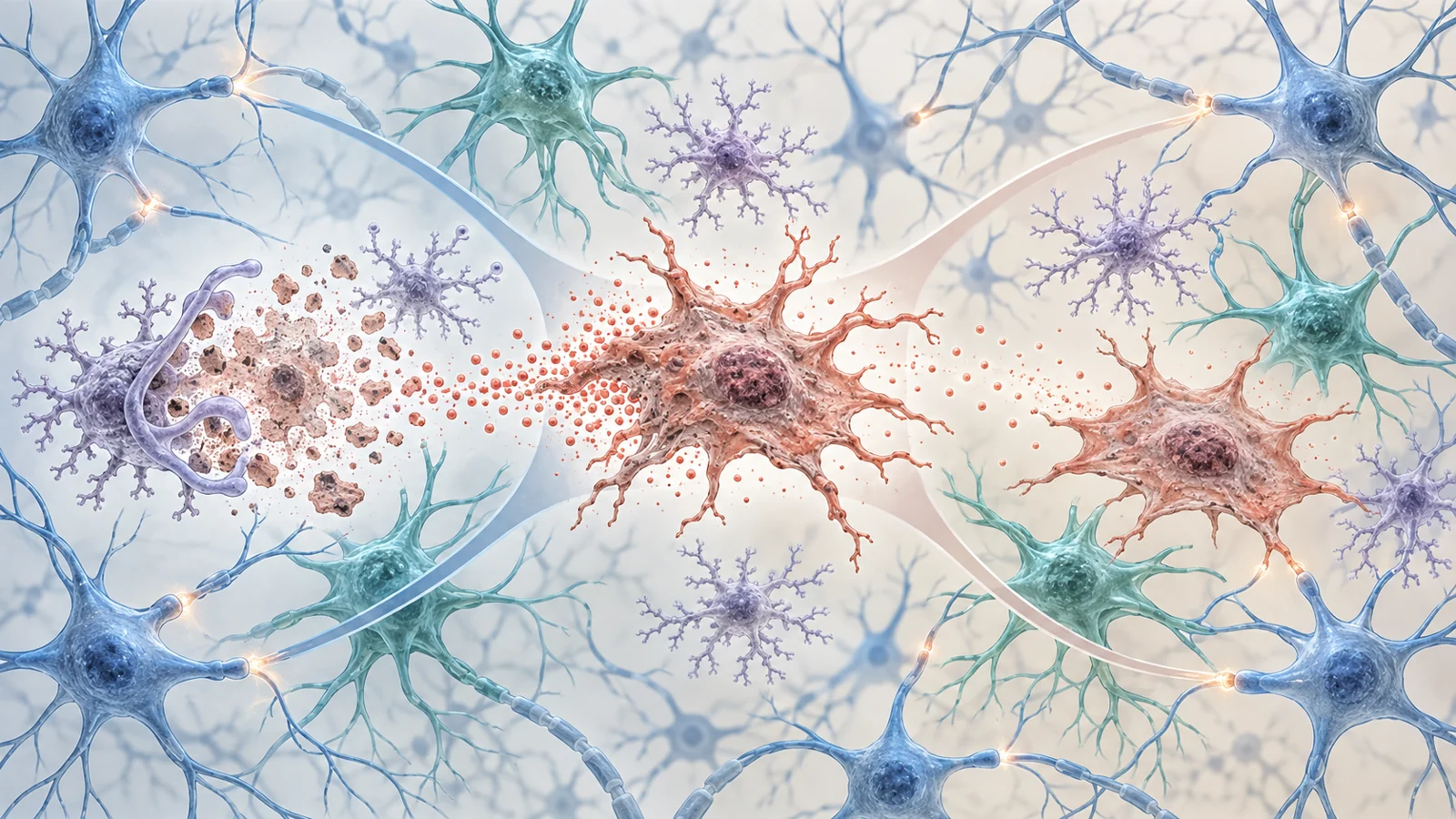
The concern is not simply that one cell has become old. Senescent-like cells can remain metabolically active and release a collection of inflammatory factors, proteases, growth factors, and reactive oxygen species. This secretory pattern is called the senescence-associated secretory phenotype, or SASP. In the aging brain, such signals may sustain neuroinflammation and oxidative stress, changing the conditions in which neurons communicate.
The effects can also spread beyond the original cell. SASP factors and extracellular vesicles may influence nearby healthy cells, creating what the review describes as a bystander effect. A dysfunctional glial cell may therefore matter not only because of its own altered state, but because its signals can disturb neighboring cells and the wider neural environment. Glia are not neurons; they are support and regulatory cells that help maintain that environment. When their behavior changes, the consequences may reach processes involved in synaptic plasticity and cognition without requiring the affected cell itself to be a neuron.
This broader view makes the intervention problem harder. A marker associated with senescence may identify a cell under stress, but it does not automatically reveal whether that cell is harmful, what it is secreting, or whether removing it would disrupt another function.
Two ways to intervene in a difficult tissue
Senolytics are drugs intended to eliminate senescent cells. Senomorphics take a different approach: they suppress or modify harmful secretions without killing the cells that produce them. The distinction is important in the brain because a cell with senescent-like features may also retain functions that support tissue repair, immune surveillance, or the local neural environment.
The review discusses dasatinib plus quercetin as an example of a senolytic combination studied in aged mice. In the account summarized by the review, treatment was associated with fewer senescence markers in brain regions including the hippocampus and prefrontal cortex, lower levels of inflammatory cytokines, and improvements in measures related to synaptic plasticity. The same line of work reported better performance on tests of spatial learning, memory retention, and executive function. These findings make the clearance strategy biologically interesting, but they do not establish that the same combination improves memory in older adults.
Rapamycin illustrates the more preservative logic of a senomorphic approach. The review describes it as an mTOR inhibitor that can promote autophagy, support the clearance of damaged cellular components, and suppress SASP expression in experimental settings. Studies discussed in the review associate long-term treatment with preserved cognitive performance in aged animals and delayed features such as synaptic loss, tau phosphorylation, and gliosis. The compound is therefore presented as an example of changing cellular activity and tissue conditions rather than simply removing a population of cells.
Neither example settles the broader comparison. Removing a damaging influence could reduce inflammation, while suppressing its secretions could preserve a cell that still has useful roles. Conversely, retaining a dysfunctional cell may leave some harmful activity in place. The appropriate balance could differ among neurons, astrocytes, microglia, vascular cells, and other parts of the neurovascular environment. The review does not support ranking senolytics over senomorphics or treating either category as ready for routine brain-aging use.
What the evidence can and cannot compare
The evidence summarized in the review spans several kinds of outcome, and they should not be treated as interchangeable.
In aged mice, the most direct behavioral findings concern performance on memory and learning tasks. The review links dasatinib plus quercetin to improvements in spatial learning, memory retention, and executive-function tests, alongside lower inflammatory markers and changes in synaptic measures such as brain-derived neurotrophic factor and long-term potentiation. These results suggest that cellular and inflammatory changes can coincide with better performance in an animal model.
Alzheimer’s disease mouse models address a different question. In those experiments, the review describes reductions in amyloid-beta plaques and hyperphosphorylated tau aggregates after senolytic treatment. Such molecular and pathological changes may help researchers investigate whether inflammation and cellular dysfunction contribute to protein accumulation. They are not the same as demonstrating a meaningful improvement in a person’s daily memory, reasoning, or independence.
The review also discusses metformin, a senomorphic with effects involving energy-sensing and inflammatory pathways. In aging rodents, it has been associated with cognitive preservation. In human observational research summarized by the review, metformin use has been associated with a lower incidence of dementia. An observational association can help motivate further investigation, but it does not by itself show that metformin’s senomorphic action caused the difference or that it would benefit every older person.
Early clinical studies represent another stage altogether. The review describes investigations of compounds including dasatinib plus quercetin and navitoclax in older adults and in people with mild cognitive impairment or early Alzheimer’s disease. Their stated aims include examining safety, pharmacokinetics, preliminary efficacy, and biomarker responses. Measures under consideration include plasma neurofilament light chain, glial fibrillary acidic protein, inflammatory cytokines, and cognitive test scores.
A cognitive test in a mouse, a change in a brain-related protein marker, an observational pattern in people, and a sustained clinical benefit are different endpoints. The first three may help determine whether a biological hypothesis deserves more testing. None, alone, establishes that senotherapeutics preserve human memory over the long term.
The translation problem starts before a memory test
For a senotherapeutic to affect an aging brain, enough of the active treatment must reach the relevant cells without causing unacceptable effects elsewhere. The blood–brain barrier makes that difficult. The review notes that many senolytics have limited central nervous system bioavailability, prompting research into lipid-based nanoparticles, polymeric carriers, and prodrug formulations. These are delivery strategies under development, not evidence that successful brain targeting has already been achieved.
Even exposure is not enough if researchers cannot identify the right target. Senescence is heterogeneous across neurons, astrocytes, microglia, oligodendrocyte progenitors, and vascular endothelial cells. Different cell types may show different secretory patterns, metabolic states, and responses to stress. A treatment that acts broadly could miss the most relevant population, affect healthy cells, or interfere with functions that are useful in a particular context.
Reliable biomarkers are therefore central to the field. The review points to circulating SASP proteins, exosomal microRNAs, imaging tracers, and genomic profiling as possible tools for identifying senescence, selecting patients, and monitoring response. The challenge is to determine whether a measurable signal reflects a harmful senescent-like state, whether it changes because treatment reached the intended cells, and whether that change predicts better cognition rather than merely a different laboratory value.
Long-term safety remains unresolved as well. Senescent cells can have context-dependent roles in wound healing, tissue remodeling, and immune modulation. The neurovascular unit is one setting in which indiscriminate clearance could create problems. For that reason, the review discusses intermittent dosing, tissue-targeted senolytics, and combinations with senomorphics as possible ways to limit risk. These ideas describe research directions, not established safeguards for older adults.
What targeting senescent cells could mean for memory in later life
The potential benefit is concrete: a treatment might eventually help preserve memory and thinking by reducing a cellular contributor to neural dysfunction. That possibility depends on several links holding together at once. Researchers would need to identify which senescent-like cells or signals are harmful, deliver an intervention effectively into the brain, change the relevant biology without disrupting useful functions, and demonstrate sustained cognitive benefit in people with acceptable safety.
The December 2025 review presents senotherapeutics as a promising avenue, not as a completed solution. Its animal findings provide reasons to investigate both cell clearance and secretion control. Its discussion of early clinical research shows how the field is beginning to test feasibility and biological response. Whether either approach can protect cognitive health in later life remains a question for carefully designed human studies.
Key Sources
- Primary source: Senotherapeutics for Brain Aging Management.
DOI or Journal Page · Review or Meta-Analysis · 2025-12-15
Keep exploring