
Research Signal – Source date 2021-02-03
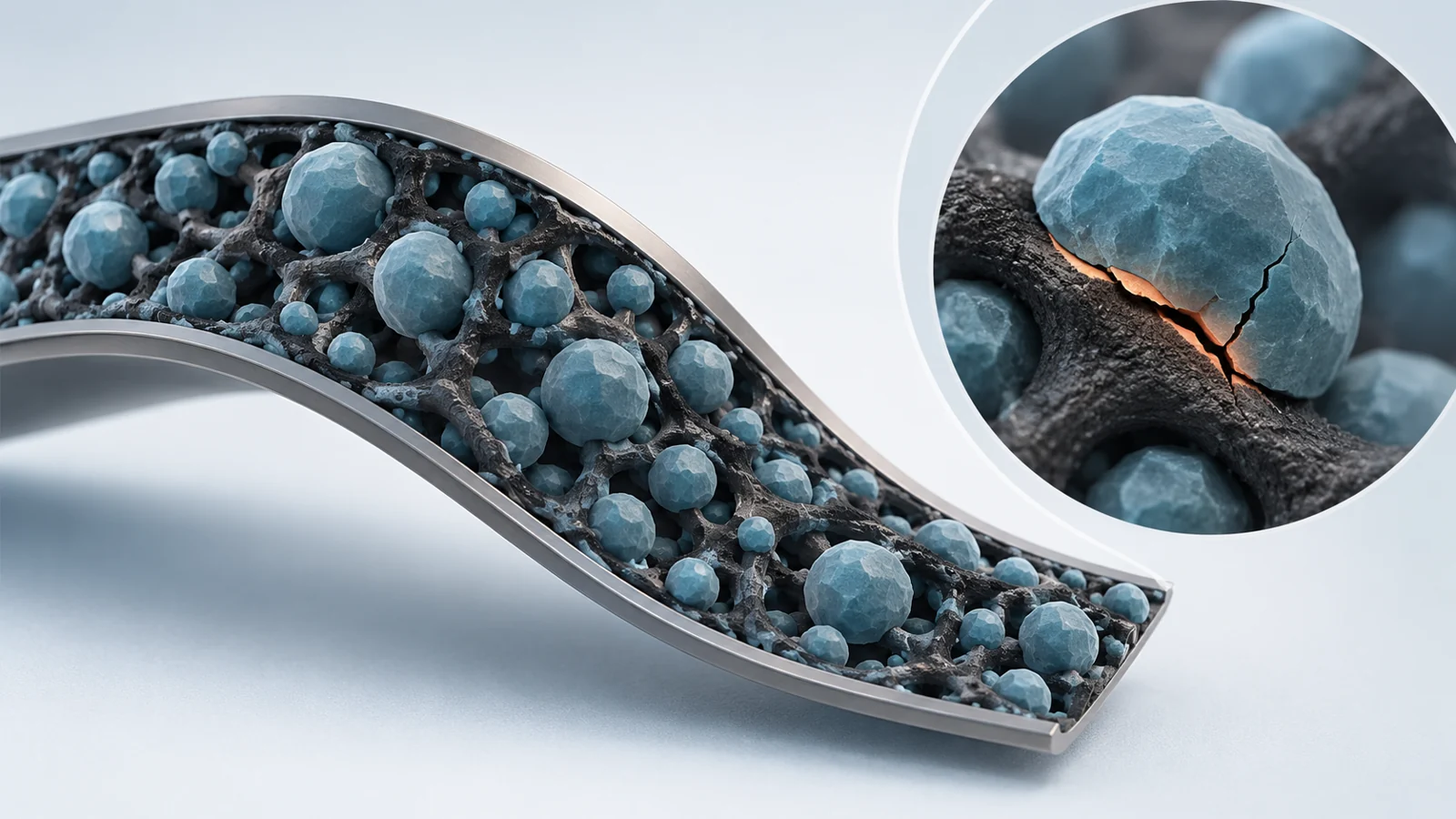
A metal-supported battery electrode can look stronger at first: in a review of earlier flexible lithium-ion battery research, metal-based designs had a higher average initial capacity than the carbon-based groups the authors compared. Yet the review describes carbon-based electrodes as more consistent over repeated cycling, while bending can crack supports or loosen the materials that store charge. For a battery expected to flex, a strong first reading is only part of the story.
The comparison comes from a review published on February 3, 2021, which gathered results from different laboratory studies. Its averages are useful for seeing broad patterns, but they are not the outcome of a new, controlled experiment that tested carbon and metal electrodes side by side. Understanding why the early numbers and the durability picture can point in different directions starts with the two jobs inside an electrode.
The support and the charge-storing material must stay connected
An electrode combines material that stores and releases lithium with a conductive structure that carries electrons through the electrode and connects it to the battery’s outer circuit. The charge-storing material is often called the active material. The conductive support gives that material a pathway for electrons and, in a flexible design, helps the electrode withstand bending.
Those parts have to remain in contact as the battery is charged, discharged and flexed. Cracks in the conductive structure can interrupt pathways. If active material peels away from its support, some of it may lose electrical contact. The review also describes corrosion of metal current collectors as a possible source of rising resistance and structural damage. These failures can undermine an electrode even when its material looked promising in an early capacity measurement.
Carbon materials and metals offer different starting advantages. Carbon structures can provide a large surface area and a stable, lightweight framework; metals conduct electricity well. But neither property alone guarantees a useful flexible electrode. The support also needs to hold the active material securely, tolerate repeated deformation, and leave room for ions to move through the electrode.
Two ways to keep pathways open
One carbon-based approach is to build a porous, interconnected framework. A three-dimensional network can give electrons connected routes through the electrode while its open spaces help preserve the structure under stress. The review describes a carbon nanotube and graphene hybrid foam whose resistance increased only negligibly after repeated flexing. It also discusses porous carbon films and foams as ways to improve mechanical strength and maintain conductivity.
Metal supports can also be shaped into open structures rather than used as a flat, solid layer. Meshes and fibril mats create a network that can carry electrons while providing space for electrolyte movement and surfaces for active material to attach. A reviewed example used a stainless-steel fibril mat to support a silicon anode. The researchers also assembled a flexible full cell from the electrode: it retained 86% of its capacity at a reported current density of 1000 mA g−1 after 150 bends.
That result shows what one laboratory design achieved under its stated conditions. It does not tell us how every metal mesh would perform, or whether that cell could meet the combined needs of a practical device. The review presents structured carbon and metal supports as design strategies, not as a settled contest between two kinds of material.
The averages capture a pattern, not a race
Across the studies it compiled, the review calculated simple average initial capacities for several carbon-based electrode groups and one metal-based group. The metal group averaged 1610.25 mA h g−1; this unit expresses charge capacity per gram of material. The carbon group averages ranged from 825.55 mA h g−1 for graphene to 1235.97 mA h g−1 for carbon-fiber-textile-supported electrodes. The groups were tested at different average current densities: about 284 mA g−1 for the metal group, compared with roughly 155 to 803 mA g−1 across the carbon groups.
Current density describes the test’s charge or discharge rate relative to the electrode’s mass. Since these rates differed, the capacities are not a like-for-like ranking. The averages also combine distinct electrode structures and studies, so they summarize a varied body of laboratory work rather than the outcome expected from a single standardized test.
The review’s later-cycle figures add another part of the picture. It reports average capacity retention of about 71.4% for the metal-based group after an average of 1010 electrochemical cycles. The carbon groups ranged from 51.65% to 77.95% retention, with average cycle counts ranging from about 255 to 537. These figures should not be read as a direct durability comparison: the groups had different test currents, cycle counts and underlying studies. The authors describe carbon-based electrodes as more consistent in performance, while metal-based electrodes tended to start higher and then lose more performance over cycling.
The metal averages are especially sensitive to a few exceptional reported results. In the review’s calculations, removing a reported 5000-cycle result reduced the group’s average cycle life to 345. Excluding a reported capacity of 3441.9 mA h g−1 lowered its average capacity to 767.8 mA h g−1. With relatively few metal-based investigations available for the comparison, those standout values can shift the averages substantially. The numbers help describe the field, but they cannot establish which material would be better in a matched device test.
A bend is not one measurement
Bending angle, end-to-end distance and bend radius describe different aspects of how an electrode is flexed. The angle records how far its moving end turns; the end-to-end distance measures the gap between its ends when bent; and the bend radius describes the curve itself. For a long electrode, angle or end-to-end distance alone may not fully represent the bend’s shape or the stress on its material.
Researchers have used different ways to determine bend radius, including wrapping an electrode around a cylinder of known diameter. The review explains that evaluation methods remain unsettled and that there is no established standard flexion limit for these electrodes. A capacity result after bending therefore needs its test conditions to be meaningful. Without common measures and protocols, results from different studies can be hard to compare even when both use the word “flexible.”
From a workable sample to a useful battery
The review describes manufacturing as a major hurdle alongside electrochemical and mechanical performance. Some carbon-fiber-textile supports offer flexibility but can be heavy: the review notes reported values above 10 mg cm−2, compared with around 0.7 mg cm−2 for copper foil. Carbon-fiber textiles can also involve costly production, make it difficult to load a desired amount of active material and bond poorly with that material. The authors discuss lower-cost coating methods and changes to fiber structure or surface as possible ways to address these issues.
Carbon coatings and foams bring other tradeoffs. The review identifies concerns including limited flexibility, low volumetric or specific capacity, restricted ion movement and greater electrolyte consumption. Metal supports can be heavy, corrode during long-term cycling, or develop cracks in stressed regions. A support that performs well in a small laboratory electrode still has to fit a process that can produce lightweight batteries with adequate active-material loading at a viable cost.
The review’s central engineering problem is therefore broader than maximizing an early capacity figure. The support must carry electrons, keep active material attached and preserve useful structure through both electrochemical cycling and mechanical flexion. Improving one property can leave another unresolved, and the review describes production complexity as part of the challenge rather than a separate afterthought.
What bendable batteries could power
Reliable, lightweight power built into wearable or foldable electronics could become more practical if flexible electrodes keep useful capacity through repeated bending and battery cycling. The reviewed work points to porous carbon networks and structured metal supports as routes toward maintaining electrical pathways, while also showing that production cost, weight and material attachment still matter. From the review’s 2021 perspective, those advances offered a possible path to flexible batteries; whether they could deliver durable performance in a useful device at viable cost remained an open engineering challenge.
Key Sources
- Primary source: Review on carbonaceous materials and metal composites in deformable electrodes for flexible lithium-ion batteries.
DOI or Journal Page · Review or Meta-Analysis · 2021-02-03
Keep exploring