
Research Signal – Source date 2025-04-23
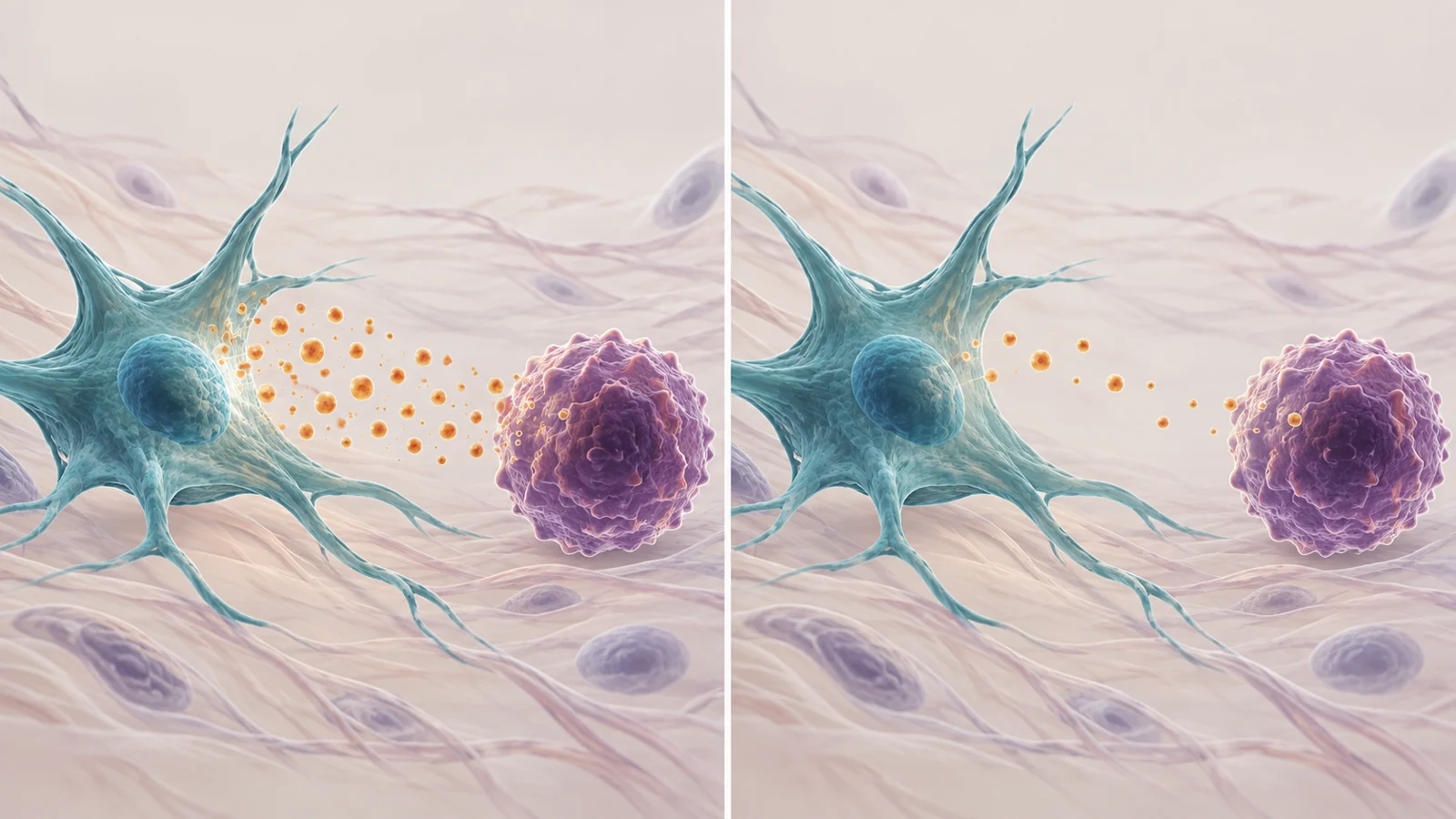
A cancer treatment can change more than the cancer cells it is meant to attack. Supporting cells around a tumor can also sustain damage, stop dividing and release substances that help nearby cancer cells withstand treatment. A study published on April 23, 2025, investigates whether interfering with those secretions could make chemotherapy more effective.
The researchers identified apigenin, a plant compound in the flavonoid family, through a screen of 66 natural products. In cultured human supporting cells, it reduced many of the secreted factors associated with cellular senescence—the state in which stressed cells stop dividing but remain biologically active. Measures of growth arrest and senescence staining stayed largely unchanged. The distinction matters: these experiments showed altered activity in cells that remained in place, rather than their removal or a return to cell division. Researchers call this kind of effect senomorphic.
The study then connected that cellular effect to two different experimental outcomes. Apigenin improved the response to chemotherapy in a mouse model containing human prostate cancer cells and supporting tissue cells. In a separate experiment, it partially improved physical performance and changed memory- and anxiety-related behavior in mice exposed to whole-body irradiation. Together, the experiments ask how the behavior of damaged cells affects their surroundings, from neighboring tumor cells to functions measured in an animal.
Following the effect to an enzyme
The initial screen used human prostate stromal cells, a type of supporting cell. The researchers induced senescence with bleomycin, a drug that damages DNA, and assessed the cells eight to ten days later. Alongside tests of cell survival, they looked for compounds that reduced the cells’ secretory activity.
This collection of secretions is called the senescence-associated secretory phenotype, or SASP. It includes inflammatory signals, growth factors and proteins that can alter surrounding tissue. Analysis of the fluid from apigenin-treated cultures showed reductions in a broad subset of these substances, including the inflammatory factors IL-6 and CXCL8. The effect did not cover the entire secretory spectrum, suggesting that additional signaling routes remained active.
To investigate how apigenin produced this change, the team focused on peroxiredoxin 6, or PRDX6, an enzyme involved in cellular redox chemistry. Several kinds of experiment supported its involvement. Binding assays detected an interaction between apigenin and PRDX6, while protein-stability tests supplied further evidence that the compound engaged the protein. Enzyme assays then showed reduced activity in PRDX6’s phospholipase function, which acts on lipids.
Binding alone would not establish that this enzyme explained the change in secretions. The researchers therefore tested the connection in other ways. A separate inhibitor of PRDX6’s phospholipase activity also reduced characteristic SASP factors. Depleting PRDX6 in the stromal cells weakened the development of those factors, and adding apigenin afterward did not further reduce the selected factors measured. That result supports PRDX6 as a functional part of the response, beyond a protein that happens to bind the compound.
The proposed mechanism also involves HSPA8, a protein involved in cellular stress responses. Apigenin weakened its interactions with ATM and p38MAPK, signaling proteins implicated in the development of the secretory phenotype. These findings suggest that disrupted HSPA8 interactions contribute to apigenin’s suppression of the secretory phenotype. The experiments support that mechanism without establishing PRDX6 as apigenin’s only target or the exclusive explanation for every animal outcome.
How supporting cells passed resistance to cancer cells
The next experiments made the relationship between neighboring cells unusually tangible. The researchers collected the liquid in which stromal cells had been growing and transferred it to prostate cancer cells. This “conditioned medium” carried substances released by the supporting cells, allowing the team to examine their effects without requiring the two cell types to touch.
Medium from senescent stromal cells increased proliferation, migration and invasion in the tested prostate cancer cell lines. It also helped cancer cells survive chemotherapy exposure. When the supporting cells had received apigenin, these cancer-promoting effects were reduced, and measures of cancer-cell death increased during chemotherapy treatment.
The resistance experiments included mitoxantrone and a separate test using docetaxel. Their significance lies in the direction of the interaction: damaged supporting cells supplied something that changed how cancer cells responded to a drug, and treatment of those supporting cells weakened that influence. This helps explain why an intervention directed at a tumor’s surroundings might matter even when it is not an effective cancer treatment on its own.
Chemotherapy first, apigenin afterward
For the tumor experiments, the team implanted mixtures of human prostate cancer cells and human stromal cells beneath the skin of immunodeficient mice. This arrangement let them study human cell interactions inside a living animal, although it does not reproduce an intact human immune system or a tumor growing in its original organ.
The treatment sequence was deliberate. After allowing two weeks for the implants to become established, the researchers administered mitoxantrone at the beginning of weeks three, five and seven. Apigenin followed seven days after each chemotherapy administration. Tumor volumes were evaluated at the end of the eight-week regimen.
Apigenin alone produced no significant benefit in this regimen. Mitoxantrone alone reduced tumor volume by 57.8% relative to the placebo group. The sequence combining mitoxantrone with apigenin produced a 74.9% reduction relative to placebo. Those percentages describe the tumor-volume comparison at the experimental endpoint; they are not percentages of mice cured or estimates of improved survival.
The tissue measurements connected the treatment result with the cell-culture findings. Chemotherapy increased senescence markers and characteristic secreted factors in the stromal component of the tumors. The combined regimen reduced SASP expression, consistent with the proposed action on chemotherapy-damaged supporting tissue.
A separate comparison helped define where that explanation applied. In tumors made only from prostate cancer cells, apigenin did not produce a significant tumor-regression benefit. The response associated with the mixed tumors therefore depended on an experimental setting that included stromal cells. This makes the surrounding tissue a consequential part of the result and limits any interpretation that apigenin simply improved chemotherapy against all cancer cells.
The tumor work supplies a specific preclinical case for a timed combination treatment. It does not establish effectiveness across cancers, superiority over other senescence-targeting approaches or a survival benefit for patients.
A separate test of physical and behavioral function
The study’s aging-related experiments addressed a different question. Instead of carrying human tumor implants, these mice underwent a sublethal dose of whole-body irradiation to induce tissue damage and a premature aging-like state. The researchers then compared apigenin treatment with a vehicle control.
Irradiated animals performed worse on tests of grip strength, hanging endurance, time on a rotating rod and balance crossing. These tasks capture different aspects of strength, endurance and coordinated movement. Apigenin partially, but significantly, improved performance on each measure compared with the irradiated control group. The partial recovery is more informative than a general claim that the animals became “younger”: it identifies particular functions that changed under a defined injury condition.
Behavioral results added another layer. Performance in a Y-maze test was interpreted as improved short-term memory. In an open-field test, treated animals spent more time exploring the center of the arena, a result the authors interpreted as reduced anxiety-related behavior. These are observations of how mice performed and explored in specific tests, rather than direct measurements of human memory disorders or subjective anxiety.
The irradiation model offers a way to test whether an intervention can alleviate consequences of experimentally induced damage. Its results do not establish reversal of normal aging, prevention of human dementia or extension of lifespan. Nor should the functional improvements be treated as another validation of the tumor result: the two experiments test different biological consequences in different settings.
Experimental exposure is not dietary exposure
The largest practical gap is between controlled treatment in these experiments and an intervention that could work reliably in people. In the cell studies, the researchers tested apigenin at concentrations from 1 to 10 micromolar and identified 10 micromolar as the lowest effective concentration for the senomorphic activity they assessed. In the mouse tumor regimen, apigenin was administered by injection into the abdominal cavity.
Those conditions cannot be translated directly into eating apigenin-containing foods or taking an oral supplement. A human treatment would need to deliver an effective exposure to the relevant tissue for an appropriate duration. The compound’s plant origin does not establish that a dietary amount, supplement formulation or dosing schedule would reproduce the experimental effects. The study does not establish a usable human regimen or a benefit from adding a supplement to cancer treatment.
Safety observations also have a defined reach. In the irradiation experiments, selected blood counts and serum measurements did not show obvious additional abnormalities attributable to apigenin. The measured biochemical indicators included markers used to assess liver and kidney function. These findings offer tolerability information for the tested animals and conditions; they do not establish comprehensive long-term safety, human safety or the safety of other treatment combinations.
The study links molecular binding, enzyme activity, altered secretions and animal outcomes through several complementary approaches. All remain parts of one preclinical investigation. The unresolved translation is whether the relevant supporting-cell response can be identified and altered safely in human tumors, with exposure and timing that preserve a useful chemotherapy effect.
What this could change
If that translation succeeds, the concrete opportunity would be an adjunct treatment aimed at supporting tissue damaged by chemotherapy. Patients whose tumors receive resistance-promoting signals from that tissue could potentially benefit from a regimen that makes residual cancer cells more responsive to subsequent treatment. The sequence tested here gives the idea a practical shape: chemotherapy acts first, followed by an intervention intended to reduce a tissue response that can protect surviving tumor cells.
Such an approach would make the tumor’s response to treatment partly a question of how its neighbors respond as well. Establishing an effective human formulation, appropriate timing and a way to identify tumors with the relevant stromal behavior could turn this experimental relationship into a more selective combination strategy. Apigenin’s value in this study is that it provides a compound and a proposed enzyme target with which to pursue that possibility.
Key Sources
- Primary source: Targeting Senescence with Apigenin Improves Chemotherapeutic Efficacy and Ameliorates Age-Related Conditions in Mice.
DOI or Journal Page · Peer-Reviewed Paper · 2025-04-23
Keep exploring