
Evidence date · 2025-12-01 · Research note 2 of 2
1 2
See current Track status →
Since the previous research note · Earlier expectation not tested
Track continuity
Since the previous research note: A proposed neck operation puts Alzheimer’s drainage theory to a human test
Previous expectation: Controlled studies might show whether a drainage operation improves cognition or daily function compared with other care and whether altered drainage explains any benefit.
What this study adds: The 2025 review brings together a 26-person uncontrolled cohort, case reports and proposed clinical studies, adding short-term observations and a clearer account of which drainage bottleneck surgery could reach. It supplies no controlled comparison that tests the earlier conditional forecast.
What changed in this study
A small number of people with Alzheimer’s disease have shown changes in cognition or brain imaging after surgery that reroutes lymphatic drainage in the neck. Those reports have prompted a striking question: could an operation outside the brain affect a disease unfolding inside it?
A 2025 review brings together a 26-person prospective study and several case reports to examine that possibility. The observations offer reasons to study the approach, but they do not show whether surgery helps patients compared with other care. Understanding the gap between a postoperative change and a treatment benefit starts with the drainage route the operation is intended to affect.
A proposed route from brain tissue to the neck
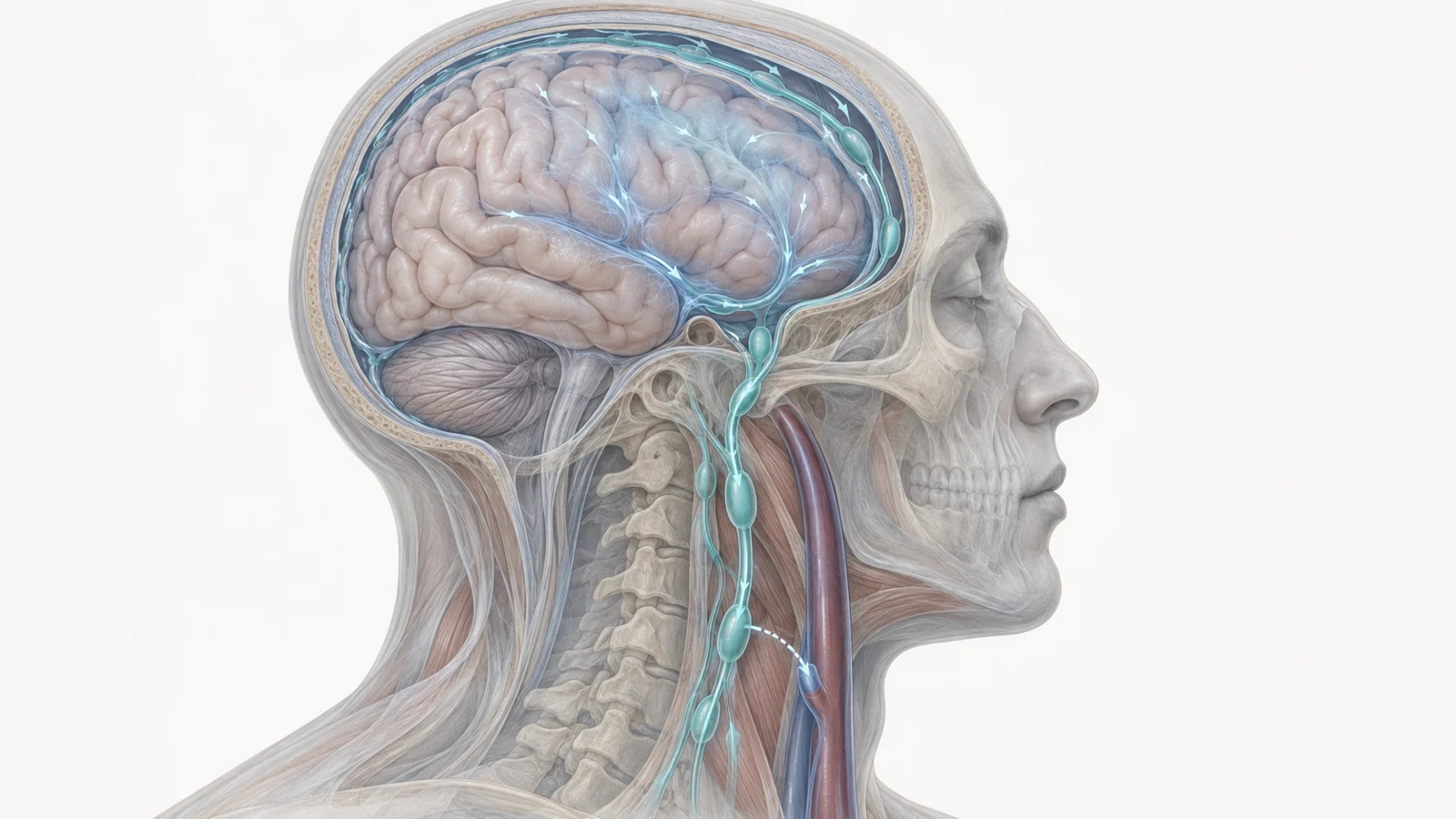
The brain has pathways that move fluid and waste toward the body’s lymphatic system. In the account summarized by the review, cerebrospinal fluid (CSF) enters brain tissue along spaces around arteries, mixes with interstitial fluid, and carries waste toward spaces around veins. The brain’s meningeal lymphatic vessels, located in the dura surrounding the brain, provide another part of the route. Fluid can drain from these vessels and through pathways alongside cranial nerves toward lymphatic channels in the neck. Deep cervical lymph nodes are among the destinations.
The proposed operation, deep cervical lymphaticovenous anastomosis (dcLVA), joins deep cervical lymphatic channels to nearby veins. In the reviewed approach, the connection is made with very small vessels in the neck. The idea is to give lymphatic fluid an alternative outflow route where the cervical drainage chain meets the venous system. If that point is restricting drainage, bypassing it might help fluid leave the neck lymphatic channels.
That is a specific mechanical proposal, not a way to repair every part of the brain’s waste-clearance system. For a neck connection to make a difference, fluid must still reach the neck through the upstream routes, and the restriction must be at a point the surgery can reach. If the main problem lies earlier in the meningeal or brain-tissue pathways, a connection in the neck may not address it. The review notes that clear diagnostic criteria for identifying a surgically reachable drainage problem are not yet established.
The cohort’s first-month picture was mixed
The review describes one single-center prospective study involving 26 people who met clinical and biomarker criteria for Alzheimer’s disease. The procedure was a modified form of deep cervical lymphaticovenous surgery, using a lymphatic flap joined to a vein. The principal outcomes summarized were assessed one month after surgery.
Caregivers reported some degree of overall symptom improvement for about 60% of participants. On the Mini-Mental State Examination (MMSE), the study reported a median increase of about three points, with an interquartile range of zero to six; the change was statistically significant. At the group level, the Montreal Cognitive Assessment (MoCA) and Neuropsychiatric Inventory (NPI) did not show statistically significant changes. The review notes that 15% of participants had higher MoCA scores and 42% had lower NPI scores.
CSF measurements, including amyloid beta and tau markers, showed overall downward trends, but none of those changes reached statistical significance. These measures therefore did not provide a statistically significant group-level biomarker change alongside the MMSE result. The different findings matter: a change on one cognitive scale, caregiver observations, other cognitive or behavioral measures, and CSF biomarkers are not interchangeable evidence of improvement.
The reported perioperative experience was also limited in what it could answer. The cohort had no severe surgery-related adverse events reported in the review; two participants experienced difficulty raising a shoulder, which gradually resolved during follow-up. This is useful early information about the operation as performed in that group. It is not enough to establish how safe the procedure is over longer periods or in a broader range of patients.
Individual case reports add detail, but they answer a different question from a group study. One report described a patient with improvements on clinical scales alongside changes in brain glucose-metabolism imaging and a lower tau PET signal five weeks after surgery. Other reports described changes in amyloid PET measurements and everyday abilities, or a higher MMSE score at follow-up. Such before-and-after observations can show what was measured in an individual and when. They cannot establish what would have happened to that person without the operation, and their results should not be combined with the cohort as though they were one study.
Why the early changes cannot yet show a treatment effect
The key limitation is the lack of a comparison group. When a score changes after surgery, the change alone cannot show that surgery caused it. Without a comparable group receiving other care, researchers cannot separate a treatment effect from other explanations, including ordinary variation in test performance, changes over time, or who was selected for surgery. The evidence summarized by the review does not provide a controlled estimate of how patients fare with the operation compared with other care.
Time also matters. The cohort’s main observations were at one month, while only a small number of individual reports extended to three or four months. Those windows can capture early changes, but not whether any difference lasts, whether it affects daily function over time, or how the procedure’s risks develop with longer follow-up.
Comparisons across reports are difficult for another reason: the procedures, patient severity, and outcome measures varied. The review groups together reports using different names and techniques for neck lymphatic bypass. Their results are not automatically interchangeable. A study of a modified flap-to-vein connection in one group cannot, by itself, establish the result expected from every procedure described under a similar label.
A convincing answer would need to connect three things: a controlled difference in outcomes compared with other care, a sustained change in cognition or daily function that matters to patients, and evidence that the intended drainage route was affected. A change on an image or fluid test could help explain how an operation works, but would not substitute for evidence that patients benefit. The studies named in the review are proposed or ongoing research, not results that resolve these questions.
A narrow research option with practical tradeoffs
The review places dcLVA in an exploratory role for selected people, especially those with moderate-to-severe Alzheimer’s disease and objective evidence that brain-to-neck drainage is impaired. Its proposed clinical position is not as a first step for early disease: established, evidence-based care remains the starting point, and the review describes the operation as a possible research option when standard treatment has not stopped progression.
Selection is central to the rationale. A person could have Alzheimer’s and impaired waste clearance without having a blockage at the neck outflow point. The proposed benefit depends on the problem being both measurable and reachable by a neck bypass. The review points to assessments that researchers could use to characterize disease and drainage, including amyloid or tau PET, CSF or plasma markers, and MRI-based measures along perivascular spaces. These are part of a research framework; the review does not present a validated test that identifies who will benefit from surgery.
The decision also involves the burdens of an operation. The procedure requires specialized microsurgical skill and assessment of the drainage pathways, along with perioperative care. The review highlights surgical risks such as bleeding, infection, and anastomosis problems, as well as anesthesia-related concerns including postoperative delirium. For people with more advanced disease, those risks and the resources required would need to be weighed against an uncertain potential benefit within an appropriately regulated study and with informed consent.
The review also calls for longer monitoring of systemic safety, including liver, kidney, and blood-related measures. The limited perioperative observations so far cannot answer those longer-term questions. Similarly, using the operation alongside Alzheimer’s medicines, including anti-amyloid therapies when appropriate, or rehabilitation remains something to evaluate in research rather than an established combination strategy.
Where a proven drainage bypass could fit in Alzheimer’s care
If controlled research shows that a neck bypass can durably improve cognition or preserve daily function, and confirms that it changes the intended drainage route with acceptable safety, it could become a targeted adjunct for some people with moderate-to-severe Alzheimer’s disease whose outflow problem is reachable in the neck. That would give clinicians another potential way to support patients whose disease continues to progress despite standard care. The current reports make that possibility worth testing; they do not yet show that the operation delivers it.
Key Sources
- Primary source: Deep cervical lymphaticovenous anastomosis for Alzheimer's disease: A narrative review.
DOI or Journal Page · Review or Meta-Analysis · 2025-12-01