
Research Signal – Source date 2023-06-30
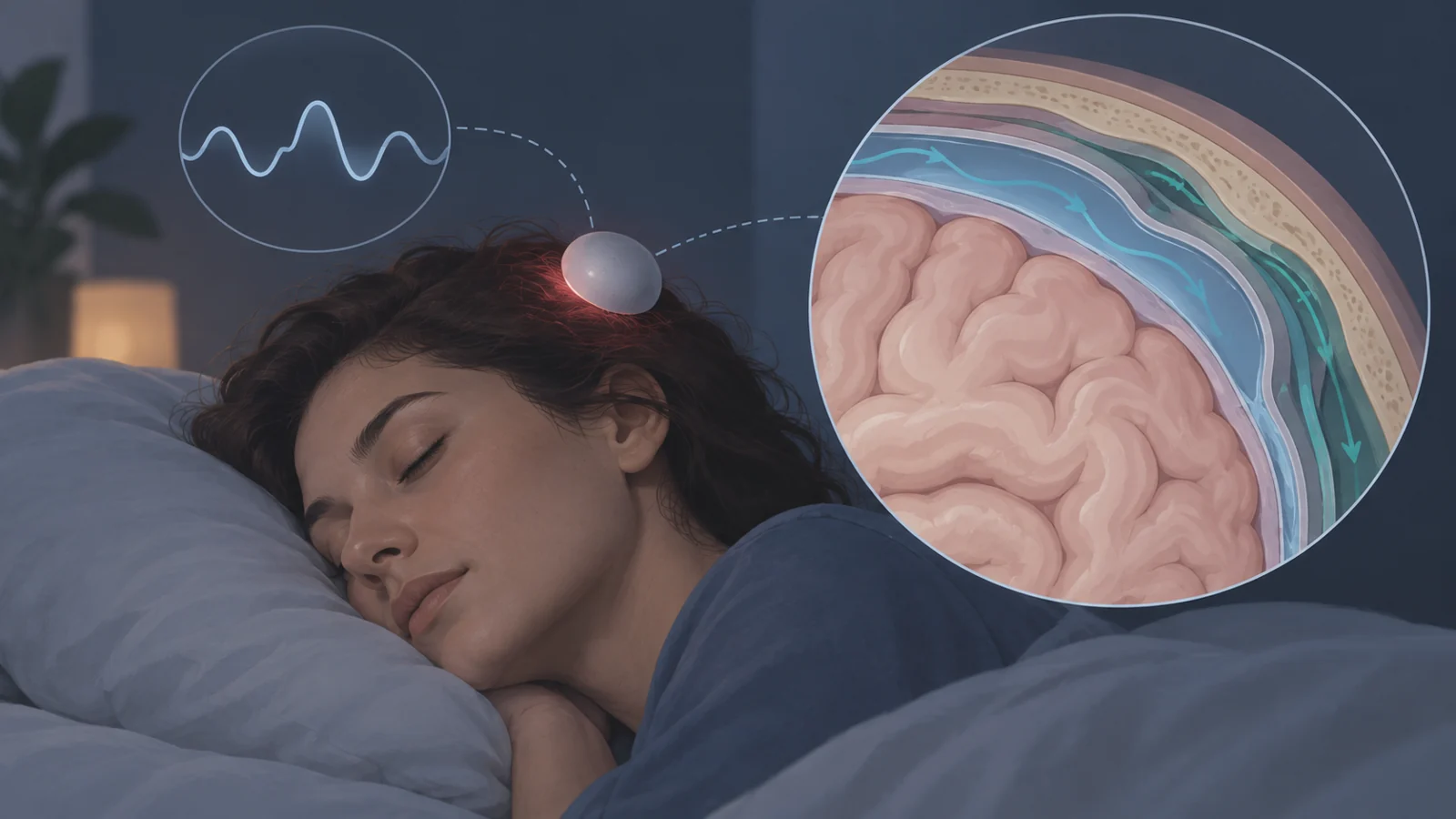
Could treating the brain while someone sleeps change what light therapy can accomplish? A systematic review published on June 30, 2023, examines that possibility through photobiomodulation—treatment using red or near-infrared light. Its authors propose coordinating light exposure with deep sleep, when fluid movement associated with the brain’s waste-removal processes may create a different opportunity for treatment.
The idea brings together research on brain drainage, sleep physiology and therapeutic light. Small human studies contribute findings about cognition and biological markers, while the direct nighttime-versus-daytime treatment comparison described in the review comes from mice modeling Alzheimer’s disease. Together, these findings motivate a sleep-timing hypothesis; they do not establish that treating people during sleep improves cognition or slows Alzheimer’s progression.
The authors report searching PubMed and ClinicalTrials.gov, with additional material drawn from reference lists. From 1,471 initially retrieved records, they included 133 after screening. They describe a study period of 2008–2023. Those records cover a broad mixture of cells, animals, healthy volunteers and patients, so the total should not be read as 133 clinical tests of treatment during sleep.
How fluid movement becomes a treatment target
The drainage idea begins with two connected parts of the brain’s surroundings. Cerebrospinal fluid bathes the brain and spinal cord, while interstitial fluid occupies spaces between brain cells. Movement and exchange of these fluids help transport dissolved substances through and away from brain tissue. Lymphatic vessels in the meninges—the membranes surrounding the brain—provide outward drainage routes connected with lymph nodes in the neck.
These are distinct parts of a transport system. Fluid exchange within brain tissue and drainage through vessels in its surrounding membranes each matter to the proposed route out. Describing both as “brain clearance” can obscure the separate steps that an experiment would need to measure.
Amyloid-beta makes those steps relevant to Alzheimer’s research. This protein can accumulate in the brain and form plaques associated with the disease. The review describes mouse experiments in which damaging meningeal lymphatic vessels reduced amyloid-beta clearance, and other animal work linking impaired drainage with worse disease-related changes. Such interventions help test whether drainage contributes to pathology, beyond simply observing the two together.
Light could potentially influence this system alongside other proposed effects on cellular energy metabolism, small-vessel circulation, inflammation and oxidative stress. The authors discuss experimental evidence involving lymphatic pumping and nitric oxide, a molecule that helps regulate vessel relaxation. Cell and animal findings suggest possible ways light might alter transport, although the mechanism remains incompletely understood. Better relaxation and filling between contractions could matter to fluid movement; that is a more specific proposition than light somehow dissolving brain deposits.
Deep sleep and nighttime answer different questions
The authors focus on deep, slow-wave non-rapid eye movement sleep. This sleep state has a distinctive pattern of slow electrical activity and is central to their argument about when drainage might be most responsive. Three strands of evidence contribute different pieces of that argument.
In mouse experiments summarized by the review, researchers compared fluid-tracer movement and amyloid-beta removal across sleep, wakefulness and anesthesia. Sleep-related findings included greater space between cells and enhanced clearance compared with waking conditions. These experiments supply a biological reason to investigate treatment timing because the transport environment itself changes with brain state.
Human observations contribute another piece. Research discussed in the paper detected pronounced cerebrospinal-fluid oscillations during deep sleep. That connects human sleep physiology with changing fluid dynamics. The observation measures fluid movement, however, and does not by itself measure how much amyloid-beta leaves brain tissue or establish an effect of therapeutic light.
The treatment comparison comes from pilot animal work. According to the review, a nighttime course of photobiomodulation produced better therapeutic effects than a daytime course in mice modeling Alzheimer’s disease. This gives the timing proposal experimental support beyond the general observation that sleep and drainage are connected.
Yet clock time and sleep state are different variables. The summarized nighttime-versus-daytime result does not isolate sleep itself from circadian influences or other differences between the treatment conditions. For the authors’ proposal, the important question is whether exposure coordinated with a measured sleep stage offers an advantage. Scheduling a device to switch on at night would not, by itself, demonstrate that relationship.
What the human studies actually measured
The human reports described in the review ask several questions that should be kept separate. Can people perform better on cognitive assessments? Do daily abilities change? Does brain circulation change? Do concentrations of disease-associated molecules in cerebrospinal fluid shift? Each outcome supplies a different kind of information.
One report followed five people with dementia or possible Alzheimer’s disease through 12 weeks of light treatment delivered through the head and nose. It described improvements in cognition and abilities used in daily living. Another small study of four people with mild-to-moderate dementia reported cognitive and behavioral improvements together with increased brain microcirculation after 12 weeks of treatment through the head. These findings concern performance and physiology, with daily function particularly relevant to the practical burden of dementia.
A separate report involving seven patients with Alzheimer’s described lower cerebrospinal-fluid concentrations of amyloid-beta 42, tau and neurofilament light chain after 16 weeks of treatment. These are biological measurements. They do not answer the same question as a memory assessment or an evaluation of daily activities.
A fluid concentration is also different from a measurement of transport. A lower amyloid-beta concentration in a sampled compartment cannot, on its own, show that lymphatic vessels removed more of the protein from brain tissue. Establishing that explanation would require evidence connecting the treatment to the movement and destination of the material. Likewise, an improvement in cognition would not identify drainage as its cause, given the other mechanisms proposed for light therapy.
The clinical literature therefore contributes several kinds of preliminary observations, rather than one consistent estimate of benefit. Participants differ in diagnosis and severity, delivery methods vary, and some reports involve only a single person. The findings help define outcomes worth investigating, but their interpretation depends on which outcome was measured and how the study was conducted.
Delivering light without disrupting sleep
The practical challenge couples two requirements. Enough light must reach the intended target to produce a useful biological effect, and its delivery must remain compatible with the sleep state the treatment is intended to exploit. A treatment that repeatedly disturbs deep sleep could undermine its own rationale.
The review describes substantial variation in wavelength, intensity, exposure duration, pulsing and delivery through the head or nose. Red and near-infrared wavelengths interact differently with tissue, while the amount delivered at the scalp is not a direct measurement of exposure at a deeper target. The diversity of published settings leaves an unresolved question about which combination could produce a reproducible effect in a sleeping person with Alzheimer’s.
This is why the authors propose combining light delivery with sleep monitoring. A system able to recognize the relevant sleep stage could, in principle, coordinate exposure with that state. It would also make the timing hypothesis more testable by distinguishing treatment during measured deep sleep from treatment given merely at a particular hour. In the June 2023 paper, this is a device concept and development direction, not an established clinical capability.
The main translation gap sits at the intersection of these problems. Pilot mouse timing results and small human treatment reports do not establish the effectiveness of a monitored, sleep-timed intervention in patients. A convincing human demonstration would need to connect a defined exposure with preserved sleep, measurable biological effects and durable benefits in cognition or daily life. Otherwise, a change in one laboratory measure could be mistaken for a useful treatment effect.
Safety also depends on the specific exposure and application. Although the authors use broad reassuring language about photobiomodulation, they discuss possible adverse effects, including transient visual symptoms, and uncertainty over suitable dosing for Alzheimer’s. That discussion does not establish regulatory authorization for this proposed treatment, universal safety or suitability for unsupervised use. Comfort, eye exposure and effects on sleep would all matter to whether repeated nighttime treatment could be practical.
What this could change
If light delivered during verified deep sleep safely improves drainage, and that improvement produces lasting clinical benefit, a combined treatment-and-monitoring device could offer a non-drug component of Alzheimer’s care during rest. The meaningful payoff would be preservation of cognition and everyday abilities, potentially helping people retain independence and easing some of the support required from caregivers.
The proposed advantage depends on the whole sequence working: detecting a useful sleep state, delivering an effective exposure without disrupting it, changing relevant biology and improving life outside the laboratory. From the perspective of this June 2023 paper, the possibility is a treatment adapted to the sleeping brain’s physiology. Its value would ultimately be measured in what people could continue to remember and do.
Key Sources
- Primary source: Phototherapy of Alzheimer's Disease: Photostimulation of Brain Lymphatics during Sleep: A Systematic Review.
DOI or Journal Page · Review or Meta-Analysis · 2023-06-30
Keep exploring