
Research Signal – Source date 2026-01-01
A protein that helps cells detect DNA in the wrong place might seem like an obvious target: turn it up to help fight cancer, or shut it down to curb inflammation. AIM2 complicates that choice. Depending on the tumor, surrounding cells and signaling route involved, its activity has been linked to restrained tumor growth, inflammatory damage, or features that help cancers progress.
A January 2026 review, “A Comprehensive Review of AIM2 in Cancer: Functional Roles, Molecular Pathways, and Clinical Relevance,” brings together research on those contrasting roles. It summarizes cell and animal experiments alongside patient expression and prognosis associations. It does not report a new AIM2-directed treatment outcome. The central question is therefore not simply whether AIM2 is “good” or “bad,” but which of its functions is active in a particular setting—and what the evidence can support about changing it.
One sensor, more than one route
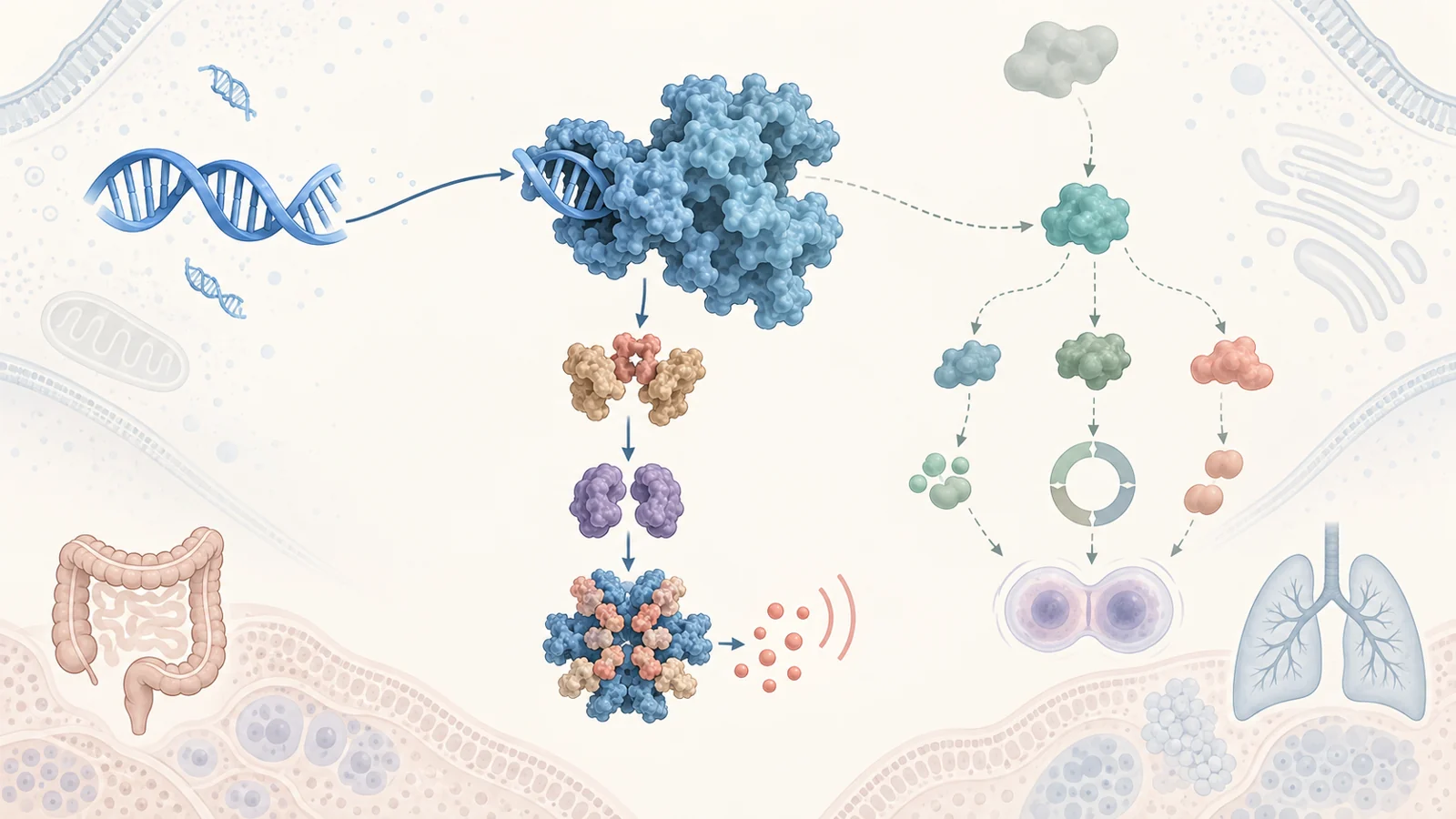
AIM2 is an immune protein that recognizes double-stranded DNA in the cell’s cytoplasm. When it detects that DNA, it can recruit the proteins ASC and caspase-1 to assemble an inflammasome. Caspase-1 helps release inflammatory signals, including IL-1β and IL-18, and can activate gasdermin D, which forms pores in the cell membrane and triggers a type of inflammatory cell death called pyroptosis.
Those responses can help the immune system detect danger, including signals associated with genomic instability. But AIM2 can also influence cell growth and survival without assembling an inflammasome. The review describes effects on signaling proteins such as DNA-PK and Akt, as well as other pathways. A drug that blocks one branch may leave another intact; changing the balance could also have different consequences in different tissues.
In the colon, growth restraint comes with a complication
Much of the research reviewed concerns colorectal cancer. In cell and animal models, AIM2’s DNA sensing can lead to inflammasome assembly, caspase-1 activation and pyroptotic death. In one mouse model, animals lacking AIM2 developed a greater colorectal tumor burden after exposure to a cancer-causing compound, alongside more cell-proliferation markers. Restoring AIM2 in colon cancer cells also reduced their proliferation and viability in laboratory experiments.
The growth-related effects extend beyond cell death. In colorectal tumors, the review describes AIM2 interacting with DNA-PK and reducing Akt phosphorylation, a change associated with less tumor-cell proliferation. Experiments in colon cancer cells and intestinal organoids likewise found lower Akt activation when AIM2 function was present or restored.
Yet one cell-line experiment complicates the picture: restoring AIM2 reduced cell growth while also changing adhesion- and invasion-related features in a direction the authors described as promoting an invasive phenotype. That result does not cancel the other findings. It shows why a reduction in proliferation alone cannot stand in for every aspect of tumor behavior, even within one cancer type.
AIM2’s role in the intestine also reaches beyond tumor cells. The review describes mouse research connecting AIM2 to gut microbial balance, inflammatory control and antimicrobial peptide production. In those models, changes in the gut environment were associated with tumor development. These findings make the surrounding tissue part of the story, while remaining evidence from experimental systems rather than a treatment guide for patients.
Infection shifts the gastric picture
In gastric disease, the review describes a split between growth signaling and inflammation. AIM2 can restrain DNA-PK/Akt-associated growth and migration in gastric cancer cell experiments. Patient studies summarized in the review associate lower AIM2 expression with poorer survival, while higher levels are associated with less aggressive disease. These observations suggest a relationship; they do not show that increasing AIM2 would improve a patient’s outcome.
In a different setting, AIM2-driven inflammation may contribute to harm. In mice infected with Helicobacter pylori, AIM2-deficient animals had less gastric tissue damage, inflammation and epithelial proliferation than wild-type animals. The review also describes tumor experiments and mechanistic studies in which AIM2-related inflammatory signals, including IL-18 and IL-1β, were linked to tumor-promoting effects. One proposed route connects IL-1β to recruitment of immune-suppressing cells.
The mouse infection result and patient expression associations answer different questions. Together with cell and tumor experiments, they show how a growth-restraining effect can coexist with inflammation that worsens disease in an infection-linked context. They do not establish a single direction for AIM2 treatment across gastric cancers.
Lung cancer involves pathways beyond the inflammasome
The lung-cancer account makes pathway coverage especially important. In non-small-cell lung cancer models, some AIM2-related effects involve inflammasome assembly, caspase-1 and IL-1β. The review describes experiments where disrupting inflammasome components or inhibiting caspase-1 reduced those effects. Such results address the inflammasome-dependent branch; they cannot by themselves show that every AIM2-associated route is blocked.
Other studies summarized in the review describe inflammasome-independent effects. These include changes in mitochondrial dynamics and reactive oxygen species linked to MAPK/ERK signaling, and associations with MAPK and STAT3 signaling in KRAS-driven lung adenocarcinoma models. The review also reports patient-tissue associations between higher AIM2 expression and features of an immune-suppressive environment, including PD-L1 expression, resting dendritic cells and regulatory T cells. Those associations are not proof that AIM2 caused immune escape in those patients.
A treatment directed at inflammasome assembly could therefore miss growth or immune-related routes described elsewhere in the review. Conversely, blocking AIM2 broadly might affect functions that restrain growth in another tissue or model. The evidence points to a need for tumor- and pathway-specific interpretation, rather than a universal AIM2 switch.
In liver cancer, stage changes what expression may mean
The review describes hepatocellular carcinoma as particularly context-dependent. Early-stage findings are mixed: studies differ on whether AIM2-associated inflammation restrains damage or contributes to tumor development. Viral setting, including hepatitis B virus, and the cell type involved may also affect the observed role.
In advanced liver cancer, the review characterizes AIM2 more often as tumor-suppressive. Lower expression is associated with greater aggressiveness, metastasis and poorer prognosis in the studies it summarizes. Proposed mechanisms span inflammasome signaling and inflammasome-independent routes involving mTOR, autophagy and p53.
A marker associated with prognosis describes how disease features relate to outcomes in studied groups. It does not automatically predict which patients would benefit from activating or inhibiting the marker. The review’s patient associations do not amount to a validated test for selecting AIM2-directed treatment, especially across different stages and viral contexts.
Treatment ideas still face a targeting problem
The review discusses several possible strategies, but their evidence and targets differ. Restoring AIM2 in a specified BRAF-mutant colorectal cancer setting is presented as a preclinical approach associated with caspase-1-mediated cell death and reduced tumor growth in experimental work. It is not evidence that an AIM2 activator is ready for patients or would suit other cancers.
Other proposals aim downstream. Blocking IL-1β or broader inflammasome signals could address inflammatory routes implicated in some tumors, while combinations with checkpoint inhibitors or radiotherapy are discussed as possibilities. These ideas carry a biological tradeoff: inflammatory signals can support tumor-promoting environments in one context and contribute to immune defense in another. The review notes that tissue and cell specificity, patient selection and potential effects on normal immune defense remain challenges.
The therapeutic table mentions canakinumab, an IL-1β-blocking drug, and summarizes that the CANOPY trial series did not meet its endpoints. That outcome concerns blocking a cytokine downstream of inflammasome activity; it is not a direct clinical test of inhibiting AIM2. Likewise, proposed combinations with immunotherapy do not establish that AIM2 modulation improves treatment response. The strategies remain distinct hypotheses, not interchangeable evidence for an AIM2 therapy.
What tailored AIM2 treatment could change
If researchers can identify which AIM2 branch is active in a particular tumor and patient setting, future treatments could be designed to target harmful inflammatory signaling while preserving growth-restraining or immune-supporting functions. That could make AIM2 useful as part of a more precise way to select or combine cancer therapies. The path to that benefit depends on clinical validation: the experimental findings and patient associations summarized in the review have not yet shown that changing AIM2 improves outcomes for people with cancer.
Key Sources
- Primary source: A Comprehensive Review of AIM2 in Cancer: Functional Roles, Molecular Pathways, and Clinical Relevance.
DOI or Journal Page · Review or Meta-Analysis · 2026-01-01
Keep exploring