
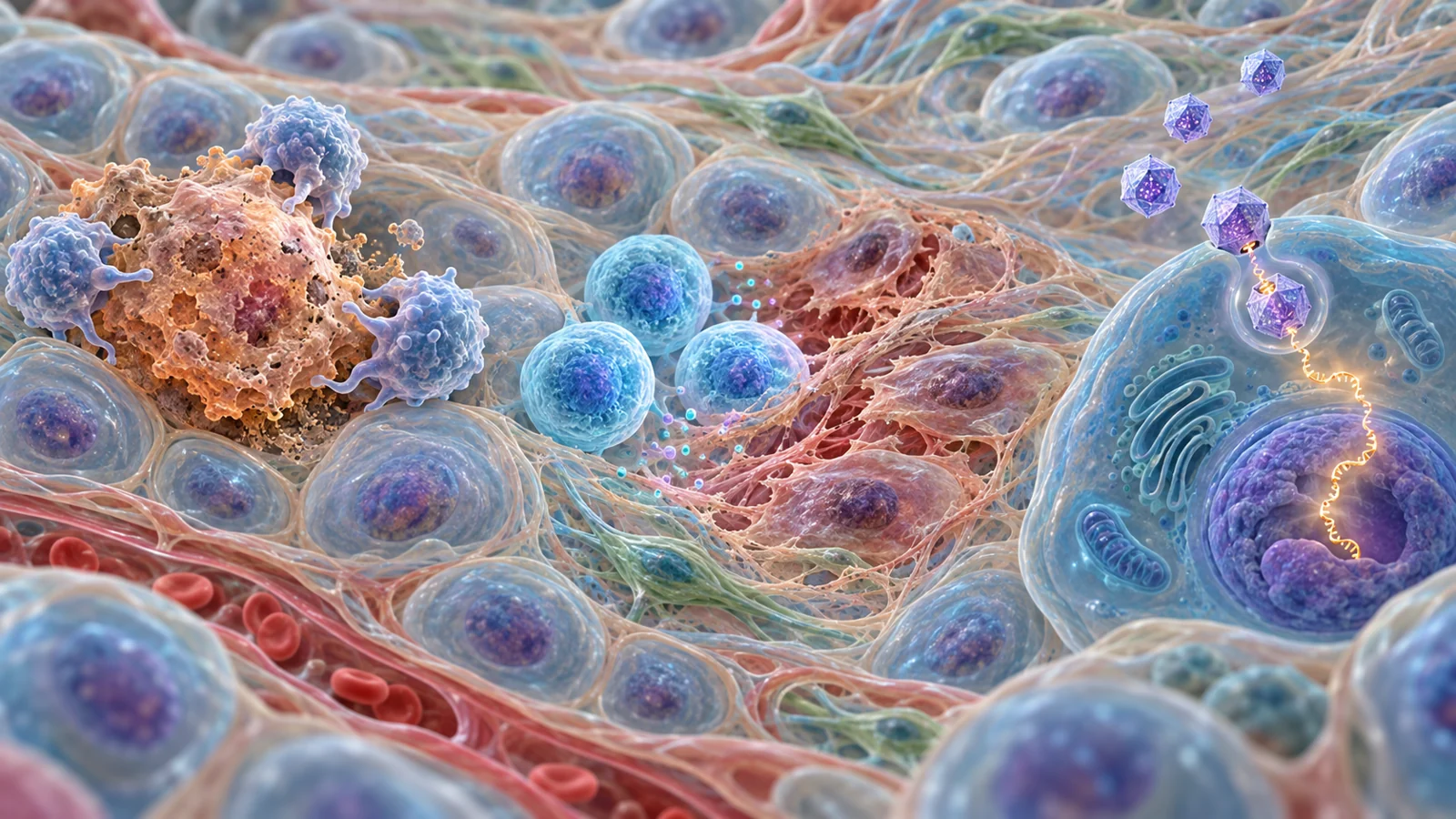
Research Signal – Source date 2024-01-04
The phrase “anti-aging treatment” can describe very different biological jobs. A drug might remove cells that have become harmful, transplanted cells might support repair in one damaged tissue, and gene therapy might alter a signal that influences metabolism. These aims should not be treated as interchangeable measures of rejuvenation.
A review published on January 4, 2024, in the International Journal of Molecular Sciences compares pharmacological, cellular, and gene-based strategies for addressing age-related decline. Its central question is practical: what is each intervention trying to change? Findings from cultured human cells, animal models, and localized patient treatment answer different questions. Together, they describe possible routes toward healthier aging, but they do not establish a treatment that safely extends healthy human life or reverses aging throughout the body.
Aging cells can help and harm depending on their context
Cellular senescence is a state in which a cell stops dividing and changes how it behaves. It is not simply another name for every form of aging. Senescent cells can show markers such as increased senescence-associated β-galactosidase activity and altered signaling. They may also release a collection of growth factors, chemokines, and cytokines known as the senescence-associated secretory phenotype, or SASP.
Those secretions can affect neighboring cells and the surrounding tissue. The review discusses factors including IL-6, IL-8, MCP-1, VEGF, and TGF-β. In some settings, signals from senescent cells can encourage inflammation or support processes associated with disease. The review also describes experimental evidence that IL-8 released by senescent fibroblasts can stimulate invasion and metastasis in a breast cancer cell line grown in vitro.
Senescence itself is not automatically a defect to be erased. Under physiological conditions, it can contribute to tumor suppression, embryonic development, differentiation, and wound healing. The immune system can remove senescent cells, but persistent accumulation changes the problem. Chronic senescence can leave cells unable to perform their original functions while continuing to influence nearby tissue.
That combination of useful and damaging roles explains why selective intervention matters. A therapy that removes every senescent cell would risk interfering with biological processes that are beneficial in the right place and at the right time. The therapeutic task is narrower: identify cells whose persistence is contributing to dysfunction, then alter the tissue environment without disrupting necessary repair or protection.
Senolytics target cells that have outstayed their usefulness
Senolytic drugs are intended to eliminate senescent cells. The approach described in the review focuses on survival mechanisms that allow these cells to resist programmed cell death. More than 46 potentially senolytic compounds had been identified in the review’s discussion, including the tyrosine kinase inhibitor dasatinib and the flavonoids quercetin and fisetin. These compounds act on varied targets linked to cell survival, growth signaling, apoptosis, and related pathways.
One example makes the idea of selectivity more concrete. In cultured human IMR-90 fibroblasts, a FOXO4-related peptide reduced the viability of senescent cells by more than tenfold compared with non-senescent fibroblasts or other cell types. The proposed mechanism involves disrupting the interaction between FOXO4 and p53 in the cell nucleus, allowing p53 to move into the cytosol and activate caspase-dependent apoptosis.
This is evidence of selective killing in a cell-culture setting, not a demonstration that a peptide can safely clear harmful cells from an older person. The review identifies serious side effects as a major constraint for senolytics more broadly. Selectivity must therefore be understood as a design objective that has to hold across relevant tissues and biological conditions, not as a general property that can be assumed from one laboratory result.
Tissue repair has a narrower meaning than whole-body rejuvenation
Cell-based therapies can pursue several tasks. They may introduce cells with regenerative or immunomodulatory properties, or use genetically modified cells to influence a damaged tissue. Some also target senescent cells for removal: the review describes genetically modified CAR T cells that did so in laboratory experiments and helped restore tissue homeostasis in mice with induced fibrosis. The review emphasizes that the age of both the recipient and the tissue environment can affect the result.
Examples involving bone marrow-derived cells suggest that younger recipients can show better skin-healing efficiency than older recipients. The review also discusses observations involving donor organs, in which organs from younger donors had advantages in some recipient settings, while organs from elderly donors were associated with effects that could accelerate aging-related changes. These findings point to the importance of the surrounding biological environment rather than treating transplanted cells as autonomous repair machines.
A spinal-cord example shows why cell survival and functional recovery must be separated. Old rats received human neural progenitor cells derived from induced pluripotent stem cells at the site of chronic cervical spinal-cord injury. The transplanted cells survived and remained at the site, and histological analysis did not show tumor formation. Yet the animals showed no improvement in behavioral tests. The experiment also reported high mortality at several stages: 41.2% during behavioral training, 63.2% after injury, and 50% after cell injection. The reported mortality is a serious interpretive complication, but the supplied evidence does not establish its cause.
The review describes a different kind of result in a localized dental-repair setting. Bone marrow cells multiplied in vitro and placed at a defect site with biphasic calcium phosphate granules supported enough new bone formation for dental implant placement in patients aged 52 to 79, with satisfactory aesthetic and functional results reported in that setting. This is a meaningful example of tissue repair. It is not evidence that the intervention restores aging throughout the body or extends healthy human lifespan.
Gene delivery can sustain a signal without deciding its purpose
Gene therapy adds another layer to the question. Recombinant adeno-associated viruses, or AAVs, can carry genetic instructions into cells. The vectors described in the review are engineered so they cannot replicate and can provide long-term expression after a single infection. Their role is delivery. The biological effect depends on the gene, promoter, target tissue, dose, and duration of expression, among other factors that determine what the delivered instructions do.
FGF21 illustrates a bounded use of this strategy. FGF21 is a hormone involved in regulating glucose and lipid metabolism. In mouse models exposed to a high-fat diet, and in obese mice, AAV-FGF21 produced sustained reductions in body weight, adipose-tissue enlargement, inflammation, liver fat, fibrosis, and insulin resistance for more than a year. The review also describes reduced age-related loss of thymus fat in mice overexpressing FGF21.
The significance of the example is sustained metabolic activity in an animal model, not a general prescription for extending human life. The review describes the animal experiments as showing no side effects despite persistently elevated serum FGF21 in those settings. That observation remains tied to the models and conditions studied. The review nevertheless identifies undesirable side effects and production costs as barriers to broader use of AAV-based approaches.
A delivered gene can therefore provide a durable biological signal, but durability is not the same as universal benefit. Keeping a signal active for a long time may be useful when a defined tissue needs continuing support. It may also create problems if the signal acts in the wrong tissue, reaches the wrong level, or persists after the therapeutic need has changed.
The same signal can point in opposite therapeutic directions
VEGF shows why tissue context can reverse the preferred intervention. VEGF promotes blood-vessel growth. In the review’s experimental examples, increasing VEGF activity was associated with improvements that included reduced mitochondrial dysfunction, metabolic disorders, endothelial-cell senescence, inflammation, abdominal fat accumulation, liver steatosis, muscle loss, bone loss, and kyphosis in treated mice. The animals also showed increased longevity and a lower incidence of spontaneous tumors in those experiments.
For wet age-related macular degeneration, however, the therapeutic direction is the opposite. Excess or harmful VEGF signaling in the eye is a target for blocking treatment. The review discusses AAV-based delivery intended to provide sustained expression of an anti-VEGF protein in the eye and reduce the burden of repeated treatment. The contrast is not a contradiction. It shows that a biological signal cannot be labeled simply “pro-aging” or “anti-aging” without specifying the tissue and the disease process.
Telomerase presents a different tension. Telomeres are protective caps at chromosome ends, and telomerase helps maintain their length. Because telomeres shorten with age and cell division, restoring telomerase activity appears attractive as a way to preserve cellular capacity. The review describes a mouse study in which a viral vector encoding telomerase reverse transcriptase and follistatin increased longevity by more than 32% and improved glucose tolerance and physical endurance.
The same review also identifies a safety concern: hTERT activity may contribute to malignant cell transformation. It discusses a proposed human application using AAV-delivered hTERT for age-related neurodegenerative disease, but a proposed or ongoing application is not evidence of successful treatment. The gap between an appealing mechanism, an animal outcome, and a safe human functional benefit is especially important when the intervention could alter cell persistence or growth.
What targeted repair could mean for healthier aging
The most credible future promise in this review is not an all-purpose elixir. It is the possibility of helping older people retain useful function by addressing a defined biological problem: removing damaging senescent cells, supporting repair in a particular tissue, or sustaining a useful signal where it is needed.
That prospect could make later life less limited by age-related disease if the interventions produce meaningful functional benefits in people and maintain an acceptable balance of benefit and harm. For gene delivery, feasible production costs would also matter. The January 2024 perspective supports cautious interest in targeted repair, while leaving open the harder question of whether any combination of these approaches can safely improve healthy human aging across the body.
Key Sources
- Primary source: Eternal Youth: A Comprehensive Exploration of Gene, Cellular, and Pharmacological Anti-Aging Strategies.
DOI or Journal Page · Review or Meta-Analysis · 2024-01-04
Keep exploring