
Research Signal – Source date 2025-07-18
For someone living with chronic lung disease, breathing is only part of the story. The same changes that reduce respiratory reserve can occur alongside weaker muscles, less physical activity, cardiovascular disease, metabolic problems and greater vulnerability to everyday stress. Why do these problems cluster, and how much does their shared biology actually tell us about treatment?
A narrative review published on July 18, 2025, The Aging Lung: Exploring Multimorbidity Patterns and Their Clinical Implications, examines that question. It defines multimorbidity as having two or more chronic conditions in the same person and argues that accompanying illnesses should not always be treated as unrelated diagnoses. The review brings together mechanistic explanations, observational associations, intervention findings and expert recommendations. Those kinds of evidence answer different questions, so the review is a synthesis rather than a new clinical trial.
The puzzle is bigger than breathing
Multimorbidity becomes more common with age. The review cites estimates showing a rise from an average of 1.18 conditions per person, with multiple chronic conditions affecting 30% of adults aged 45 to 64, to an average of 2.60 conditions and a 65% rate among people aged 65 to 84. These figures describe a broad aging pattern, not a single explanation for every combination of disease.
The authors focus on chronic lung disease because its effects can extend across the body, while changes elsewhere can alter how well a person copes with respiratory symptoms. Cardiovascular disease, type 2 diabetes, bone loss, muscle loss and neurological or psychological problems may affect physical capacity and recovery at the same time. The central idea is not that lung disease causes every accompanying disorder. It is that some conditions may share biological pressures and may interact in ways that matter clinically.
Why reserve falls with age
The lungs and the structures that help them work change gradually with age, even without a diagnosed lung disease. The chest wall and its muscles can become less efficient as muscle mass falls and the spine becomes more curved. The lungs also lose some elastic recoil, which contributes to age-related hyperinflation. In the review, these changes are linked with declining measures of airflow and vital capacity, with the fall in forced expiratory volume in one second becoming more pronounced after age 65.
The practical meaning is a smaller reserve. A person may have less capacity to respond when infection, exertion or another illness places extra demand on breathing. Cough clearance can also weaken as respiratory muscle force declines, while the movement of mucus and inhaled particles out of the airways becomes less effective. Aging also changes immune responses, including a smaller pool of naive T cells available to respond to unfamiliar infections. Exposure to cigarette smoke, air pollution or infectious material can add local and systemic oxidative stress, but the review presents these as contributors within a wider process rather than as a single cause.
The paper then considers mechanisms that may connect normal aging with chronic disease. Oxidative stress can damage DNA, proteins and lipids. Senescent cells are cells that have stopped dividing after stress such as DNA damage or oxidative stress. They can release inflammatory cytokines, chemokines, growth factors and proteases, a collection of signals often called the senescence-associated secretory phenotype. Their accumulation may contribute to tissue dysfunction.
The review also discusses inflammaging, meaning persistent, low-grade inflammation associated with aging. C-reactive protein, interleukins 1 and 6, and tumor necrosis factor-alpha are among the inflammatory markers reported as elevated in older adults and in people with chronic lung disease. These mechanisms offer a biological explanation for overlap between aging and chronic disease, but they do not turn every shared pathway into a proven treatment target.
When weakness and inactivity reinforce each other
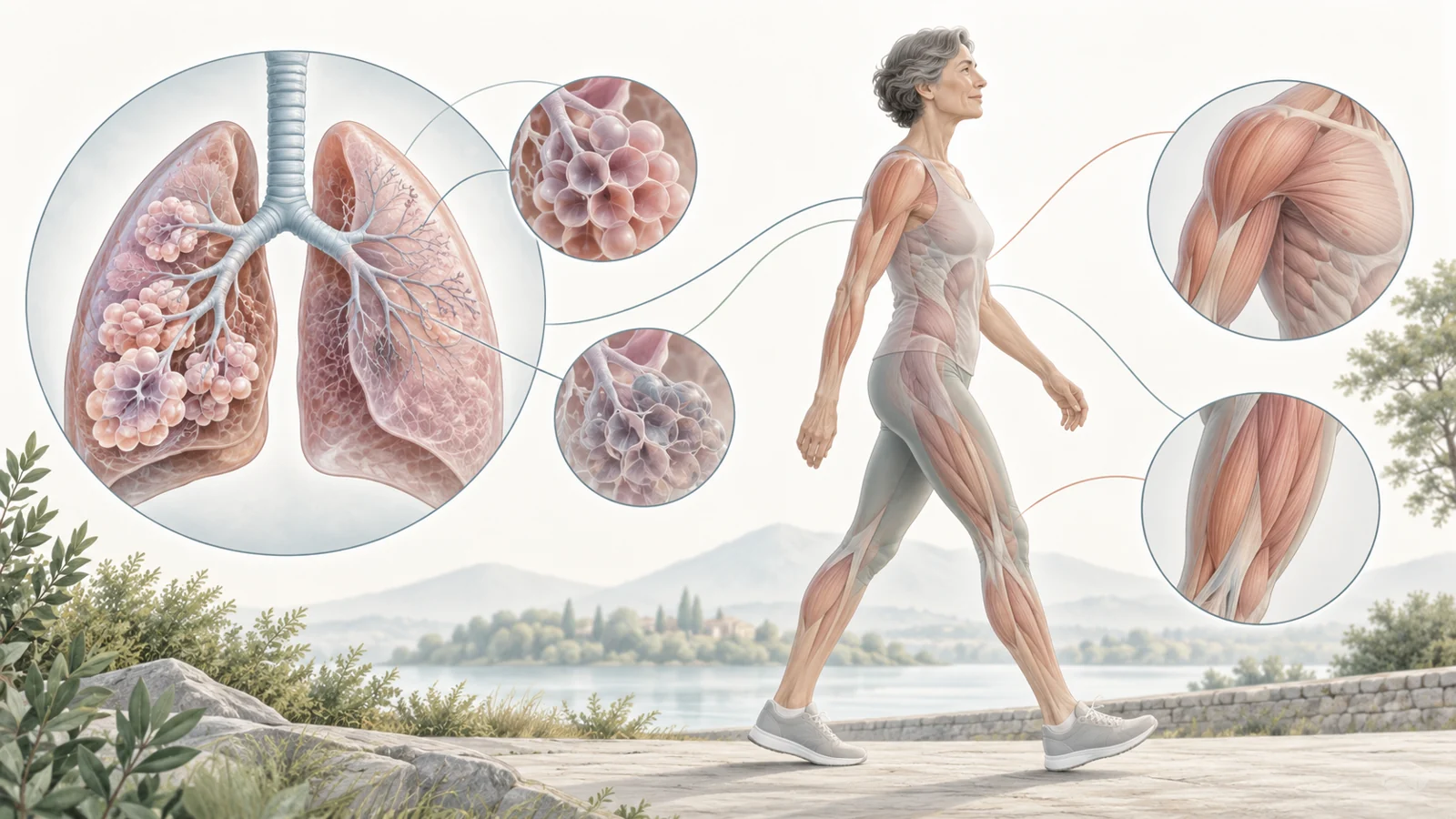
The most immediate feedback loop described by the review involves muscle and movement. Aging and chronic lung disease can both be accompanied by loss of muscle mass, changes in body composition, reduced bone density and declining physical activity. Less activity can further reduce muscle strength and functional capacity, making movement more demanding and encouraging still less activity.
This relationship helps explain why a breathing problem can become a broader loss of everyday ability. A person may have less strength for walking, climbing stairs or recovering from an illness, while the effort of breathing and other symptoms make sustained activity harder. The review treats this interaction as a system-level problem rather than a sequence in which one organ always acts as the original cause.
Frailty adds another dimension. The review describes it as a reduced ability to respond to external stresses and maintain normal stability. It can be assessed through physical changes or by counting deficits across several physiological systems. Either approach is meant to capture vulnerability that a list of diagnoses, or chronological age alone, may miss.
The review cites a systematic review and meta-analysis in which frailty prevalence among people with chronic lung disease ranged from 9% to 28% when assessed using Fried criteria. It also reports that people with chronic lung disease had about twice the risk of frailty compared with people without lung disease. The mechanisms behind that association remain unresolved, and the shared contributors include smoking, inflammation, inactivity and social factors. The combined presence of chronic lung disease and frailty was associated in the reviewed evidence with greater risk of hospital admission during acute exacerbations and premature mortality.
That vulnerability is not necessarily fixed. The review discusses pulmonary rehabilitation as a comprehensive approach that can account for symptoms, comorbidities and physical conditioning. It also notes that older adults with sarcopenia can improve muscle force and functional capacity through supervised resistance exercise, although the review describes the supporting evidence as limited in some areas. The important point is the target: preserving function may require attention to movement and whole-person capacity, not only to airflow measurements.
Treatment aims are not interchangeable
The review separates several kinds of intervention. One is the ordinary management of accompanying conditions, such as cardiovascular disease, high blood pressure, heart failure, type 2 diabetes, osteoporosis and chronic lung disease. Treating these conditions remains part of responsible care, but the authors argue that clinicians should account for their interaction rather than manage each one in isolation.
Another aim is conditioning. Regular physical activity and supervised exercise can address muscle strength, cardiovascular capacity and functional decline. The benefits discussed here concern muscle strength and functional capacity; they do not by themselves demonstrate reversal of biological aging.
A third aim is changing inflammation or cellular aging. The review discusses statins partly because their effects can include changes in inflammatory markers. In the JUPITER study, apparently healthy participants with low-density lipoprotein cholesterol below 3.4 mmol/L and high-sensitivity C-reactive protein above 2.0 mg/L were assigned to rosuvastatin or a sham treatment. After a median follow-up of nearly two years, high-sensitivity C-reactive protein fell by 37% with rosuvastatin and by 17% with the sham treatment. The review also describes a network meta-analysis in people with chronic obstructive pulmonary disease that found differences among statins in the probability of reducing C-reactive protein.
Those findings illustrate why endpoints matter. A lower inflammatory marker is not the same as better breathing, stronger muscles, greater independence or longer survival. Results from apparently healthy participants cannot automatically be transferred to frail people with chronic lung disease, and the marker findings do not by themselves establish a clinical benefit.
The review also describes senotherapy, a proposed strategy for targeting accelerated cellular aging. Senolytics are agents intended to eliminate senescent cells, often by promoting their programmed death. Other proposed targets include signaling pathways, microRNAs and antioxidant mechanisms. These proposed targets may help guide future research, but identifying them does not demonstrate that senolytics restore lung function, reverse frailty or extend life in people with chronic lung disease. The difference between a plausible biological target and a demonstrated patient benefit remains central.
A clinic organized around connections
The authors propose changes in how specialties look for accompanying problems. Cardiovascular clinics, particularly when caring for current or former smokers, could consider lung-function assessment. Respiratory clinicians could pay closer attention to blood pressure and pursue simple cardiovascular investigations when appropriate, while both settings could measure glucose and follow up according to established guidance.
This is an expert proposal for earlier recognition, not a tested service model with demonstrated reductions in admissions or mortality. Its significance is practical: a patient should not have to move through separate clinical compartments before someone notices that shortness of breath, weak muscles, cardiovascular risk and metabolic problems are affecting one another.
The review argues that a more integrated approach could involve pulmonologists, geriatricians, cardiologists, physical therapists and primary care clinicians. Its call for longitudinal studies and cellular and systemic aging measurements concerns understanding age-related chronic lung disease. Establishing whether coordinated care improves function, admissions or survival would require direct evaluation of those outcomes.
What this could change
Older people with chronic lung disease could retain everyday function and independence for longer when cardiovascular, metabolic and physical problems are recognized and addressed together. That possibility depends on more than identifying shared biology. Earlier recognition would need to lead to effective treatment, appropriate conditioning and sustained functional benefit, while proposed therapies aimed at inflammation or senescent cells would need to demonstrate improvements beyond laboratory markers. The review’s contribution is to make that clinical goal more visible: preserving resilience may require care organized around the person who has several interacting problems, not around one diagnosis at a time.
Key Sources
- Primary source: The Aging Lung: Exploring Multimorbidity Patterns and Their Clinical Implications: A Narrative Review.
DOI or Journal Page · Peer-Reviewed Paper · 2025-07-18
Keep exploring