
Evidence date · 2023-07-24 · Research note 1 of 2
1 2
See current Track status →
A lung injury is meant to start a temporary repair program. In idiopathic pulmonary fibrosis, or IPF, that program can remain active while scar tissue accumulates and the lung becomes harder to use. IPF is an irreversible and often fatal lung-scarring disease found mainly in older adults, and aging is its strongest known risk factor.
A review published on July 24, 2023, brings two parts of that problem into the same picture: senescent cells and the extracellular matrix around them. The matrix is not passive packing material. It gives cells physical support, stores growth factors, and helps determine how they respond to stress. As aging changes the matrix, and as senescent cells release signals into it, the conditions around a healing injury may begin to favor continued fibrosis.
When healing does not switch off
Normal repair follows a sequence. Damage to the alveolar epithelium prompts type II epithelial cells to multiply and help restore the type I cells that line much of the gas-exchange surface. Fibroblasts move into the injured area, proliferate, lay down new extracellular matrix, and remodel it so the tissue can regain structure. Once repair is sufficiently advanced, the excess fibroblast population falls, in large part through programmed cell death.
The timing matters. A fibroblast that appears during repair is not automatically a permanent source of scarring. The problem arises when the repair population persists or remains unusually active. Fibroblasts from people with IPF have shown resistance to apoptosis, the controlled form of cell death that would normally help reduce their numbers after the repair phase. Persistent fibroblasts can continue producing and organizing matrix, helping create the dense tissue associated with fibrosis.
Senescence adds another cell state to this sequence. A senescent cell has stably withdrawn from division but remains metabolically active. Senescence can be useful in some settings, including aspects of tissue repair, development, and tumor suppression. With age, however, senescent cells can accumulate because they remain viable for longer and are less effectively cleared. Their continued presence changes the local environment through the senescence-associated secretory phenotype, commonly shortened to SASP.
SASP is a collection of secreted factors rather than a single substance. It can include inflammatory cytokines, chemokines, growth factors, and enzymes that modify the surrounding matrix. These factors can act back on the cell that releases them or travel to nearby cells, influencing behavior through autocrine and paracrine signaling. In an aging lung, the result may be a repair environment that keeps recruiting, activating, or protecting cells involved in matrix production.
The lung’s scaffold becomes part of the problem
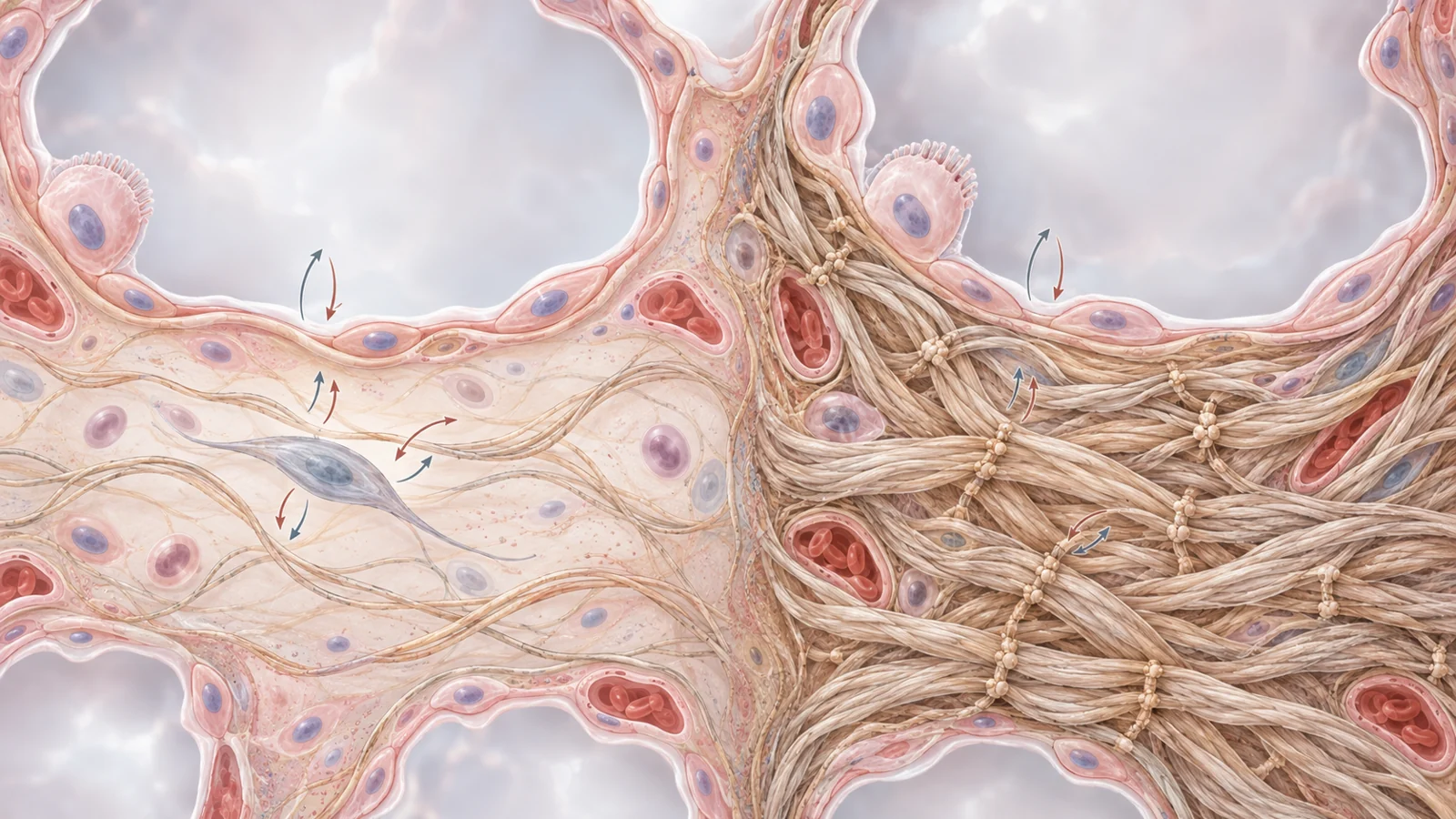
The extracellular matrix is the material outside cells that supports tissue architecture and provides biochemical contact points. In the lung, it includes fibrous proteins such as collagen, fibronectin, elastin, and laminins, along with proteoglycans and glycosaminoglycans. Together, these components create a changing scaffold rather than a fixed background.
Aging changes the scaffold’s physical and chemical properties. One important change involves cross-linking, the formation of bonds that stabilize neighboring matrix fibers. Cross-links can make collagen more durable, but they can also make aged matrix harder to dismantle and alter its mechanical behavior. The review discusses dysregulated lysyl oxidase-family enzymes in lung fibrosis, including increased LOXL1 and LOXL2 in IPF lung tissue and an association with thicker collagen fibrils.
As the matrix becomes stiffer, cells sense a different physical environment. Stiffness can alter how fibroblasts and epithelial cells attach, move, survive, and respond to signals. The matrix also stores growth factors in forms that can be released or activated as its structure changes. In fibrotic lung tissue, stiffness combined with an acidic local environment can activate latent transforming growth factor beta, or TGF-beta, a growth factor that promotes fibrotic activity.
That creates a route by which scarring may continue after the original injury has faded. Activated TGF-beta can encourage further matrix production and reinforce fibroblast activity. An abnormal matrix can also reduce the expression of miR-29, a regulator that normally restrains some extracellular-matrix genes. The surrounding tissue therefore becomes more than a record of earlier injury. Its altered properties can help maintain the signals that produce additional matrix.
Senescent-cell signals can feed into this setting by changing matrix turnover and the behavior of neighboring cells. A stiff matrix can, in turn, make the environment more favorable to persistent fibroblast activity. The review presents this as a connected mechanism assembled from findings across cellular, tissue, and animal research, rather than as one new experiment proving the entire feedback loop in people with IPF.
Senescence changes the repair cast
The important question is not simply whether a cell is old or whether a matrix is stiff. It is which cells are present, what state they are in, and when their signals appear during repair.
Early senescence can have a useful role. Temporarily stopping cell division may help limit damaged cells, support aspects of tissue remodeling, or prevent cells with dangerous changes from continuing to proliferate. A senescent cell can also contribute to repair-related communication. Those functions help explain why removing every senescent cell, or suppressing every factor associated with SASP, is unlikely to be a simple biological reset.
The risk lies in persistence. Long-lived senescent cells can release inflammatory and matrix-modifying factors for extended periods. In an older lung, impaired immune clearance may allow their burden to rise. The same broad cell-state program that can be protective for a time may become harmful when it remains in place after the tissue needs to return to a quieter state.
This temporal difference also helps explain why a damaged lung may not behave like a fresh wound. Aging can reduce the flexibility of the repair response, change the matrix that cells encounter, and leave behind fibroblasts that resist normal removal. The tissue is then responding to present injury in an environment already shaped by earlier aging-related changes.
The same signals can help or harm
Intercellular vesicles provide one example of why context matters. These small membrane-bound packages can carry molecular messages between cells, and their release increases in some forms of cellular senescence. The review describes evidence that vesicles from IPF fibroblasts can promote senescence in epithelial cells, including effects involving mitochondrial damage and reactive oxygen species. In that setting, communication from one diseased cell population may extend stress into another.
Vesicles do not have one universal effect, however. The reported response depends on the source cell and the receiving tissue. Vesicles from inflammatory monocytes have been found in another setting to induce fibroblast and myofibroblast cell death, a potentially antifibrotic effect. These opposing observations are not a contradiction to be averaged away. They show that the meaning of a signal depends on who released it, what it carries, which cell receives it, and when the exchange occurs.
The same caution applies to matrix-remodeling activity. Enzymes that alter collagen can support normal restructuring in one circumstance and contribute to excessive stabilization in another. A molecule associated with SASP may influence inflammation, growth, survival, or matrix turnover in different combinations. Broadly blocking all such activity could remove harmful communication while also interfering with repair functions that the lung still needs.
Two ways to target the problem
The review distinguishes two broad therapeutic ideas. Senolytics are intended to remove senescent cells. Senomorphics aim to change the behavior of those cells, especially by reducing harmful components of their secretory phenotype, without necessarily killing them. A third direction involves immune-mediated clearance, allowing the body’s own defenses to remove accumulated senescent cells.
Eliminating a senescent cell addresses the source of its signals. That could be useful when the cell is persistently releasing factors that damage neighboring tissue or encourage fibrosis. It also creates a risk: a cell that is harmful in one phase may have been useful in another, and the biological effects of senescent cells vary by tissue and context. Selective removal therefore depends on identifying which cells are driving disease rather than treating senescence as a single uniform target.
Modifying SASP takes a different route. A senomorphic strategy could preserve the cell while reducing inflammatory, growth-promoting, or tissue-destructive signals. That may avoid some consequences of cell removal, but it also requires choosing which signals to suppress and which functions to leave intact. Blocking one set of factors may not fully change the surrounding matrix, while broad suppression could interfere with beneficial communication.
The review discusses these approaches as proposed ways to act on the biology of fibrosis. Its mechanistic synthesis helps explain why they are attractive, but the supplied evidence does not establish a quantified benefit for people with IPF, a ranking among treatments, or reversal of established scars. Translating a cell-and-matrix mechanism into patient benefit requires more than identifying a plausible target.
What this could mean for treating lung fibrosis
For people with IPF, the practical ambition is to keep a repair response from becoming a self-reinforcing source of new scar. Treatments that interrupt persistent fibroblast activity, harmful senescent-cell signaling, or the matrix changes that reactivate profibrotic growth factors could help preserve functioning lung tissue and slow the loss of lung function.
That possibility remains conditional from the review’s 2023 perspective. Effective interventions would need to interrupt damaging feedback while retaining the useful roles of senescence, matrix remodeling, and cellular repair. The goal would be preservation of remaining lung function, not a promise that established fibrosis can be removed or cured.
Key Sources
- Primary source: The aged extracellular matrix and the profibrotic role of senescence-associated secretory phenotype.
DOI or Journal Page · Review or Meta-Analysis · 2023-07-24