
Research Signal – Source date 2025-09-08
Immune treatments are increasingly being discussed as possible tools against aging-related damage. But the important question is not simply whether an intervention can remove an aging-associated cell or reduce an inflammatory signal. It is whether that change improves the function a person cares about while leaving useful immune and repair processes intact.
A review published on September 8, 2025, brings several research directions together. It covers immunotherapies aimed at aging biology itself, as well as treatments directed at diseases that become more common with age. The distinction matters. A change in a molecular marker, an amyloid plaque, or an inflammatory pathway is not automatically the same as better cognition, stronger tissue, or longer healthy life. The review connects these levels without presenting them as one measure of human rejuvenation.
Aging damage can create targets for immune intervention
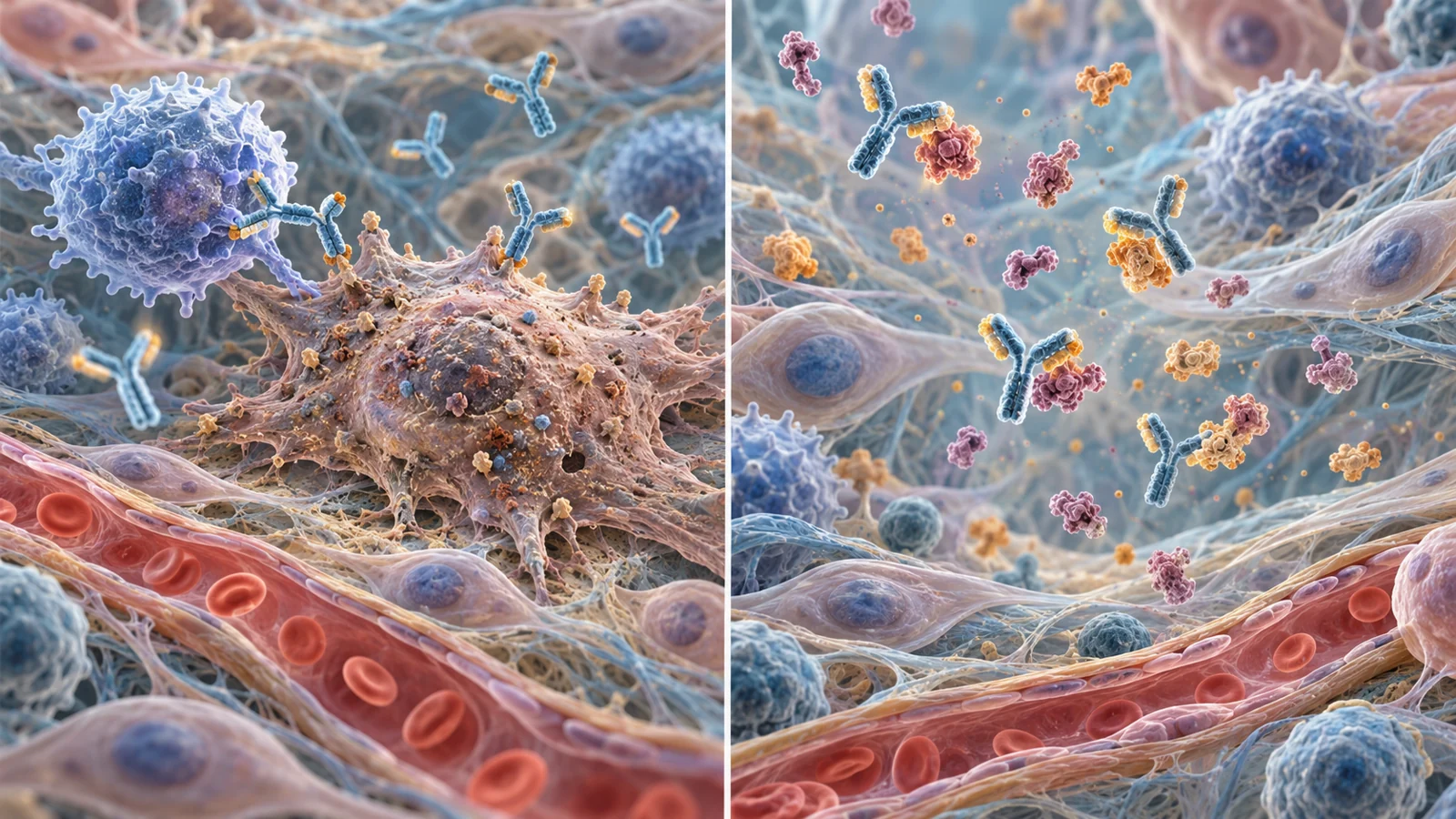
The review describes a causal chain that begins with accumulating damage to the genome, telomeres, epigenetic regulation, protein maintenance, and mitochondria. Cells may respond by entering senescence, a state in which they stop dividing but remain metabolically active. When immune surveillance becomes less effective, these cells can persist and release a senescence-associated secretory phenotype, or SASP. The resulting inflammatory signals can damage neighboring tissue, promote fibrosis, and reduce the reserve of organs over time.
This creates two broad intervention possibilities. One is to identify and remove cells carrying an aging-associated marker. The other is to block a signal that helps maintain inflammation or tissue damage. They may both be described as immunotherapy, but they act on different parts of the chain.
The GPNMB example includes distinct cell-depletion and vaccination experiments in mice. In a high-fat-diet mouse model, removing GPNMB-positive cells alleviated metabolic abnormalities and atherosclerosis. The review then describes a GPNMB-peptide vaccine tested in high-fat-diet mice: it induced antibodies and reduced several tissue-senescence markers. Antibody-dependent cellular cytotoxicity enabled immune cells to eliminate GPNMB-positive cells. The review also reports improved age-related phenotypes and longer lifespan with GPNMB vaccination in mice.
Those findings make GPNMB-positive cells a plausible experimental target, not a universal human aging target. GPNMB is also involved in immune-response initiation, lysosomal integrity, and vascular endothelial-cell replication. Removing cells that express it could therefore affect functions that are not harmful. The same molecule can be associated with damage in one context and with repair or normal physiology in another.
The IL-11 example takes a different route. The review describes IL-11 as a cytokine whose levels rise with age and whose activity can influence the ERK–AMPK–mTORC1 pathway. In mice, anti-IL-11 treatment reduced inflammation in visceral white adipose tissue and was associated with a 25% lifespan increase in females and a 22.5% increase in males. These are findings from experimental animals receiving a defined intervention, not evidence that blocking IL-11 slows aging across human organs.
The contrast is useful. A vaccine can help the immune system recognize and clear a selected cell population. An antibody against IL-11 can interrupt a signal without directly removing every cell that produces it. The safety questions differ accordingly: one concerns the precision of cellular targeting, while the other concerns what else the blocked signal does in the body.
A changed marker is not the same as better function
Disease-focused trials in the review show why biological improvement and human function need to be kept separate. In Alzheimer’s disease, gantenerumab and donanemab are both antibodies directed at amyloid-β42, but the reported outcomes were not interchangeable.
The review says two phase II gantenerumab trials did not meet their cognitive-improvement endpoints, even though some disease-related indicators declined after treatment. Two later phase III trials also did not show a significant difference from control in decline on the reported dementia rating measure. Donanemab, by contrast, produced substantial amyloid-plaque reduction in a phase II study. More than half of participants were amyloid-negative at 52 weeks, and cognitive and functional decline was slowed in the donanemab group. The review also reports amyloid-related imaging abnormalities in 24% of participants in phase III trials and notes that the treatment was approved by the FDA in July 2024.
These examples do not establish a ranking between the antibodies. They show that changing a disease-associated feature and changing cognition or daily function are separate tests. A treatment may succeed on one endpoint while producing a more limited result on another, and the relevant population, study design, safety profile, and duration all matter.
The tocilizumab example adds another layer. In systemic sclerosis, the antibody did not improve skin thickening in a phase II trial, but it was associated with less decline in forced vital capacity, a measure of lung function. In a phase III trial involving patients with elevated acute-phase reactants and early systemic-sclerosis-associated lung disease, tocilizumab preserved lung function and improved the rate of change in forced vital capacity. The review presents long-term safety as verified in that setting.
A single disease can therefore contain multiple functional outcomes. Skin and lung tissue do not respond as one system, and a treatment that is unhelpful for one manifestation may still protect another. For aging research, the practical endpoint is not simply whether an intervention changes a pathway. It is whether the person retains organ function with an acceptable balance of benefit and harm.
Protection and repair can become part of the risk calculation
Selecting an aging-related target is difficult because molecules associated with senescence may also participate in useful biology. The review’s discussion of GPNMB makes this problem concrete. Because GPNMB contributes to vascular endothelial repair, broadly blocking or eliminating GPNMB-expressing cells could theoretically impair repair and lead to internal bleeding. That is a mechanistic concern raised by the target’s normal functions, not a demonstrated adverse outcome from a human GPNMB vaccine trial.
Canakinumab illustrates a different kind of tradeoff: an observed clinical result in a disease-focused trial. In the CANTOS trial, involving 10,061 people with a previous myocardial infarction, blocking interleukin-1β reduced the risk of recurrent cardiovascular events. It did not reduce total mortality, with the review attributing that outcome to increased infection risk.
The two examples should not be collapsed into one conclusion. GPNMB shows why a target may carry a plausible repair hazard before broad clinical use. Canakinumab shows that reducing a damaging inflammatory pathway can produce a measurable cardiovascular benefit while also weakening a defense that matters to survival. Immune treatment is therefore not a simple choice between inflammation and health. Inflammation can damage tissue, but immune activity also protects against infection and helps maintain repair.
The right target may depend on the person receiving it
The review identifies three connected obstacles to matching treatment to an older patient. First, senescent cells and their secreted signals are heterogeneous. The relevant markers may differ between people and between tissues, making a single universal aging target unlikely to work equally well.
Second, the recipient’s immune system may not be able to carry out the intended response. Immunosenescence can include elevated inflammatory signals and PD-1 expression, impaired differentiation of B cells into antibody-producing plasma cells, and T-cell exhaustion. A therapy that depends on antibody production, immune-cell recruitment, or sustained cellular activity may therefore behave differently in an older or more immunologically compromised person than it did in an experimental model.
Third, identifying senescent cells inside living tissue remains difficult. Markers established in cultured cells may not perform as reliably in natural tissue environments. The review discusses proposed minimum-information standards for in-vivo senescence experiments and points toward genomics, transcriptomics, proteomics, lipidomics, metabolomics, and phenomics as ways to characterize aging-related states more fully.
The authors’ future blueprint uses that molecular information to guide treatment selection. Individual molecular profiles could be assessed for target abundance, immune recognition, cross-reactivity, and physiological function. Artificial intelligence could help analyze those data or design candidate antibodies and antigens. Nanorobots are also mentioned as a possible future way to monitor molecular profiles and deliver drugs to affected areas.
This is a proposed direction, not a clinically validated platform that can already select an effective anti-aging treatment for each person. Its promise depends on solving two problems at once: finding the cells or signals that are genuinely driving harm, and determining whether the patient’s immune system can act on that target without disrupting essential functions.
What this could change
Older people could eventually retain more organ function if immune interventions were matched to the inflammatory signals or senescent-cell populations causing damage in their particular tissues. The benefit would come from selective action: suppressing harmful signaling or clearing damaging cells while preserving infection defense, vascular repair, and other useful immune functions.
That prospect remains conditional on reliable target identification, a durable improvement in meaningful function, and acceptable harms in the patient groups receiving treatment. The review’s central contribution is to make those requirements visible at the same time. A successful aging immunotherapy would need to do more than alter biology associated with age; it would need to help people function better without removing protection they still need.
Key Sources
- Primary source: Immunotherapies for Aging and Age-Related Diseases: Advances, Pitfalls, and Prospects.
DOI or Journal Page · Peer-Reviewed Paper · 2025-09-08
Keep exploring