
Research Signal – Source date 2023-08-23
Aging research is moving toward interventions that target the biology behind age-related disease rather than treating each disease in isolation. The attraction is clear. If a treatment could preserve organ function for longer, it might help people remain healthy and independent as they age.
The difficulty is that aging biology is not a single switch. The same cell type or pathway may be harmful in one setting and useful in another. A treatment can improve a laboratory measure while leaving the more important question unanswered: does it help people keep their abilities and avoid disease?
An article published on August 23, 2023, brings these problems together through research on cellular recycling, senescent cells, therapeutic interventions and biomarkers of healthy aging. Its examples range from fruit flies, worms and mice to human clinical evidence. They point toward a more selective goal than simply trying to make an organism biologically younger.
Aging biology has more than one intervention route
One route focuses on autophagy, the process cells use to break down and recycle damaged or unnecessary components. In the article’s account, reducing activity in the mTOR pathway can release this recycling process. Dietary restriction and the drug rapamycin have extended lifespan in fruit flies, worms and mice. These findings help explain why pharmaceutical researchers are interested in pathways that influence the maintenance of cells rather than a single age-related disease.
Autophagy changes what happens inside a living cell. It can alter how that cell handles its own components, including material that needs to be cleared or reused. A senolytic approach makes a different physical intervention. It aims to remove selected senescent cells, which are cells that have stopped dividing but can remain metabolically active and release inflammatory signals.
Those routes should not be treated as interchangeable. One changes intracellular recycling; the other changes the number and identity of cells remaining in a tissue. The distinction matters because a cell that appears damaging may also have a role in repair, development or protection against other problems. The relevant target is therefore not just an aging pathway in the abstract. It is a particular process in a particular tissue at a particular time.
The article also discusses cellular reprogramming as a possible route toward reversing biological age in mammals. Full reprogramming can return cells to an undifferentiated stem-cell state, but the same efficiency can create a risk of tumor formation in living organisms. Partial reprogramming is presented as a way researchers might try to preserve cellular identity while changing age-related features. These are promising laboratory concepts, not evidence that human aging has been stopped or reversed across the whole body.
Removing a cell can change the repair response
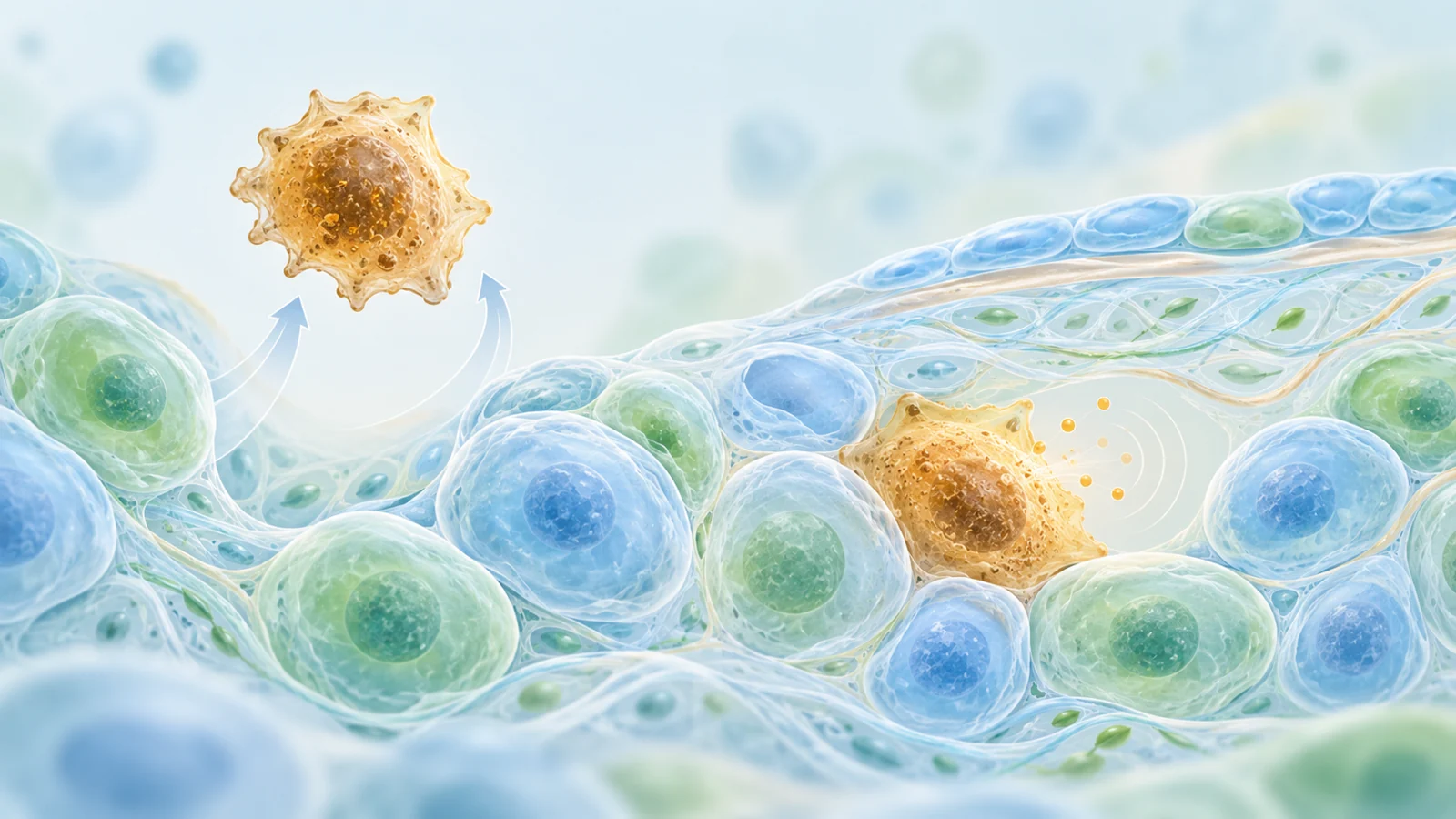
Senescent cells are often studied because they can contribute to chronic, low-grade inflammation and may influence nearby cells. In aged mouse tissues, removing some p16-expressing senescent cells delayed several age-associated changes. Such results helped establish cell clearance as a possible strategy for improving healthspan.
But senescence is not automatically harmful. The article describes highly senescent p16- and p21-expressing cells in young tissues that may support regeneration. In young mice, removing a particular population of p16-positive mesenchymal cells in the lungs impaired restoration of the airway barrier after injury. Removing senescent liver sinusoid cells in another experimental context triggered collagen deposition and liver fibrosis.
These examples change the scientific question. It is not enough to ask whether senescent cells are present or whether their number can be reduced. Researchers also need to know which cells are being targeted, what those cells are doing in that tissue and when clearance occurs. A population that contributes to chronic inflammation in an older vascular setting may not have the same role in a young lung recovering from injury.
The article describes one more selective possibility through seno-antigens, markers on the surface of some senescent cells. It highlights GPNMB-bearing vascular cells and an experiment in which mice were immunized against GPNMB. In mouse models of atherosclerosis, the approach improved vascular function; in progeroid mice, it was associated with lifespan extension. Those are separate model-specific outcomes. They illustrate the idea of targeting a defined cell population, but they do not show that indiscriminate clearance is safe or that the same benefits occur in people.
Selectivity is therefore both a therapeutic opportunity and a measurement problem. A treatment needs to distinguish harmful cells from cells that still support tissue maintenance. It also needs a way to show whether the intended population was changed in the organ that matters, rather than merely producing a general shift in a blood sample.
Suppressing secretions offers a different tradeoff
Cell removal is only one way to address the effects of senescence. Senomorphic interventions aim to reduce the production or release of the senescence-associated secretory phenotype, often abbreviated as SASP. Instead of eliminating the cell, they try to alter what it sends into its surroundings.
That option could offer finer control when a senescent cell has both harmful and useful functions. Suppressing inflammatory secretions may leave the cell in place while reducing one part of its influence on neighboring tissue. The article discusses pathways involving mTOR, TNF-alpha, NF-kappa B and JAK/STAT as targets being tested in this area.
The tradeoff is exposure. Senolytics are intended to remove a target population, whereas senomorphics need to be administered continuously in the article’s description. Longer or repeated exposure could introduce additional side effects. A treatment that is easier to adjust at the level of secretions may also require more sustained management.
The distinction matters clinically because changing a cell’s behavior is not the same as proving that the tissue works better. Lowering an inflammatory signal could be useful, but the result still has to be connected to preserved function, reduced disease or longer independent living. Those outcomes cannot be assumed from the mechanism alone.
An anti-inflammatory rationale is not enough
The discussion of aspirin provides a human example of why biological plausibility needs to be tested against meaningful health outcomes. Aspirin had been considered a possible senomorphic intervention because of its anti-inflammatory and antioxidant properties. The ASPREE trial examined daily low-dose aspirin in healthy older adults without previous cardiovascular events.
The outcome described in the article was not prolonged healthy and independent living. The discussion also notes a possible increase in cancer mortality and the recommendation against routine low-dose aspirin for this group from the American Heart Association. The point is not that every intervention affecting senescent-cell secretions will have the same result. It is that an appealing anti-inflammatory explanation cannot stand in for evidence that people remain healthier for longer.
For anti-aging medicine, the endpoint changes the interpretation. A treatment may influence a pathway, reduce a laboratory marker or alter a molecular estimate of age. The public-health value depends on whether that change translates into abilities people care about, such as maintaining organ function, avoiding disabling disease and remaining independent.
Biomarkers need different jobs
The article describes several possible biomarkers of healthy aging, including blood-based measures derived from omics research and indicators connected with neurodegenerative disease. A useful biomarker might help identify people who are more vulnerable before a disease becomes obvious, predict future morbidity or mortality, or show whether an intervention is affecting a relevant biological process.
Those are different jobs. A marker used to identify risk is not automatically a measure of treatment response. A marker that changes after an intervention is not automatically evidence of improved organ function. And neither necessarily establishes longer independent living.
The article sets out demanding properties for a strong biomarker. It should be inexpensive and minimally invasive, reproducible and accurate, and more informative about age-related disease or mortality than chronological age alone. Ideally, it would also work in both humans and model organisms, making it easier to judge whether laboratory findings might translate.
The examples discussed include a declining sense of smell, toxic beta-amyloid oligomers in blood and neuronal extracellular vesicles containing phosphorylated tau or alpha-synuclein as possible routes for predicting early cognitive impairment or dementia. Their value depends on the outcome they predict and the setting in which they are tested. A population study signal still needs to prove useful in the clinical situations where decisions about vulnerability or treatment would actually be made.
Molecular age is not the same as lived health
DNA methylation clocks are among the more promising tools discussed for estimating biological age. They use methylation at selected CpG sites to produce a molecular estimate that can reflect the state of organs and tissues or the biological age of mammals after longevity interventions.
That estimate can be informative without answering every question researchers need to ask. A changed clock reading may indicate that some molecular features have shifted. It does not, by itself, demonstrate that a person will avoid disease, retain mobility or live independently for longer. The measurement job is different from the clinical outcome job.
The article identifies an unresolved problem in the same area: how to quantify senescence and the effect of senolytic or senomorphic treatment in individual organs. A blood measurement may not reveal what is happening in a lung, liver, brain or blood vessel. If the intervention is meant to preserve one organ, researchers need a credible way to connect the measured change with that organ’s function.
This is also why claims about rejuvenation require care. The source describes epigenetic resetting and partial reprogramming as possible approaches, while emphasizing the unresolved risks and the lack of evidence that human aging has been stopped or reversed at the organismal level. A molecular age estimate can help researchers investigate a hypothesis; it is not a substitute for demonstrating healthier aging in people.
What this could change
A more useful future for anti-aging medicine would be one in which older adults retain organ function and independence for longer because interventions are matched to harmful aging processes without disrupting beneficial repair. Earlier identification of vulnerability could help researchers study who is at risk and which tissues need attention, while organ-specific measurements could show whether a treatment is changing the intended biology.
That future depends on several conditions. Senescent-cell targeting would need to be selective enough to preserve cells that support regeneration. Secretory control would need to provide meaningful benefit without imposing unacceptable long-term exposure. Biomarkers would need to connect molecular or cellular changes with outcomes that matter in daily life. Human studies would then have to demonstrate those benefits rather than relying on laboratory resemblance.
The article places these interventions alongside personalized support for healthy eating and physical exercise. In that combined view, medicines would not replace the basic conditions that support healthy aging. Medicines would need to preserve function safely and help people live independently for longer, while biomarkers would need to identify vulnerability or reliably assess treatment effects.
Key Sources
- Primary source: Challenges in anti-aging medicine-trends in biomarker discovery and therapeutic interventions for a healthy lifespan.
DOI or Journal Page · Peer-Reviewed Paper · 2023-08-23
Keep exploring