
Research Signal – Source date 2025-06-20
Atherosclerosis—the buildup of plaque in artery walls—becomes more common with age. But the relationship may run in both directions: aging can make vessels more vulnerable to plaque, while diseased arteries may contribute to changes in other organs often associated with aging.
A review published on June 20, 2025, brings together proposed cellular mechanisms, animal findings and human cardiovascular evidence for this connection. It describes a plausible feedback between vascular disease and wider decline, while leaving important questions open about what starts the process and how far the findings translate to people.
A vulnerable vessel lining can invite plaque
The inner lining of a healthy artery helps regulate blood flow and discourages clotting and inflammation. One of its protective molecules is nitric oxide, which helps blood vessels relax and supports a less inflammatory vessel surface.
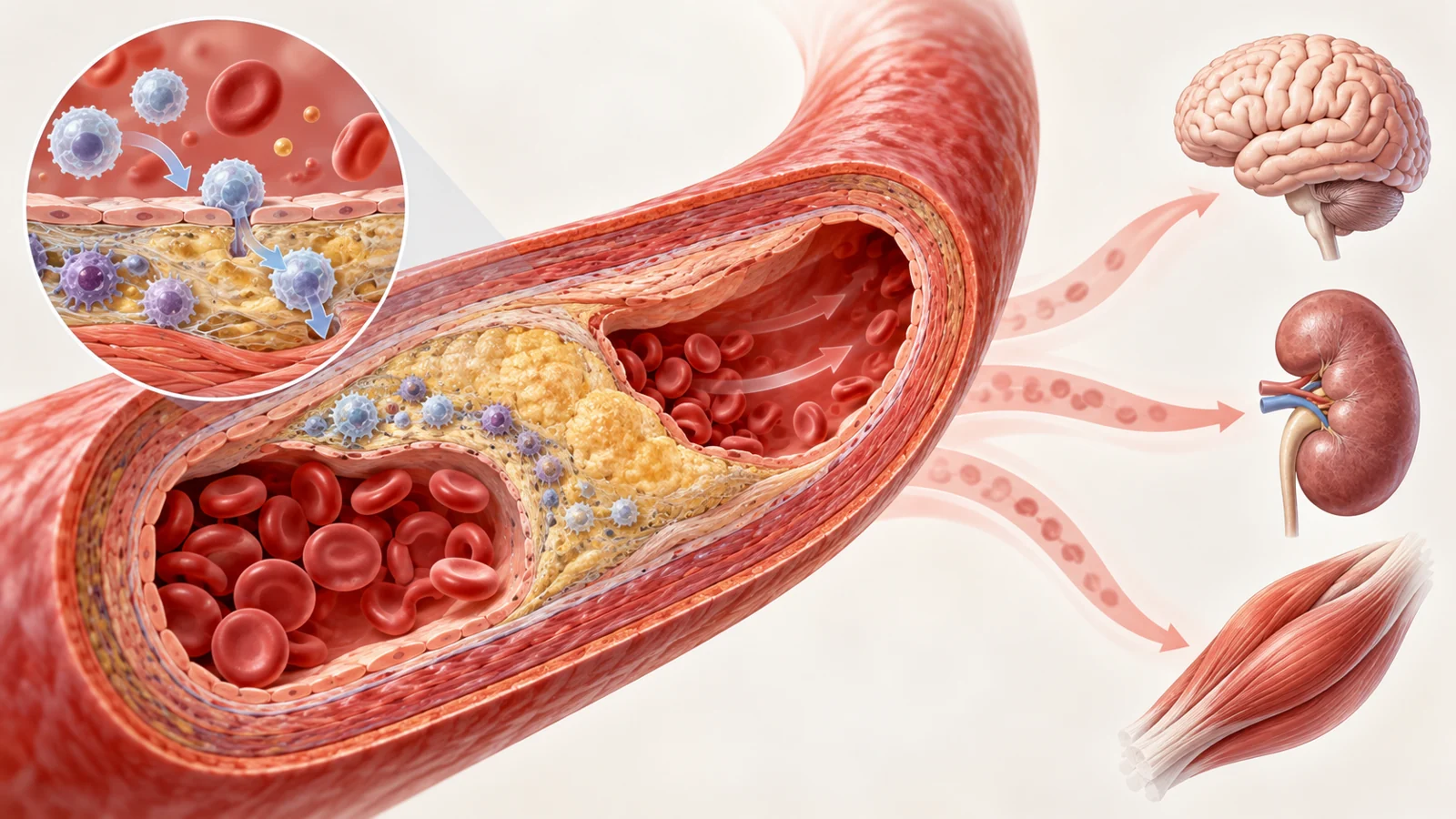
With age, oxidative stress can rise as mitochondria become dysfunctional and other cellular sources generate reactive oxygen species. These molecules can reduce nitric oxide by converting it into peroxynitrite. With less nitric oxide available, the vessel loses part of its protection. Redox-sensitive signaling can also raise levels of adhesion molecules and chemokines, which help immune cells attach to the lining and move into the artery wall.
There, monocytes can become macrophages and take up oxidized LDL, a modified form of cholesterol-carrying particles. Lipid-filled macrophages are called foam cells. Their accumulation contributes to fatty streaks and growing plaque. The review describes age-related immune changes that may reinforce the process: adaptive immunity shifts, inflammatory signals rise, and some aged macrophages show altered behavior, including greater uptake of oxidized LDL.
These pathways offer a way aging could help set the stage for atherosclerosis. They do not settle whether aging alone is enough to cause substantial plaque.
Plaque may affect organs beyond the artery
As plaque narrows arteries or disrupts their integrity, downstream tissues can receive less blood. The review describes chronic ischemia—an ongoing shortage of blood and oxygen—as one route by which atherosclerosis could contribute to wider functional decline.
The brain, kidneys and skeletal muscles are among the tissues discussed. Reduced supply to the brain may impair energy production in neural tissue and contribute to cognitive decline. In the kidneys, impaired microcirculation is associated in the reviewed evidence with declining filtration and tissue changes. In muscle, chronic ischemia is linked to reduced strength and exercise tolerance. These are proposed consequences of prolonged vascular dysfunction, not proof that plaque independently causes human aging across organs.
A second route runs through inflammation. Immune cells in plaque release cytokines, chemokines and other signals. The review describes how such signals may circulate beyond the artery wall and promote inflammatory or senescence-related changes in distant tissues. Blood-flow restriction and inflammatory signaling are related parts of the same disease context, but they are distinct possible routes from local plaque to effects elsewhere.
The direction of cause remains disputed
The review describes disagreement over whether aging is an independent driver of atherosclerosis or a factor that makes arteries more vulnerable to other insults. Support for the first view includes age-related vascular changes and plaque-like lesions reported in aged animal models without added metabolic disease. In the alternative account, aging creates a susceptible setting, while dyslipidemia, insulin resistance or hypertension supplies additional pressure that helps drive plaque formation.
Inflammation’s role is also contested. It may help initiate plaque by activating the endothelium and encouraging immune-cell entry. Or it may intensify after oxidative stress, lipid oxidation and plaque development have already begun. Both directions may operate at different stages, but the evidence summarized in the review does not resolve the causal sequence in people.
Treatment evidence depends on the intervention
The review discusses human cardiovascular trial evidence for targeted anti-inflammatory treatment. It cites CANTOS, in which the IL-1β-targeting drug canakinumab reduced recurrent myocardial infarction and cardiovascular mortality in patients with elevated hs-CRP, and COLCOT and LoDoCo2, which support colchicine for secondary prevention. These findings give the inflammatory pathway clinical relevance for cardiovascular disease. They do not show that every anti-inflammatory strategy slows systemic aging.
The evidence for senolytics and NAD⁺ approaches is at a different stage. In animal studies summarized by the review, dasatinib plus quercetin and fisetin reduced vascular senescence-related measures or inflammation, while NAD⁺ precursors improved measures tied to mitochondrial function and vascular biology in preclinical models. Early human senolytic work in conditions such as idiopathic pulmonary fibrosis concerns safety and biological activity in those settings; it is not evidence of an atherosclerosis benefit. The review also describes ongoing trials of NAD⁺ precursors, but the cited animal findings do not establish that these supplements prevent cardiovascular events or slow aging in people.
There is a particular safety concern with clearing senescent cells indiscriminately. Some senescent vascular smooth muscle cells may help maintain the fibrous cap that covers plaque. Removing cells that contribute to that structure could weaken the cap and raise the risk of plaque disruption. A treatment that improves one aspect of vascular aging could therefore create another hazard if it compromises plaque stability.
What protecting arteries could mean for aging organs
If future treatments preserve healthy blood flow and reduce harmful inflammatory signaling without weakening plaque caps, they might help protect function in the brain, kidneys and muscles alongside cardiovascular health. That possibility depends on showing meaningful benefit in people and demonstrating that interventions do not compromise the structures that keep plaques stable. The review outlines a reason to study vascular health as part of healthy aging; it does not establish that current senolytics or NAD⁺ supplements deliver that broader benefit.
Key Sources
- Primary source: The Complex Bidirectional Relationship Between Aging and Atherosclerosis: Mechanistic Insights and Translational Opportunities.
DOI or Journal Page · Review or Meta-Analysis · 2025-06-20
Keep exploring