
Research Signal – Source date 2022-01-21
Aging can leave the body in a puzzling state: inflammatory signals may remain elevated, yet the immune system can become less effective at responding to infection. The two observations are not opposites. They can arise from different failures in a system that needs both rapid activation and accurate control.
The review Interconnections between Inflammageing and Immunosenescence during Ageing, published on January 21, 2022, examines this relationship. It uses “inflammaging” to describe persistent, low-grade inflammation associated with aging. “Immunosenescence” refers to age-related changes in immune function, including weaker responses to pathogens and reduced vaccine effectiveness. The review brings together evidence from cell experiments, animal studies, human cohorts, and intervention research. It does not describe a newly conducted experiment or establish one complete human mechanism.
Why background inflammation does not guarantee stronger protection
Acute inflammation is useful. After an injury or infection, a coordinated sequence recruits immune cells, helps clear threats, and supports tissue repair. The problem is persistent activation without a suitable trigger, or a failure in the signaling and effector systems that should resolve the response. Chronic low-grade inflammation can then become part of the biological burden associated with later life.
At the same time, aging can reduce the immune system’s ability to recognize and respond to new threats. Barriers, innate immune cells, and adaptive immune cells all change over time. The review describes reduced responsiveness to pathogens and often weaker vaccine responses in older adults. A person may therefore have more inflammatory activity at baseline while lacking the well-timed, effective response needed to control an infection.
This helps explain why inflammation should not be treated as a simple measure of immune strength. A continuously active system is not necessarily a prepared system. Protective immunity depends on timing, coordination, and the ability to resolve a response after it has done its work.
A feedback loop involving senescent cells
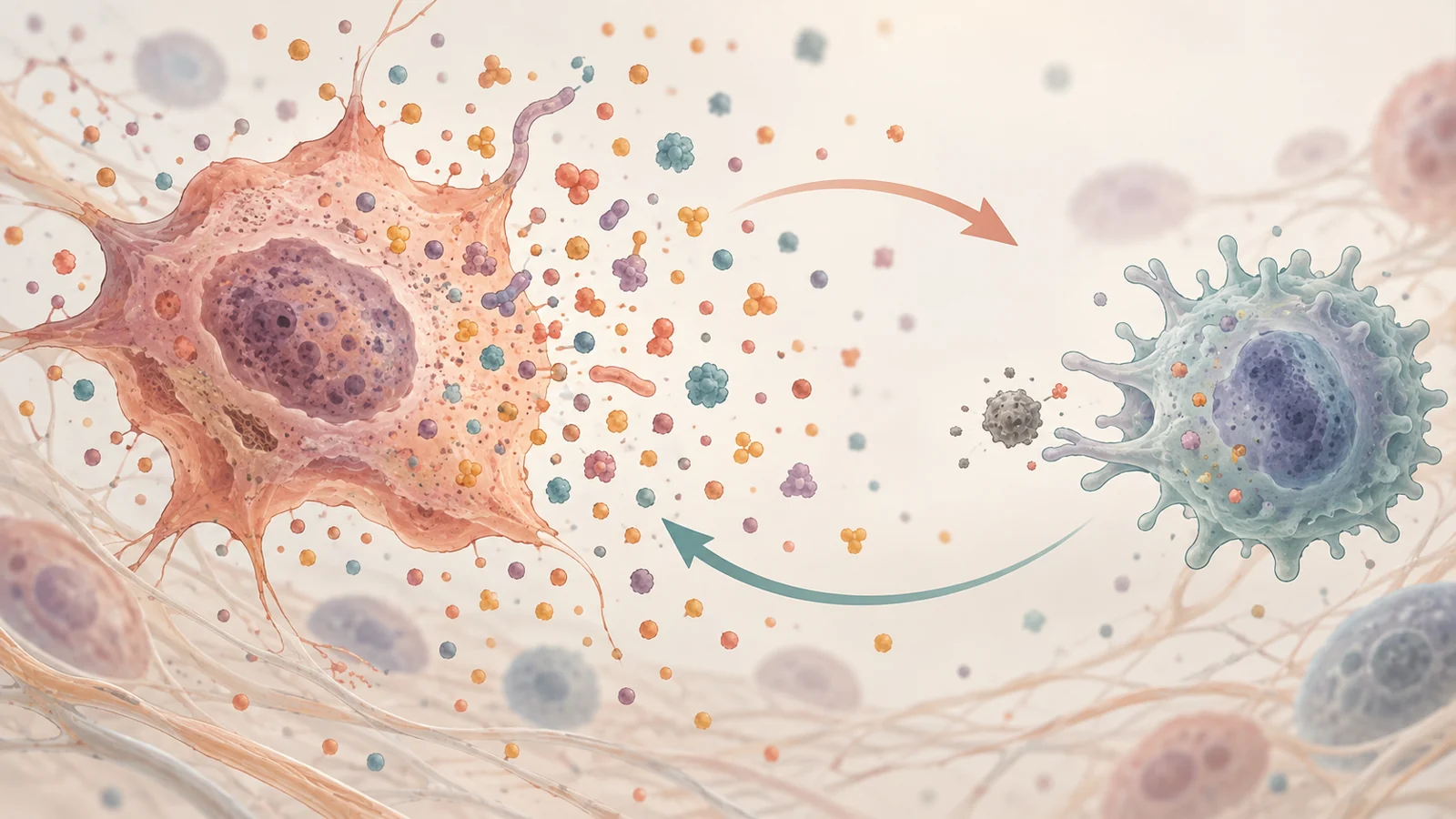
One proposed connection runs through cellular senescence. Many senescent cells release a mixture known as the senescence-associated secretory phenotype, or SASP. The mixture can include inflammatory cytokines, chemokines, soluble receptors, proteases, and growth factors.
The contents of this secretion are not universal. They vary with the cell lineage, the trigger that produced senescence, and the amount of time that has passed. That variability matters because it makes “senescent cells” a broad biological category rather than a single uniform population.
The review describes a potentially self-reinforcing relationship. Senescent cells can add inflammatory signals to their surroundings. Chronic inflammation can promote telomere dysfunction and further senescence. Meanwhile, aging immune surveillance may become less effective at identifying and removing senescent cells, allowing them to accumulate. The resulting relationship could connect cellular aging, persistent inflammation, and declining immune protection.
Mouse experiments illustrate one part of this process without proving the entire loop in humans. In one set of studies, transplanting senescent cells into a mouse knee joint produced an osteoarthritis-like tissue state. Removing senescent cells locally reduced the joint changes. The finding supports the idea that senescent-cell secretions can influence neighboring tissue, but it is a bounded tissue experiment, not evidence that the same intervention prevents infection or reverses aging throughout a person.
A blood marker needs biological context
The meaning of an inflammatory measurement depends on what produced it, where it was measured, and what else is happening in the body. IL-6 is a useful example. It is an immune signaling protein often associated with inflammation, but the same molecule can participate in different biological responses.
During exercise, muscle can release IL-6 in a signaling role that differs from chronic inflammatory activity. The review describes evidence that this exercise-associated IL-6 can stimulate anti-inflammatory mediators such as IL-1RA and IL-10 and reduce macrophage production of TNF-alpha. A high IL-6 value therefore cannot be interpreted in isolation as proof of harmful inflammation. Age, disease state, tissue, and recent physical activity all matter.
The same caution applies to anti-inflammatory factors. Their elevation may represent an attempt to damp down a pro-inflammatory response rather than a cause of harm. A high level may indicate that compensation is working, failing, or responding to a different process. The balance between related signals may be more informative than the concentration of one molecule alone.
Population findings also need careful interpretation. In the cohorts discussed by the review, the relationship between inflammatory scores and mortality was not equally strong at every age. Associations were more pronounced in some older groups and less clear among people who had reached very advanced ages. Differences in health, disease burden, and survival may all affect what a marker means in a particular population. A change in a blood test is therefore not interchangeable with a change in clinical protection.
Exercise shows why timing changes the signal
The exercise evidence adds a time dimension. A bout of resistance training may cause a brief rise in an inflammatory marker such as IL-6. In the context described above, that short-lived response can be part of signaling from active muscle rather than evidence of damaging chronic inflammation.
Over a longer period, the pattern can look different. Lifelong endurance training was associated with lower levels of pro-inflammatory markers in observational studies. Separate interventions introducing regular endurance or resistance training to older adults were reported to reduce baseline inflammatory markers over time. The review also describes exercise as relevant to the relationship between inflammation and muscle function: persistent inflammation may contribute to weakness and sarcopenia, while physical activity can help reduce both risks in the studies discussed.
These findings distinguish an immediate biological response from a longer-term change in baseline state. They do not establish a head-to-head ranking of exercise against drug interventions, and they do not turn a marker pattern into a universal exercise prescription. The important point is interpretive: the same measurement can carry different meaning depending on when it was taken and what the body was doing.
Two intervention logics with different endpoints
The review discusses interventions that target different parts of the problem. Senolytics aim to remove selected senescent cells, reducing the signals those cells release. In mice, approaches involving senescent-cell removal were associated in particular experiments with improved tissue integrity, lower local inflammatory signals, or longer lifespan. In people with diabetic kidney disease, the review describes clinical-trial findings in which a senolytic combination was associated with reduced indicators of senescence, fewer macrophages, and lower levels of some circulating SASP factors.
Those are different kinds of observations. Mouse tissue and lifespan findings do not establish human lifespan extension. Changes in senescence-related or inflammatory indicators in people with diabetic kidney disease do not establish a generally effective immune-rejuvenation treatment for healthy older adults. They also do not show that lowering every SASP-related molecule would produce the same outcome.
mTOR inhibitors follow another logic. Signaling through mTOR helps regulate the metabolic changes involved when T cells switch between active effector states and memory states. The review reports findings that older adults receiving mTOR inhibitors had improved T- and B-cell responses to influenza vaccination and a reduced incidence of respiratory tract infections in the cited studies.
The immune effect depends on the intervention context. At high doses, these drugs can suppress immunity; at lower doses, the reviewed findings describe potentially immune-protective effects. That dose-dependent tradeoff is a reason not to treat “more inhibition” as automatically better. The senolytic and mTOR findings concern different populations, mechanisms, endpoints, and evidence types. They are not a head-to-head comparison and do not support combining treatments or using them without clinical evaluation.
What this could mean for infection protection in later life
The January 2022 perspective points toward a broader goal than lowering a laboratory value. Older adults could eventually retain more effective vaccine responses and greater resistance to respiratory infections if interventions can address persistent inflammation and age-related immune dysfunction together. The potential benefit would be fewer vulnerabilities when a pathogen appears, not simply a more favorable inflammatory panel.
That possibility remains conditional. An intervention would need to preserve the acute inflammatory responses that help clear infection, work safely in the intended populations, and produce durable improvements in meaningful health outcomes. The review’s central lesson is that inflammaging and immunosenescence should be interpreted as connected but distinct problems: reducing background inflammatory pressure may matter most when it also helps the immune system respond at the right time and in the right way.
Key Sources
- Primary source: Interconnections between Inflammageing and Immunosenescence during Ageing.
DOI or Journal Page · Review or Meta-Analysis · 2022-01-21
Keep exploring