
Research Signal – Source date 2025-10-13
Why treatment choices can be difficult to predict
People with colorectal cancer can receive surgery and treatments such as chemotherapy, radiation, targeted drugs, or immunotherapy. Yet patients with similar diagnoses may respond differently. A treatment that controls one person’s cancer may bring another person side effects without enough benefit.
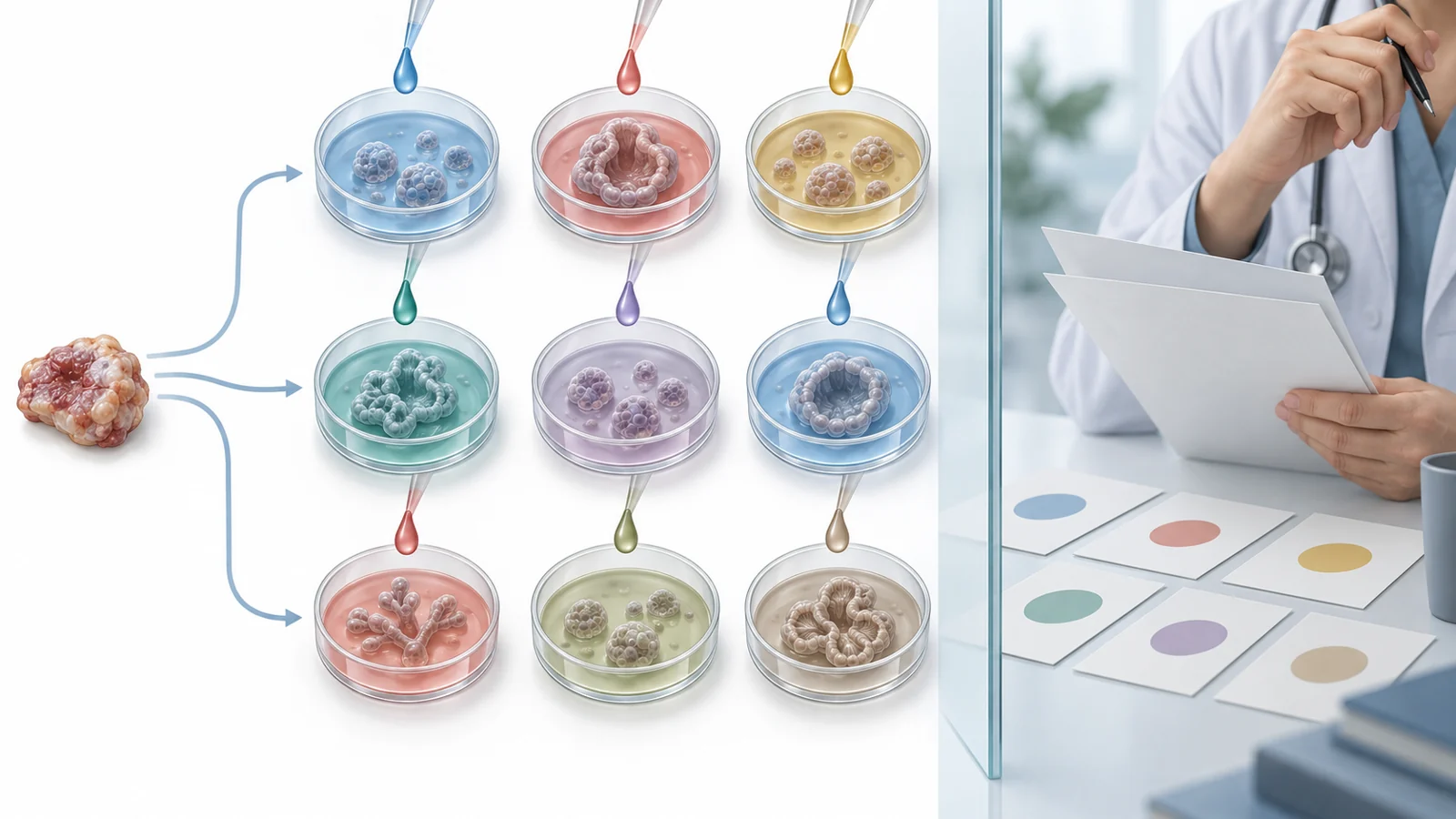
The review published in 2025 considers whether patient-derived organoids could help address this uncertainty. An organoid is a three-dimensional culture grown from a patient’s tumor tissue. Researchers can expose it to drugs and observe how the cells respond, offering a way to investigate a particular tumor outside the body.
The idea is useful because ordinary cell cultures can leave out features of a tumor’s organization and biology. Patient-derived organoids can preserve selected genetic, protein, and structural characteristics of the original tumor. They are still models, though: resemblance can make a laboratory result more relevant to a patient’s cancer, but it does not make the dish equivalent to the person.
A tumor sample has to become a reliable model
Organoids can be grown from primary tumors or metastatic lesions. Researchers compare them with the original tissue, including its markers and genetic features, to check whether the culture represents the tumor they intend to study.
There is also a practical complication in the sample itself. Healthy colon cells may grow faster than cancer cells in culture. If healthy cells overtake the tumor cells, a drug assay could reflect the wrong population. The review describes using selective culture conditions to favor tumor organoids and reduce that risk.
Once established and checked, a culture can be tested against one or more treatments. The result is a measurement of how those cells behaved under laboratory conditions. Whether that response predicts what happens in a patient is a separate question—and the answer may depend on the drug, disease setting, and way the organoid was grown.
Chemotherapy findings are encouraging, but specific
The review summarizes studies in which organoid sensitivity was associated with patients’ responses to chemotherapy. In one study of colorectal cancer liver metastases, organoid sensitivity to FOLFOX or FOLFIRI was associated with clinical response and prognosis. Another study reported correlations between organoid sensitivity and patient response for three drugs: 5-fluorouracil, irinotecan, and oxaliplatin, with reported correlation coefficients of 0.58, 0.61, and 0.60, respectively.
The same account describes a difference in progression-free survival among patients whose organoids were classified as resistant or sensitive to oxaliplatin: 3.3 months versus 10.9 months. These are findings from particular studies, not a universal performance score for organoid testing.
The review also cites a phase II feasibility study in metastatic colorectal cancer that used organoid drug-sensitivity testing to guide treatment. It reports median progression-free survival of 67 days and median overall survival of 189 days. Feasibility means the approach could be tried in that setting; the example does not show that organoid-guided choices improve survival or quality of life compared with standard treatment selection. Nor can findings from one chemotherapy context be assumed to apply to every drug or patient group.
A mutation can make the treatment question more specific
Targeted treatments depend on features of a tumor, and a broad mutation label may not capture every difference in response. The review discusses variation among RAS mutation subtypes and even among variants at particular positions. It also describes organoid studies exploring treatment combinations for tumors with acquired KRAS mutations and other changes after treatment.
This is one way a patient-derived culture could help researchers ask a narrower question: how do cells from a tumor with a particular molecular profile respond to a proposed drug or combination? Such experiments may reveal candidate vulnerabilities to investigate. They do not, on their own, show that a treatment will benefit the patient, and laboratory findings should not be read as treatment guidance.
Immune response takes more than tumor cells
Immunotherapy presents another modeling challenge. The review notes that many colorectal cancers do not have the molecular features associated with response to immune checkpoint inhibitors, while some tumors that do have those features still respond poorly. Variation in the tumor environment is part of the difficulty.
A tumor-only organoid cannot reproduce all the interactions between cancer cells, immune cells, and supporting cells in a person. Researchers have therefore paired colorectal organoids with immune cells, including a study summarized in the review that cocultured organoids with a patient’s own peripheral blood lymphocytes. The researchers could then examine whether those immune cells killed the tumor cells in the culture.
That experiment offers a way to study tumor-specific immune activity. It does not establish that the coculture accurately predicts a patient’s response to immunotherapy. More complete models would need to capture relevant cell interactions and then be tested against clinical outcomes.
Time and consistency matter in a treatment decision
A useful test must return a result while a treatment choice is still available. Organoid cultures can take time to establish, may fail to grow successfully, and require substantial work and expense. The review notes that these constraints complicate biobanks and practical testing. It also describes efforts to automate culture and analysis, which could improve throughput and consistency, alongside a spheroid approach that classified chemotherapy sensitivity or resistance within a week in a study summarized there.
Speed alone is not enough. Results need to be reproducible across laboratories and culture methods, and studies need to assess whether the test predicts response in the setting where it would be used. Larger clinical studies and standardized approaches are among the needs identified by the review. Its examples show active research, not routine availability of a fast, dependable test.
How a reliable tumor test could change colorectal cancer care
For a patient facing chemotherapy, a timely and reproducible organoid test could help clinicians avoid a regimen unlikely to work for that individual and choose an option with stronger support. That benefit remains conditional: prospective evidence would need to show that using test results to guide treatment improves patient outcomes. Until then, organoids are a promising way to study treatment response, not a proven shortcut from a dish to a better result for patients.
Key Sources
- Primary source: Patient-derived organoids (PDOs) as a promising platform for personalized treatment of colorectal cancer: current applications and future challenges.
DOI or Journal Page · Review or Meta-Analysis · 2025-10-13
Keep exploring