
Evidence date · 2024-08-09 · Research note 1 of 2
1 2
See current Track status →
A study published on August 9, 2024, tested whether starting a senolytic intervention before obvious cognitive problems could influence later function in an Alzheimer’s-model mouse. The answer was specific rather than universal. Monthly dasatinib plus quercetin, often abbreviated D + Q, improved spatial learning and memory recall in female APPNL−F/NL−F mice. The same memory benefits did not appear in male mice, and fisetin did not reproduce them in females.
The result raises a more useful question than whether the treatment “prevented Alzheimer’s.” These mice were not people, and the intervention began before overt impairment in this model. The experiment asks whether changing biological conditions early can be followed by better performance later, while also showing how much the outcome depends on sex, compound and measurement.
The intervention started before the maze changed
Senescent cells have entered a persistent state of cell-cycle arrest. They no longer divide normally, but they can remain biologically active and release a mixture of inflammatory signals known as the senescence-associated secretory phenotype, or SASP. These signals include cytokines and other factors that may influence nearby tissue. In this study, the researchers were interested in whether reducing that senescence-related burden could affect both the brain and the body.
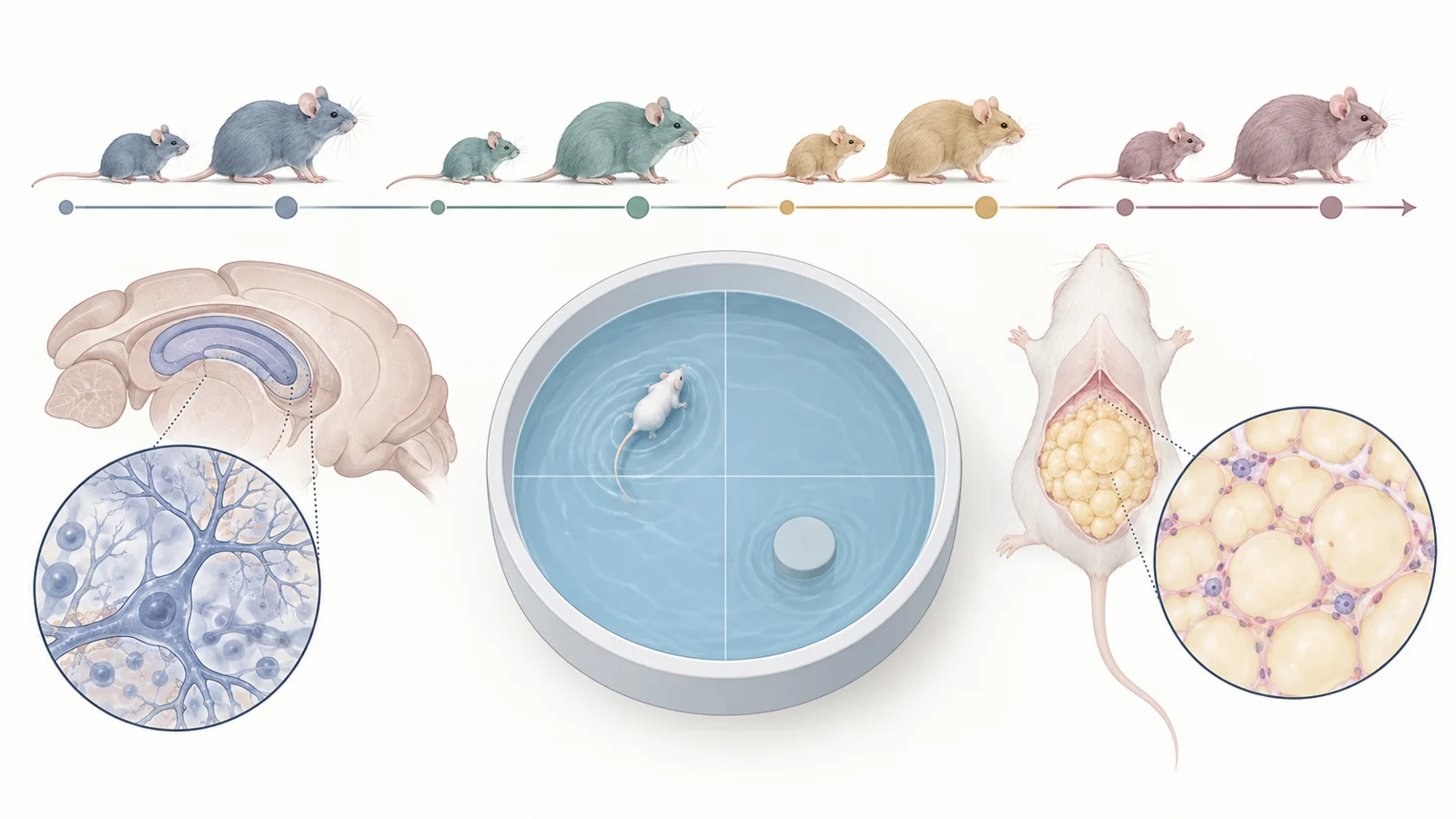
The timing came from a separate baseline cohort, not from the treatment results. At four months of age, female APPNL−F/NL−F mice had higher levels of selected senescence-related and inflammatory markers in visceral white adipose tissue and the hippocampus than age-matched background-strain controls. Male mutation-bearing mice also showed increases in several markers, although the pattern differed. At that age, the APPNL−F/NL−F mice did not yet show overt cognitive deficits, making the period a test of early intervention rather than reversal of established memory loss.
The treatment groups then received vehicle, monthly D + Q, or monthly fisetin from four to 13 months of age. D + Q combined 5 mg/kg dasatinib with 50 mg/kg quercetin; fisetin was given at 100 mg/kg. The compounds were selected as senolytics, meaning drugs intended to clear senescent cells. The schedule was intermittent rather than continuous, reflecting the study’s premise that senescent cells accumulate over time and that an effective intervention might not require uninterrupted dosing.
The maze separated learning from recall
The main cognitive test was the Morris water maze. During five training days, each mouse repeatedly searched for a hidden platform using visual cues around the room. The researchers tracked how far the animals traveled, how directly they navigated and how efficiently they moved toward the platform. After a two-day break, the platform was removed for a probe challenge. More entries into the former platform location and its surrounding target zone indicated better memory for where the escape platform had been.
After months of treatment, female mice receiving D + Q performed better during training. They showed shorter cumulative distances, lower corrected integrated path lengths and greater path efficiency. During the probe challenge, they also made more entries into the platform and surrounding target areas, indicating improved spatial memory recall.
Those observations are more specific than saying that the mice simply became “smarter.” The maze measured navigation to a hidden location and later recall of that location. A separate novel-object recognition test showed no corresponding sex or treatment effects, so the findings did not extend to every memory task used in the study.
The researchers also measured what was happening in the hippocampus, a brain region involved in spatial memory. In female mice, D + Q reduced senescence-associated β-galactosidase staining, selected senescence and SASP markers, soluble amyloid-β42, and several measures of hippocampal plaque burden. These changes occurred alongside the maze improvement, giving the behavioral result a biological context. They do not, however, identify which change produced which other change. Reduced amyloid, altered inflammatory signaling, a shift in senescence-related biology or another consequence of treatment could all be part of the relationship.
The body-wide measurements added a second layer
The D + Q-treated female mice also became lighter, largely because they carried less white adipose tissue. Visceral, subcutaneous and retroperitoneal fat depots were reduced. Indirect calorimetry showed higher oxygen consumption and energy expenditure, without a corresponding change in respiratory quotient. These measurements suggest that the treatment altered energy use and body composition, not simply maze behavior.
Blood measurements were more nuanced. In female mice, D + Q lowered fasting and fed glucose and reduced plasma insulin. Fisetin also lowered fasting glucose. But glucose-tolerance and insulin-tolerance tests were unchanged across the relevant comparisons. Lower glucose or insulin at a particular sampling point is not the same as demonstrating improved glucose tolerance or insulin sensitivity.
The metabolic findings also cannot establish that losing fat caused the memory benefit. Adipose tissue and the hippocampus were measured as connected parts of the same biological question, and both showed treatment-related changes in the female D + Q group. The design did not separate a direct brain effect from an indirect effect involving metabolism, inflammation or body composition.
The comparison groups complicate a simple prevention story
Male mice did not show improved spatial learning or memory recall after either senolytic treatment. That does not mean the males failed to respond biologically. In males, D + Q changed several visceral adipose tissue markers, including increases in p21 and SASP-related gene expression, and it reduced circulating adiponectin. Both D + Q and fisetin increased plasma insulin in male mice. These peripheral changes were not accompanied by a reported decline in maze performance, so they should not be described as cognitive harm.
Fisetin-treated females also showed a mixed response rather than a clean null result. Fisetin increased adiposity, lowered fasting glucose and reduced selected circulating plasma cytokines. During maze training, path efficiency improved in some measures, but memory recall during the probe challenge did not improve. The compound therefore produced biological and behavioral signals without matching the D + Q pattern. Its result does not establish that fisetin has no activity; it shows that this compound, dose and schedule did not reproduce the combination’s memory-recall effect in this model.
The authors propose that sex-related differences in disease progression or senescence burden may help explain the contrast. Female APPNL−F/NL−F mice had higher levels of several markers at the start of treatment and greater amyloid-related measures at later ages in the study. One possibility is that D + Q had more room to act when senescence-related pathology had reached a particular level. That remains a hypothesis, not a demonstrated rule for predicting who will respond.
The timeline limits what can be inferred
The study’s early start matters. Treatment began when the mice had biological changes associated with the model but before overt cognitive deficits. Better performance at 13 months is therefore consistent with an early disease-modifying effect in mice. It is not evidence that the intervention reverses established dementia, and it does not define a treatment window for people.
The assays also unfolded across different months rather than during one synchronized testing period. Metabolic, blood, tissue and cognitive measurements required different procedures and treatment windows. A result observed later cannot automatically be placed in a single step-by-step chain beginning with one dose, followed by fat loss, then a brain change and finally better memory. The measurements show a pattern of associations across the experiment.
The dosing choices add another qualification. The vehicle contained DMSO in canola oil; the same vehicle was used for the treatment comparisons, while the authors noted that canola oil itself can influence weight and plasma lipids. The monthly fisetin schedule also differed from a previously used schedule of several consecutive treatment days. That difference could matter when interpreting fisetin’s weaker memory result. The statistical analysis used two-way ANOVA to examine sex, treatment and their interaction, followed by treatment comparisons. This allowed the investigators to ask whether sex changed the treatment response rather than treating all mice as one group.
Together, the experiment supports a carefully bounded conclusion. In female APPNL−F/NL−F mice, early monthly D + Q treatment was accompanied by better spatial learning and recall, lower senescence-related and amyloid measures in the hippocampus, and changes in adiposity and metabolism. The male and fisetin results show why those observations cannot be converted into a general claim that senolytics prevent Alzheimer’s disease. The study did not establish a clinically usable dose, durable benefit after treatment stopped or safety in humans.
What earlier intervention could mean for preserving memory
For people at risk of Alzheimer’s disease, the most important possibility is an earlier treatment approach that helps preserve memory before substantial impairment develops. The mouse findings point toward that potential by linking intervention during an early biological window with later cognitive performance, while also suggesting that sex, disease stage and treatment choice may shape the outcome.
That possibility depends on several conditions: the relevant senescence-related biology would need to translate to people, the appropriate patients and timing would need to be identified, and the intervention would need to provide a safe, durable cognitive benefit. If those conditions can be met, early treatment could eventually support preserving human memory before substantial impairment takes hold.
Key Sources
- Primary source: Senolytic intervention improves cognition, metabolism, and adiposity in female APP<sup>NL</sup><sup>-F/NL-F</sup> mice.
DOI or Journal Page · Peer-Reviewed Paper · 2024-08-09