
Research Signal – Source date 2024-02-28
Aging changes the cardiovascular system in ways that can be measured before a major event occurs. The lining of blood vessels becomes less able to promote relaxation, while large arteries become stiffer. Both endothelial dysfunction and arterial stiffness are associated with future cardiovascular disease and can contribute to its progression in older adults.
Those changes have made cellular senescence an attractive target for research. Senescent cells have stopped dividing, but they remain metabolically active. Some release a collection of inflammatory signals known as the senescence-associated secretory phenotype, or SASP. Clearing these cells might improve certain vascular functions in aging animals. Yet the same strategy could behave differently in another tissue, which is why the lung circulation matters to the story.
A brief review published on February 28, 2024, assembled the relevant findings rather than reporting a new cardiovascular experiment. It described how senescent vascular cells may contribute to dysfunction, what genetic and drug-based clearance experiments have measured, and where the evidence remains too preliminary for a cardiovascular treatment claim.
Why aging arteries bring senescence into focus
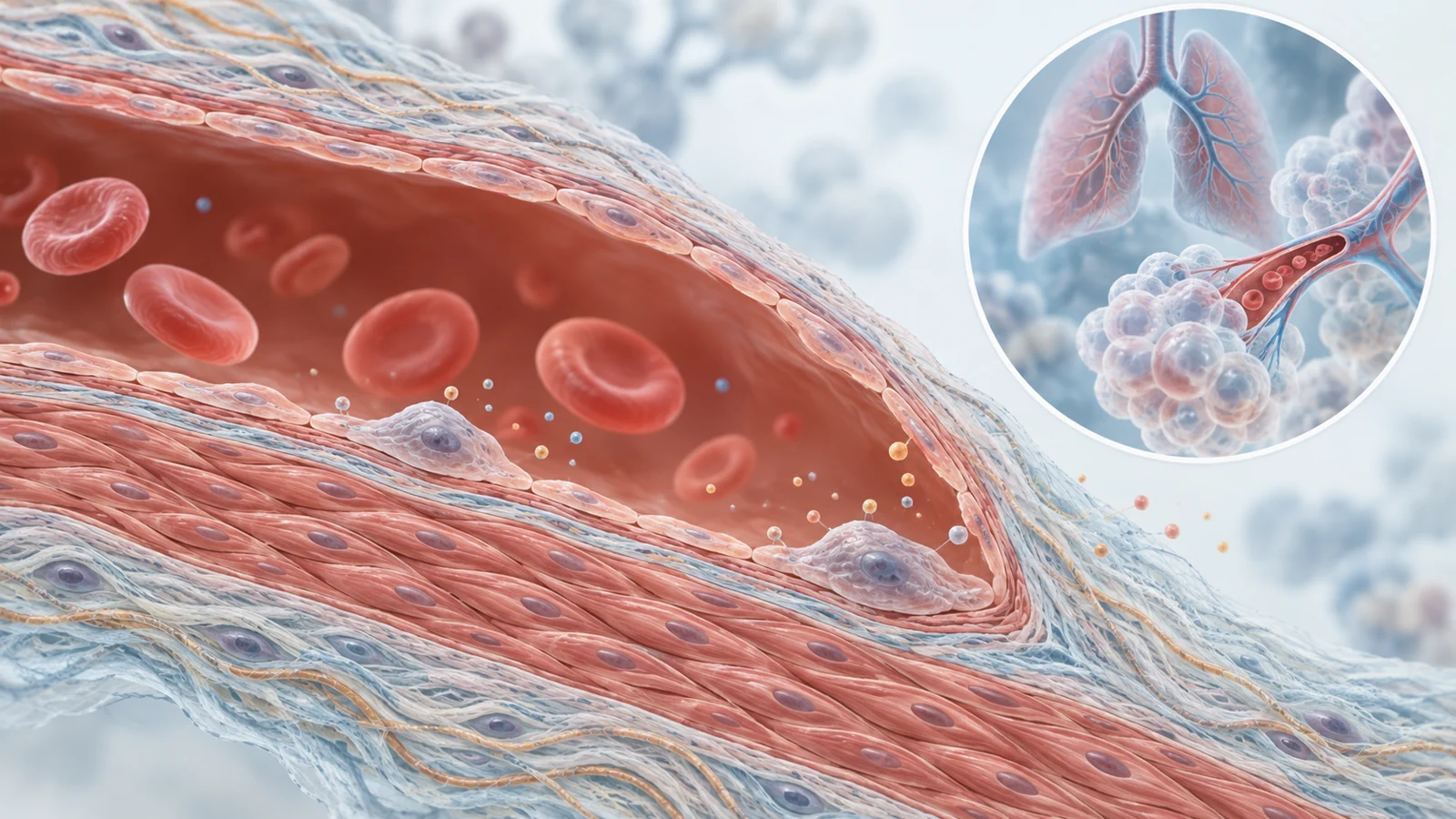
The endothelium is the thin cell layer lining the inside of blood vessels. It helps regulate vessel tone, controls exchanges between the bloodstream and vessel wall, and coordinates the recruitment of immune cells when tissue is injured. One of its most important relaxing signals is nitric oxide, or NO.
With age, endothelial cells can produce less NO and more reactive oxygen species, which contribute to oxidative stress. They can also display more adhesion molecules, including VCAM-1 and ICAM-1. These molecules help immune cells attach to and move through the vessel lining. That response is useful during repair, but chronic activation can sustain inflammation and contribute to endothelial dysfunction.
The surrounding vascular smooth muscle changes as well. Aging can disturb its ability to sense mechanical forces and alter the extracellular matrix that gives arteries their structure. More collagen and damaged or lost elastin can make large arteries less flexible. A vessel that cannot relax normally and an artery that has become stiff create a setting in which blood-flow regulation and vascular health are harder to maintain.
Senescence may help explain part of this shift. A cell entering senescence withdraws from the cell cycle, which can prevent damaged cells from continuing to divide. Senescence can therefore support processes such as wound healing, immune responses, and tumor suppression. The problem arises when senescent cells accumulate, remain active, and continuously release inflammatory factors that affect neighboring cells.
When a protective shutdown becomes a vascular problem
The effect of senescence is not simply that a cell stops dividing. Senescent endothelial cells can lose repair capacity while releasing SASP factors that change the local environment. The review connects this state with lower NO availability, more oxidative stress, and a more inflammatory endothelial surface. Those changes can encourage immune-cell recruitment and promote vascular remodeling.
The SASP is not identical in every cell or disease context. The review describes age-associated proteins such as GDF15, FAS, osteopontin, TNFR1, activin A, CCL3, and IL-15 as part of a combination associated with age, frailty, and adverse surgical outcomes in one older cohort. That observation does not turn any single protein into a universal measure of senescence. It illustrates why the inflammatory output of senescent cells may be biologically important while still varying across tissues.
In aging arteries, the concern is cumulative. Endothelial dysfunction can make the vessel lining more permissive to inflammation, while smooth-muscle and matrix changes reduce arterial compliance. Senescent cells may therefore be one contributor within a broader process involving vascular cells, immune signals, oxidative stress, and structural remodeling.
What the animal experiments actually changed
Some of the clearest evidence came from engineered mouse systems designed to identify and remove cells expressing senescence-associated markers. In the p16–3MR model described by the review, a senescence-sensitive promoter helped track cells, and the drug ganciclovir could activate apoptosis in the marked population. Removing those cells alleviated atherogenesis and stabilized plaques in the arterial wall. Another inducible model, INK-ATTAC, provided related proof-of-concept support for eliminating p16-positive senescent cells.
These experiments are different from giving an ordinary drug to an aging animal. The genetic systems were built to identify a selected cell population and make its removal possible. Their value was to test whether senescent-cell clearance itself could alter vascular disease-related features.
Pharmacological senolytics approach the problem through cell-survival mechanisms. Senescent cells can rely on senescent cell anti-apoptotic pathways, or SCAPs, to remain alive. Drugs that interfere with those survival pathways may make senescent cells more vulnerable while sparing at least some nonsenescent cells. The agents discussed in the review are not interchangeable, and their effects depend on the cells and models being treated.
The combination of dasatinib and quercetin, often abbreviated D&Q, produced senolytic effects in cultured human endothelial cells and showed vascular benefits in aged mice. Chronic treatment improved age-related vasomotor function, increased NO bioavailability, and reduced aortic calcification and osteogenic signaling in the animal studies summarized by the review.
The review also describes a separate line of experiments involving BCL-2-family inhibitors, including ABT263, or navitoclax. In aged p16–3MR mice, both genetic clearance with ganciclovir and treatment with ABT263 improved endothelial function by increasing NO bioavailability and reducing oxidative stress. Arterial stiffness, measured by pulse-wave velocity, was reduced toward levels seen in young mice. These are meaningful experimental vascular outcomes, but they remain outcomes in animals exposed to particular interventions.
Why the same strategy may behave differently in the lungs
A tissue can contain senescent cells that are harmful in one setting and potentially protective in another. The review highlights this possibility through pulmonary hypertension experiments in mice. In a hypoxia-related model, treatment with ABT263 or FOXO4-DRI aggravated the severity of monocrotaline-induced pulmonary hypertension.
The finding does not establish that senolytic treatment harms people with pulmonary disease. It does show why clearing senescent cells cannot be treated as a universally beneficial operation. In the pulmonary circulation, senescence might sometimes restrain a damaging process or interact with the disease in a way that differs from aging in the systemic arteries. The authors therefore raise the possibility that removing these cells could worsen pulmonary hemodynamics in some contexts.
This biological context changes the central question. It is not only whether a drug can reduce a marker of senescence or improve one measurement of vessel function. It is also whether the treatment reaches the relevant cells, whether it leaves useful protective functions intact, and whether its effects differ between vascular beds.
Early human signals are not cardiovascular results
The human studies discussed in the review provide context for translation, but they do not answer whether senolytics treat cardiovascular disease. In a preliminary study of 14 people with idiopathic pulmonary fibrosis, a three-day-per-week regimen of D&Q for three weeks was associated with high retention and completion rates. Participants showed improvements in six-minute walk distance and four-minute gait speed, and those physical-function changes were correlated with reductions in some SASP factors. Pulmonary function itself did not show a significant improvement.
A separate preliminary phase 1 study in people with diabetic kidney disease found that D&Q reduced senescence burden in adipose and epidermal tissue. The change was associated with lower circulating cytokines and matrix metalloproteinases. These findings suggest that senolytic treatment can influence biological markers and some functional measures in selected human studies.
They are not evidence of cardiovascular treatment efficacy. The diseases, tissues, participants, interventions, and outcomes differ from the aged-artery question. They also do not establish a broadly safe cardiovascular regimen or show that clearance prevents heart attacks, strokes, or cardiovascular death.
The review identifies cardiovascular clinical translation as unresolved, along with the longer-term systemic effects of removing senescent cells. Short-term improvements in animal endothelial function and arterial stiffness are encouraging, but they do not establish a durable benefit for human lifespan or cardiovascular health. A treatment that removes cells throughout the body may have consequences that cannot be inferred from one vascular measurement.
What targeted cell clearance could mean for aging arteries
The most useful future possibility is a treatment that selectively reduces harmful senescent-cell activity or burden in aging blood vessels while preserving protective functions elsewhere. For older adults, the practical benefit would be better-maintained vessel relaxation and arterial flexibility, potentially supporting healthier cardiovascular aging.
That possibility depends on more than finding a compound that clears senescent cells. The vascular benefit would need to persist in people, remain safe over time, and avoid damaging functions that senescence may still serve in other tissues, including the pulmonary circulation. If those conditions can be met, targeted cell clearance could become one way to preserve blood-vessel function with age. The evidence available in this February 2024 review makes that a conditional research opportunity, not an established cardiovascular treatment.
Key Sources
- Primary source: Targeting vascular senescence in cardiovascular disease with aging.
DOI or Journal Page · Peer-Reviewed Paper · 2024-02-28
Keep exploring