
Research Signal – Source date 2022-08-29
Aging research has long used a set of biological features to organize a sprawling question: why do organisms become more vulnerable to disease over time? In 2013, researchers proposed nine “hallmarks of aging” that brought several recurring processes into one framework. The list included genomic instability, telomere attrition, epigenetic alterations, loss of proteostasis, deregulated nutrient sensing, mitochondrial dysfunction, cellular senescence, stem cell exhaustion and altered communication between cells.
The framework helped researchers connect findings across the field. But a fixed list can also make processes outside its categories easier to overlook. A meeting-summary review published on August 29, 2022, describes a symposium held in Copenhagen on March 22 that reconsidered the framework and discussed several possible additions.
The proposed expansion is not a declaration that scientists have discovered five more proven causes of aging. It is a change in research emphasis: processes that may contribute to aging and age-related disease could deserve clearer recognition, while the relationships among them may matter as much as the categories themselves.
Five additions that widen the biological picture
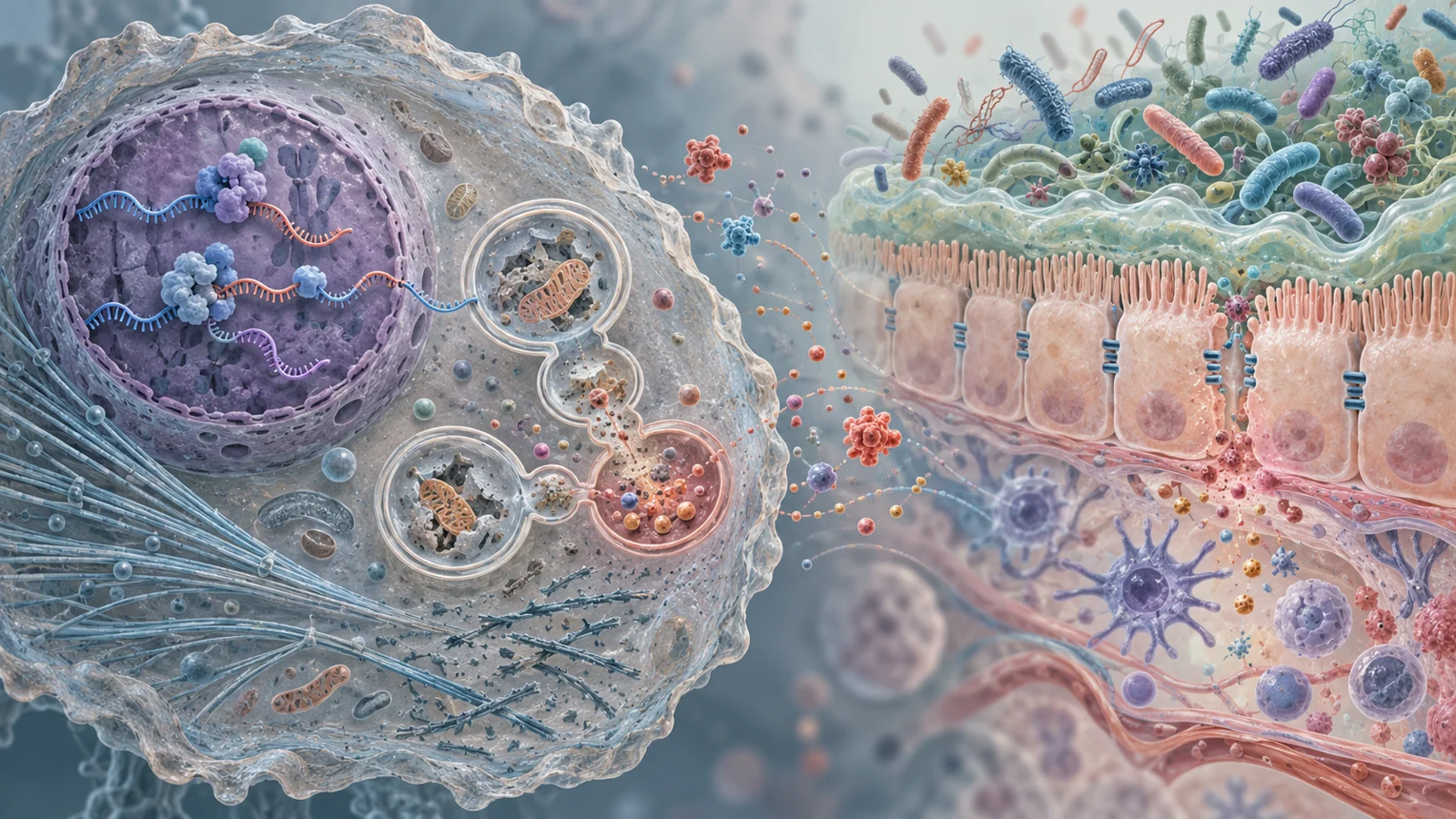
The Copenhagen discussion brought five candidates into sharper focus: compromised autophagy, disturbance of the microbiome, altered mechanical properties, dysregulated RNA processing and inflammation. Some were already present inside broader categories. Elevating them would make their roles easier to investigate on their own terms.
Autophagy is the cell’s recycling and disposal system. The meeting summary describes impaired autophagy in conditions including neurodegeneration and immunosenescence, the age-related weakening of immune function. It also recounts evidence that activating autophagy increased mouse lifespan and improved the response of older humans to vaccination. Those findings come from different settings and measure different outcomes, but they illustrate why the process may be more than a narrow part of protein maintenance. Autophagy also intersects with DNA repair and nutrient sensing, making it a possible integrative hallmark that connects several parts of the framework.
RNA processing adds another layer between genetic information and the proteins cells produce. The summary describes dysregulated RNA processing in human population studies. It separately discusses interventions that appear to reverse senescent features partly by restoring youthful patterns of splicing-factor expression, as well as age-related changes in how messenger RNAs receive their endings. These processes can influence gene expression without changing the underlying DNA sequence. Their inclusion would therefore draw attention to a regulatory layer that sits alongside genome integrity, transcription and epigenetic control.
Mechanical properties make the proposal tangible at the level of cell shape, movement and tissue structure. The review describes aging fibroblasts shifting toward more stable actin stress fibres, which can affect how cells move and communicate. It also discusses changes to the nuclear lamina and to the extracellular matrix around cells. A stiffer or less elastic environment can alter cell behavior, so the physical setting in which a cell operates becomes part of the aging question.
The microbiome and inflammation widen the picture beyond individual cells. Age-associated changes in gut microbial populations include shifts in abundance and reduced species diversity. The meeting summary also links these changes with weakened tissue barriers, including the gut barrier and the blood–brain barrier, as contributors to inflammation. Inflammation, often discussed under altered intercellular communication, was considered important enough to merit separate attention because it appears across many age-related diseases and interacts with cellular senescence and microbial changes.
When the parts interact
A list is useful for naming processes, but aging does not proceed in neatly separated compartments. A disturbed microbiome may matter partly because a weakened barrier changes what reaches surrounding tissues. Inflammation can then affect communication between cells, alter tissue behavior and interact with senescent cells. Those relationships do not turn the proposed hallmarks into a proven chain of causes. They show why an isolated category may give an incomplete account of what is happening in an aging organism.
The panel therefore argued for treating the hallmarks as a network. This changes the unit of explanation. Instead of asking only whether one process rises or falls with age, researchers can ask how several changes reinforce, offset or reshape one another across tissues. Systems-biology approaches may be useful for that task, although the meeting summary emphasizes that the field still lacks a unified theory that fully explains aging.
That network view also helps explain why the same biological process can appear in more than one category. Autophagy may affect proteostasis, metabolism and DNA repair. Inflammation may reflect communication between cells while also being influenced by microbes, barrier integrity and senescence. The categories remain a practical way to organize research, but their boundaries are not the boundaries of biology.
What the senolytic example reveals
The discussion of senolytics shows why a promising target can produce a more complicated result than a single headline suggests. Senolytics are treatments intended to remove senescent cells, which can accumulate and release inflammatory signals. The meeting summary recounts a modeling analysis of existing mouse data that separated median lifespan from maximum lifespan.
In that analysis, senolytic treatment was associated with a striking increase in median lifespan, while the increase in maximum lifespan was marginal. Those are not interchangeable measures. A population may experience a longer typical survival without a comparable shift in the furthest ages reached by its longest-lived members.
The modeling also raised a possible tradeoff. Senescent cells may have harmful effects, but they can also contribute to processes such as wound healing. Removing them could improve survival over a shorter interval while reducing some capacity for repair, potentially allowing senescent cells to accumulate more quickly after treatment ends. The proposed repair mechanism is a modeling hypothesis, not an experimentally established explanation of harm in people.
The example matters because it makes the framework’s central difficulty concrete. The modeling raises the possibility that a survival benefit could come with a cost to repair capacity. A target that looks attractive when viewed through one endpoint may look less simple when repair, timing and longer-term consequences are considered.
The distance between a framework and a treatment
The Copenhagen paper is a review of symposium presentations and panel discussion. It brings together evidence from cellular experiments, animal studies, modeling and human research, but those pieces do not constitute one intervention trial or one complete test of the expanded framework. Each finding belongs to its own biological system and endpoint.
That matters for interpretation. Evidence that autophagy changes with age, that microbial communities shift, or that inflammation is associated with age-related disease can support further investigation. It does not by itself establish that manipulating the whole network will prevent disease in humans. Likewise, the mouse senolytic analysis cannot be treated as a forecast of equivalent human lifespan effects.
The panel also emphasized the practical demands of translation. Human studies would need to resolve safety, dose, concentration and treatment timing, rather than assuming that a mechanism observed in cells or mice can be transferred directly into care. The review describes progress toward interventions aimed at senescent cells and the NAD+ system, but it also notes limitations and unresolved questions.
The larger choice remains open. Researchers may eventually find ways to influence a central process, or they may need combinations that address several interacting changes. The expanded hallmarks are useful partly because they keep both possibilities visible. They broaden the questions before claiming that the answers are settled.
What a broader view of aging could mean for treating disease
A more connected understanding of aging could eventually help researchers identify biological mechanisms shared by several age-related diseases. If the proposed relationships yield reliable intervention targets, and if treatments can address them with acceptable safety and meaningful benefit in humans, older adults might preserve health for longer rather than receiving separate solutions for each disease after it appears.
The Copenhagen discussion does not establish that such an intervention exists, or whether one treatment or several would be needed. Its contribution is more foundational: it encourages researchers to investigate aging as a set of interacting biological changes whose shared mechanisms may offer broader opportunities for protecting health.
Key Sources
- Primary source: New hallmarks of ageing: a 2022 Copenhagen ageing meeting summary.
DOI or Journal Page · Review or Meta-Analysis · 2022-08-29
Keep exploring