
Evidence date · 2022-04-29 · Research note 1 of 2
1 2
See current Track status →
Concrete is strong in compression but comparatively weak in tension. As cement-based materials harden and shrink, that imbalance can help cracks form. Once a crack opens, water and gases have a route into the cementitious matrix, where they can contribute to deterioration and reinforcement corrosion.
A laboratory study published on April 29, 2022, tested whether superabsorbent hydrogels could help manage that early shrinkage. The central result was a tradeoff: cement pastes containing hydrogels showed less autogenous shrinkage than a control paste, but they also developed lower compressive strength. The result is useful precisely because it separates two questions that are easy to blend together. A material can reduce one route to cracking without automatically becoming stronger or proving that a damaged structure will recover its original load-bearing capacity.
Following stored water through hardening
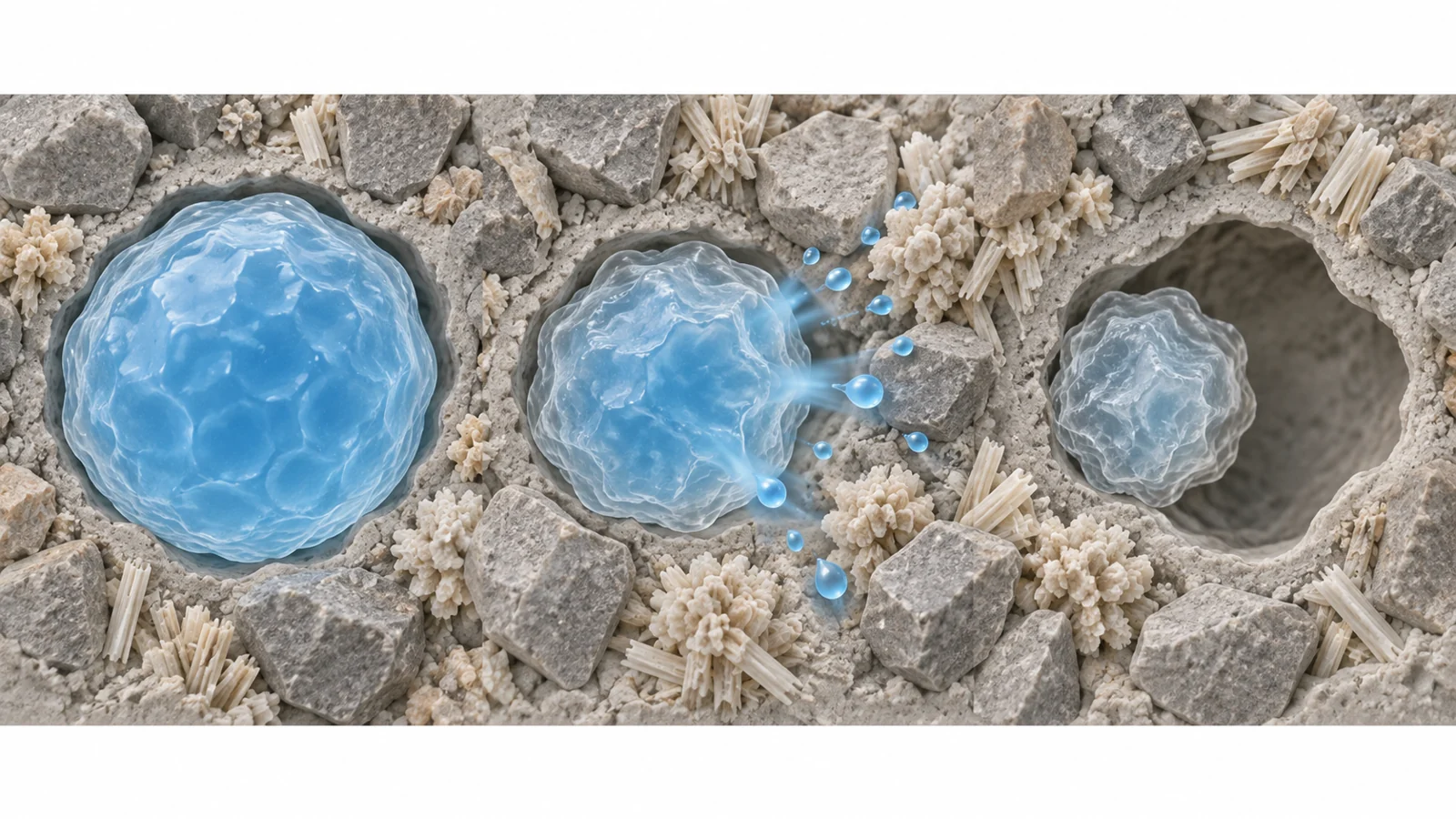
Hydrogels are three-dimensional polymer networks with water-attracting chemical groups. They can take up and hold a large amount of liquid while retaining their structure. Mixed into cement paste, a swollen particle acts as a small internal reservoir. As hydration proceeds and water becomes less available inside the hardening matrix, the stored water can be released back toward the surrounding cement.
This process is called internal curing. Its immediate role is to make water available within the material while hydration continues, helping limit the internal moisture changes associated with autogenous shrinkage. The timing matters: a gel that releases water more slowly can behave differently from one that gives up its stored water quickly.
Internal curing is related to, but not identical with, self-healing. Cement can naturally close some small fissures when unhydrated particles continue to react or when mineral products precipitate within a crack. A hydrogel may support that environment by storing water and by swelling when liquid enters a developing crack. Those mechanisms describe a pathway for healing activity; they do not by themselves show how much load a cracked material can regain.
The comparison depended on gel chemistry
The researchers synthesized hydrogel particles with different chemical compositions. Some formulations were acrylic-based and did not include silica. Others incorporated silica-related additions, including nanosilica or water glass, a sodium-silicate material already used in some cementitious products. The purpose was to examine how the gel and its surrounding cement chemistry interact, rather than to treat every water-storing particle as interchangeable.
The paper’s shrinkage measurements used three thin corrugated plastic-tube specimens for each mixture. The tubes were about 420 millimeters long and 29 millimeters in outside diameter. Measurements were taken every 12 hours during the first week, beginning after the final set identified with a Vicat needle test. The test method limited external moisture loss and restraint on length change, while horizontal plastic trays supported the specimens to reduce breakage.
Across the comparisons, hydrogel-containing pastes showed less autogenous shrinkage than the control. The response varied with the chemistry of the hydrogel. The conclusions associate particularly small shrinkage with a formulation that had a delayed desorption rate, meaning that its stored water was released more gradually into the cement matrix. Lower shrinkage alone is not enough to select a hydrogel formulation or dose for construction: the accompanying strength penalty also matters.
The comparison also points to a material-design problem. A gel must hold enough water to influence hardening, interact acceptably with the surrounding cement, and release that water at a useful time. The same particle can alter the internal structure left behind after it swells and desorbs. Reducing shrinkage therefore involves more than adding a larger water reservoir.
Why a teabag test can tell only part of the story
To measure absorption, the researchers placed a small amount of dry hydrogel in teabags and immersed the bags in artificial cement-pore solutions. At regular intervals, they removed the bags, gently dried their surfaces, and weighed the particles. The change in mass indicated how much liquid the gel had retained.
The test is a practical way to compare how particles behave in a prepared solution. It is not the same environment as a reacting cement mixture. In fresh cement paste, hydrating particles, dissolved ions, and the changing pore structure surround the hydrogel. Chemical groups on the gel surface can interact with the cement particles, altering how much liquid the gel absorbs and how quickly it releases it.
The study found meaningful differences between hydrogels in extracted pore solution and raised a broader caution about interpreting isolated absorption measurements. A particle may appear highly absorbent in a separated liquid while behaving differently once it is embedded in cement. The surrounding solid and chemical environment is part of the material system, not merely background conditions.
That dependence helps explain why the shrinkage response was chemical rather than purely physical. Two gels that both store water can change the hardening paste in different ways, affecting hydration, moisture availability, electrical resistivity, and the structure that remains after the particles lose water.
Strength development is not damage recovery
The compressive-strength tests followed the pastes during curing, with measurements at three, seven, and 28 days. Strength increased with continued curing and time for all of the tested pastes. The hydrogel-containing mixtures, however, had lower compressive strength than the control.
The reported explanation was the formation of macrovoids. After a hydrogel particle changes size and releases water, the space around it can contribute to larger gaps in the cement microstructure. Under compression, those gaps can act as stress-concentration sites. Their size and distribution help determine how readily a force is transferred through the hardened paste, which is why mixtures with different hydrogel behavior could show different strength penalties.
This result supplies the mechanical boundary for the self-healing discussion. Lower shrinkage may reduce one source of crack formation, while macrovoids may weaken the material when it is compressed. Strength measured as a specimen cures is also different from load recovery after a crack has formed. Shrinkage and strength development during curing cannot, by themselves, establish how much load a damaged specimen recovers, which crack widths can close, or which hydrogel heals cracks most effectively.
The experiments therefore establish a laboratory material baseline rather than a finished structural solution. They connect hydrogel chemistry, water absorption inside cement, shrinkage during hardening, and compressive-strength loss. They do not establish that a concrete element will last longer in service, require fewer repairs, or maintain the same performance under changing weather, loads, and exposure conditions. Benefits mentioned as background in the paper, such as chloride resistance or freeze–thaw performance, should not be treated as outcomes demonstrated by these particular comparisons.
What this could mean for longer-lasting concrete
The April 2022 findings point toward a conditional route to concrete that develops fewer shrinkage-related cracks while preserving the water and chemistry needed for its natural healing processes. If future material designs can control hydrogel release and avoid an unacceptable macrovoid penalty, the approach could eventually help infrastructure owners reduce repair demands and limit disruption for people who rely on that infrastructure.
That possibility depends on maintaining adequate mechanical strength and demonstrating durable performance beyond laboratory cement paste. The useful promise is not simply that a gel stores water. It is that the timing and chemical setting of that water might be engineered to support hardening and healing without creating a larger mechanical weakness.
Key Sources
- Primary source: Improving the Self-Healing of Cementitious Materials with a Hydrogel System.
DOI or Journal Page · Peer-Reviewed Paper · 2022-04-29