
Evidence date · 2022-07-21 · Research note 2 of 2
1 2
See current Track status →
Since the previous research note · Partly supported
Track continuity
Since the previous research note: How water-storing gels change cement as it hardens
Previous expectation: Water-storing gels might help produce longer-lasting concrete if their behavior can be controlled without unacceptable mechanical weakness.
What this study adds: The July 2022 study reports reduced shrinkage alongside reduced compressive strength, describes cement-particle interactions that can restrict gel absorption, and reports different healing rates in sand and water. These observations support parts of the material-design premise but do not establish durable performance beyond laboratory materials.
What changed in this study
Mine backfill is material placed into mined-out underground spaces. In cement-based mixtures, its usefulness depends on several properties at once: the material must be workable enough to place, strong enough to remain stable, and resistant to changes that can create cracks or reduce durability.
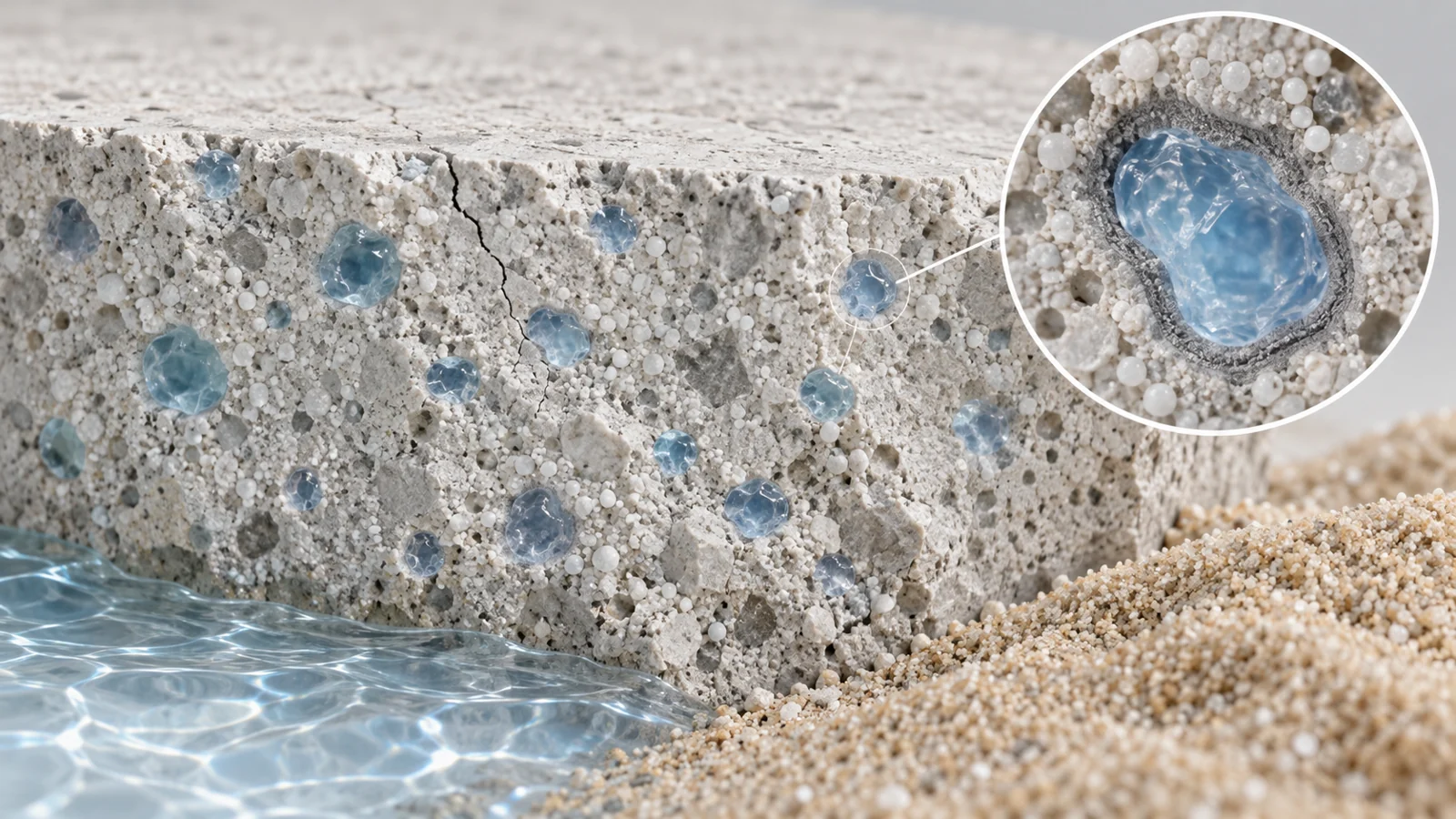
A July 2022 study investigated whether hydrogels could help manage one of those changes. Hydrogels are water-absorbing polymer networks. In a cementitious mixture, they are considered a possible form of internal curing, meaning they can supply water within the hardening material rather than relying only on water moving from outside.
The study examined hydrogel-containing cement-soil pastes in a mine-backfill application context. Its laboratory observations addressed absorption, autogenous shrinkage, compressive strength, electrical resistivity and healing behavior. The paper also compared two computational approaches for relating the measured variables to the study’s prediction target. The reported trends raise a potential tradeoff between shrinkage control and strength, but they do not demonstrate durable performance in an operating underground mine.
Why the mixture environment changes hydrogel behavior
A hydrogel does not absorb water in the same way when it is surrounded by a cement mixture as it does when it is placed in a liquid. Cement particles are chemically active as hydration proceeds. The study describes interactions between hydrating cement particles and the hydrogel surface that can produce a relatively stiff layer around the gel. That layer may restrict how much the hydrogel can absorb inside the cementitious matrix.
This proposed surface interaction matters because the amount of water a gel can take up affects its potential role in internal curing. A gel that absorbs less within the mixture may provide a different water supply than measurements made in an extracted pore solution would suggest. The authors therefore emphasize the direct relationship between solid particles and hydrogels, rather than treating the gel as an isolated water container.
The paper also describes the background mechanism of autogenous healing. When a cement-based material cracks, unhydrated cement particles can remain at the crack surface or inside the paste. With access to additional water, cement compounds dissolve and ions can move into the crack. Once the solution becomes sufficiently concentrated, new hydration products can form there. This is one route by which cement-based materials may close or partly fill small cracks without an external repair operation.
The two ideas are related but not identical. Water availability can support further hydration, while the cement matrix can simultaneously limit how much water a hydrogel absorbs. The performance of the gel therefore depends on its interaction with the surrounding solids, not simply on its absorption capacity measured in isolation.
Shrinkage fell while compressive strength also declined
The central material result is easier to understand when the measured properties are kept separate. Autogenous shrinkage describes dimensional contraction during hardening. Compressive strength describes resistance to a load pushing the material together. A reduction in one does not automatically mean an improvement in the other.
In the reported cement-soil pastes, adding hydrogel was associated with lower autogenous shrinkage. That finding is consistent with the intended internal-curing role: a water-storing phase may help moderate the conditions that contribute to contraction as the material hardens. Lower shrinkage could be useful where cracking from dimensional change is a concern, but it is not the same as proof that an existing crack has healed.
The paper also reports lower compressive strength as nanosilica concentration increased in the hydrogel. Nanosilica means very small silica particles. The available evidence does not establish that the strength, shrinkage and healing results came from one directly comparable experimental sequence. These findings raise a practical question: can a hydrogel formulation reduce shrinkage while retaining adequate resistance to compressive loading?
Electrical resistivity was another measured property. It should not be read as a direct healing score. Resistivity describes how the material responds electrically, whereas healing concerns changes in a crack or in the material’s ability to resist transport through that crack. The study reports that electrical resistivity and compressive strength declined in the cement-soil pastes as nanosilica concentration increased, while hydrogel addition reduced autogenous shrinkage.
The available results do not identify a universally best formulation. They show why a mixture cannot be judged from shrinkage alone. Any useful design would need to consider the balance among dimensional stability, load-bearing behavior and the other properties measured in the laboratory.
Water and sand produced different healing comparisons
The study’s exposure comparison adds a second layer to the material question. Samples incubated in sand often showed lower healing rates than samples incubated in water. In the paper’s interpretation, water incubation was the more favorable environment for the healing behavior observed in these tests.
This comparison is not a measure of shrinkage prevention, and it is not evidence that compressive strength was restored after cracking. It shows that the surrounding medium can affect the healing response. A water-rich environment and a sand-incubated environment do not provide the same conditions around a cracked cementitious sample.
The result is relevant to mine-backfill thinking because underground materials may encounter changing local moisture conditions rather than one uniform exposure. Still, the study does not establish how the laboratory comparison would translate to a particular mine, mixture, crack geometry or service period. The useful conclusion at this stage is narrower: the environment around the material is part of the healing problem.
What the hybrid model added to the experiments
The authors used two data-fitting approaches, an adaptive neuro-fuzzy inference system and support vector regression, to analyze the test results. In plain language, both approaches look for relationships between measured inputs and an outcome, but they use different mathematical strategies. The hybrid ANFIS-SVM approach combines elements of the two.
The data were divided so that 80 percent were used for training and 20 percent were held back for testing. A model can fit the observations it has seen and still perform poorly on data it has not seen, so the testing portion provides a more useful check within the boundaries of this experiment. The authors report that the hybrid approach performed better than the individual approaches in their analysis, using error and correlation measures such as RMSE and R².
The precise hybrid RMSE should be treated carefully. The abstract reports a test-phase RMSE of 0.5643, while the discussion reports 0.5603. The difference does not overturn the authors’ qualitative comparison, but it does mean that one exact value should not be presented as definitively reconciled. The reported R² value for the hybrid model is 0.9547, which the authors interpret as strong predictive performance for the study’s target.
These statistics describe how the models fit and predict within the reported dataset. They do not establish that the same relationships will hold for other cement-soil mixtures, different hydrogel formulations or actual underground conditions. Computational accuracy can help reduce reliance on some empirical trials inside a defined study, but it cannot substitute for independent testing of durability, mechanical adequacy and healing under relevant service conditions.
What this could mean for underground backfill
Cementitious backfill that limits cracking while preserving adequate mechanical performance could eventually become more durable in underground spaces where repair is difficult. A hydrogel-based approach might contribute to that capability if its absorption remains useful inside the cement matrix and if healing can persist under the moisture conditions the material actually experiences.
The July 2022 findings leave both parts of that condition open. Hydrogel addition reduced autogenous shrinkage, yet higher nanosilica concentration was associated with lower compressive strength. Healing also differed between water and sand exposure. For mine operators, the potential benefit is therefore conditional rather than demonstrated: better local crack control and sealing would matter only if the mixture remains strong enough and the response survives realistic underground environments. The study supplies a direction for materials development, not proof of safer operations, pollution containment or lower maintenance costs.
Key Sources
- Primary source: Mechanical Characteristics and Self-Healing Soil-Cementitious Hydrogel Materials in Mine Backfill Using Hybridized ANFIS-SVM.
DOI or Journal Page · Peer-Reviewed Paper · 2022-07-21