
Research Signal – Source date 2022-01-12
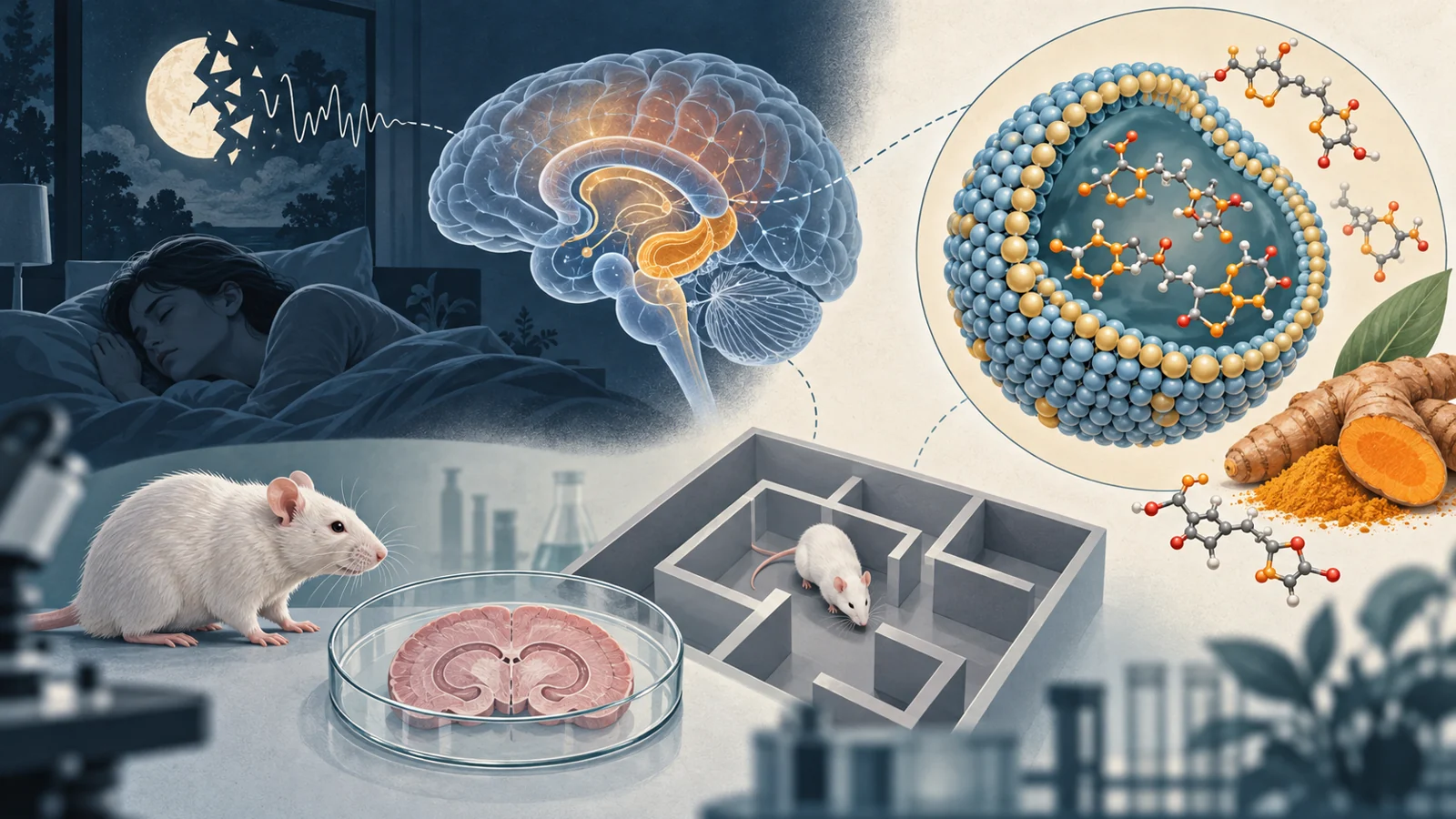
A review published on January 12, 2022, examines whether curcumin, a compound found in turmeric, might connect two concerns that often appear together in Alzheimer’s disease: disrupted sleep and impaired memory. The question is not whether turmeric is already a proven treatment. It is whether findings from sleep-deprived animals, Alzheimer’s-related models and a human study are measuring the same kind of benefit.
They are not. The research summarized in the review ranges from changes in rat brain tissue to mouse memory tasks and a cognitive screening result in people with Alzheimer’s disease. Understanding those differences is essential before an experimental effect is read as evidence that curcumin protects human memory.
Sleep and Alzheimer’s can influence each other
Sleep disruption is described in the review as both a characteristic feature of Alzheimer’s disease and a possible contributor to processes involved in its progression. Age-related changes can alter sleep patterns. Alzheimer’s-related changes in the cerebral cortex, basal forebrain, locus coeruleus and hypothalamus can also disturb the sleep–wake cycle. The relationship can therefore run in both directions: disease-related changes may interfere with sleep, while poor sleep may affect brain functions important to learning and memory.
One proposed link involves amyloid-β, a protein that can accumulate in the brain in Alzheimer’s disease. The review discusses findings in which longer wakefulness was associated with higher amyloid-β concentrations in brain interstitial fluid, with a further increase during acute sleep deprivation. Slow-wave sleep was associated with conditions that support lower amyloid-β levels. The review also describes the glymphatic system, through which fluid movement around brain cells may help clear substances such as amyloid-β and tau.
This gives curcumin research a biological rationale: a compound with reported antioxidant and anti-inflammatory effects might affect some processes involved in neural injury or amyloid-related pathology. But a proposed pathway is not the same as a demonstrated prevention strategy. Sleep-disordered breathing, changes in daylight exposure, medication use and behavioral changes associated with dementia can also complicate the relationship between sleep and disease.
Rat tissue and mouse memory are different tests
The sleep-deprivation studies summarized in the review used rats exposed to imposed sleep loss. In one line of work, researchers examined rapid-eye-movement sleep deprivation and reported improvements in measures including object-recognition time, tissue volume and cell-related features in animals given curcumin. Other rat experiments focused on the medial prefrontal cortex and reported fewer atrophic changes, cell loss and dendritic alterations after treatment.
A separate experiment examined chronic sleep deprivation and the superior cervical ganglion, a group of nerve cells outside the brain. The review reports that sleep deprivation reduced the volume of this structure and the number of neurons and satellite glial cells. Oral curcumin was associated with prevention of those reductions and with less apoptosis, or programmed cell death, in the tested tissue.
These experiments ask whether imposed sleep loss is accompanied by measurable structural or cellular changes and whether an intervention alters those measurements. A protected dendritic tree or preserved cell count does not show that normal sleep duration or sleep quality was restored, especially in people. The endpoint is tissue protection under an experimental stress, not patient memory.
The review also summarizes work in Alzheimer’s-related animal models. In older rats, dietary curcumin was associated with lower oxidative damage, less microglial activation and protection against some amyloid-related changes. In transgenic mice, engineered forms of curcumin were linked with improvements in spatial or cue-based memory tasks and with changes involving amyloid or tau pathology.
A mouse navigating a memory task and a rat’s preserved tissue are useful but narrow measurements. Cell experiments and the labeling of amyloid deposits in postmortem tissue answer still different questions. None of these settings can be treated as interchangeable evidence of a clinical cognitive benefit.
The human study used a cognitive endpoint
The review includes a six-month study in people with Alzheimer’s disease. Curcumin was administered in capsules or powder at 1 or 4 grams. The review reports no detected difference on the Mini-Mental State Examination, a cognitive screening measure, and no difference in the specified serum amyloid-β1–40 measure.
This example changes the level of the question. An animal study can show a change in tissue, pathology or task performance under controlled conditions. A human cognitive endpoint asks whether an intervention produces a detectable difference in people living with the disease. The review’s clinical example did not show such a difference on the reported cognitive measure.
The review identifies low bioavailability as an important obstacle to curcumin’s therapeutic potential. Bioavailability means how much of an administered substance becomes available in the body. Poor absorption, rapid metabolism and rapid elimination can all reduce the exposure produced by a given administered amount. The review presents this as a major limitation, but not as proof that inadequate exposure was the only reason for the unchanged cognitive result.
Delivery changes what is being tested
Exposure in the body is only part of the problem for a compound intended to affect the brain. A formulation may need to produce useful exposure in brain tissue, where the relevant neural processes occur. Ordinary curcumin and an engineered preparation that changes how the compound is transported are therefore different interventions, even when they contain the same active molecule.
The review gives one mouse example involving nanocurcumin prepared with a polyethylene glycol–polylactic acid carrier and polyvinylpyrrolidone. Compared with nonformulated curcumin, the engineered preparation was reported to increase curcumin’s mean residence time in the brain by about sixfold. Mice receiving it also showed better performance in a contextual fear-conditioning task.
The value of this example is that it makes formulation part of the scientific question. Changing the carrier can change where the compound goes and how long it remains available. It does not make ordinary culinary turmeric or an unspecified supplement equivalent to the engineered preparation. Increased brain exposure also does not by itself establish improved cognition in patients or suitability for long-term use.
Other delivery studies summarized by the review concern cell experiments or the labeling of amyloid deposits in postmortem tissue. Those findings may inform transport, interaction or detection, but they are not the same as a treatment outcome in a person.
Safety depends on the treatment context
A plant-derived compound still raises treatment-specific questions about dose, tolerability and interactions. The review describes curcumin as generally well tolerated across many studies, while also noting minor adverse effects in some higher-dose or clinical examples. Nausea and diarrhea were reported in one cited clinical trial, along with increased serum alkaline phosphatase and lactate dehydrogenase during the reported treatment period. Other clinical work summarized by the review reported minor gastrointestinal effects.
The review also discusses possible effects on drug-metabolizing systems, including cytochrome P450, glutathione-S-transferase and UDP-glucuronosyltransferase. Such effects could alter how other medicines are processed or change their concentrations. The relevant question is therefore not simply whether a substance is natural, but which formulation, dose and treatment setting are involved.
The review’s treatment discussion adds a separate clinical consideration. Sleep problems in older adults should not automatically be assigned to one cause. Symptoms can overlap with delirium or dementia, while the review associates early delirium with circumstances such as poor nutrition, physical restraints, bladder catheter use, polypharmacy or other iatrogenic conditions. Identifying the cause of a sleep disturbance is important before deciding what kind of intervention might be relevant. This distinction also helps prevent a sleep symptom from being treated as evidence of Alzheimer’s biology by default.
Why this matters for future Alzheimer’s treatments
A curcumin-based treatment could become a useful option for people with Alzheimer’s disease if it preserved memory or another meaningful cognitive function in patients. For that possibility to matter clinically, a suitable formulation would need to achieve useful exposure in the body and brain, demonstrate a meaningful patient benefit and remain acceptably tolerable in the relevant treatment setting.
The potential payoff is a treatment option for patients, not merely better laboratory measurements. The review’s January 2022 perspective connects sleep-related vulnerability, experimental curcumin effects and formulation research, but the practical value of that connection depends on whether those effects can translate into reliable cognitive benefit for people.
Key Sources
- Primary source: A New Perspective on the Treatment of Alzheimer's Disease and Sleep Deprivation-Related Consequences: Can Curcumin Help?
DOI or Journal Page · Review or Meta-Analysis · 2022-01-12
Keep exploring