
Evidence date · 2024-02-05 · Research note 2 of 2
1 2
See current Track status →
Since the previous research note · Partly supported
Track continuity
Since the previous research note: How cement ingredients change what grows inside a crack
Previous expectation: Persistent crack-filling deposits could help protect infrastructure if their benefits translated from cement-paste gaps to realistically cracked concrete under service conditions.
What this study adds: The February 2024 study reports healing observations in cracked concrete specimens and lower water absorption in treated mixtures, bringing one part of that expectation into a concrete laboratory comparison. It does not establish persistence under service exposure or validate the earlier ingredient-specific chemistry.
What changed in this study
Concrete cracks are more than visible blemishes. They can provide paths for damaging fluids to move into the material and, over time, affect its durability. A study published on February 5, 2024, tested whether crystal-forming ingredients added during mixing or applied later as a surface coating could help concrete close cracks while also changing its strength and water absorption.
The experiment was a laboratory comparison of four concrete treatments. It found the clearest combination of crack repair, strength and low water absorption in the mixture containing the larger additive dose. The coating applied to hardened concrete also showed repair-related effects, but the results do not make mixing and coating interchangeable. They place the treatment in different parts of the concrete life cycle and produce different questions about handling, application and long-term performance.
Two routes put the treatment inside concrete or on its surface
The researchers used four mixtures. Mix 1 was conventional concrete. Mix 2 contained a 1% crystalline additive by cement weight, and Mix 3 contained 2.5%. Mix 4 began as conventional concrete and was coated with the crystalline treatment after the concrete had hardened.
That arrangement compares two practical routes. An additive changes the fresh concrete before it sets, so the material is distributed through the mixture. A coating is applied to an existing surface, which could make it relevant to concrete that has already been placed. For Mix 4, the coating was prepared with water and applied to the damp concrete in two coats six hours apart, 28 days after curing.
The specimens were small laboratory samples rather than building elements. Each mixture produced six 15-centimeter cubes and two beams measuring 15 by 15 by 60 centimeters. The samples were cured for 28 days before testing. This scale allowed the researchers to compare treatment routes under controlled conditions, but it does not reproduce every feature of a cracked structure in service.
A controlled crack gave the repair process a chance
The beams were first tested in four-point bending until a crack opening of about 1 millimeter was reached by visual control. After that preliminary bending, the Mix 4 specimens received their crystalline coating, and the beam specimens were kept in water for 12 days.
The researchers marked points along the openings so that crack widths could be measured at the same locations before and after the healing period. A high-resolution camera was used to examine crack widths, while ultrasonic testing was used on the beams to assess crack depth. These methods answer different questions. A narrower visible opening suggests closure at the surface, whereas a change in measured depth gives another view of what happened within the specimen. Microscopy added still another layer by examining the material around the cracks.
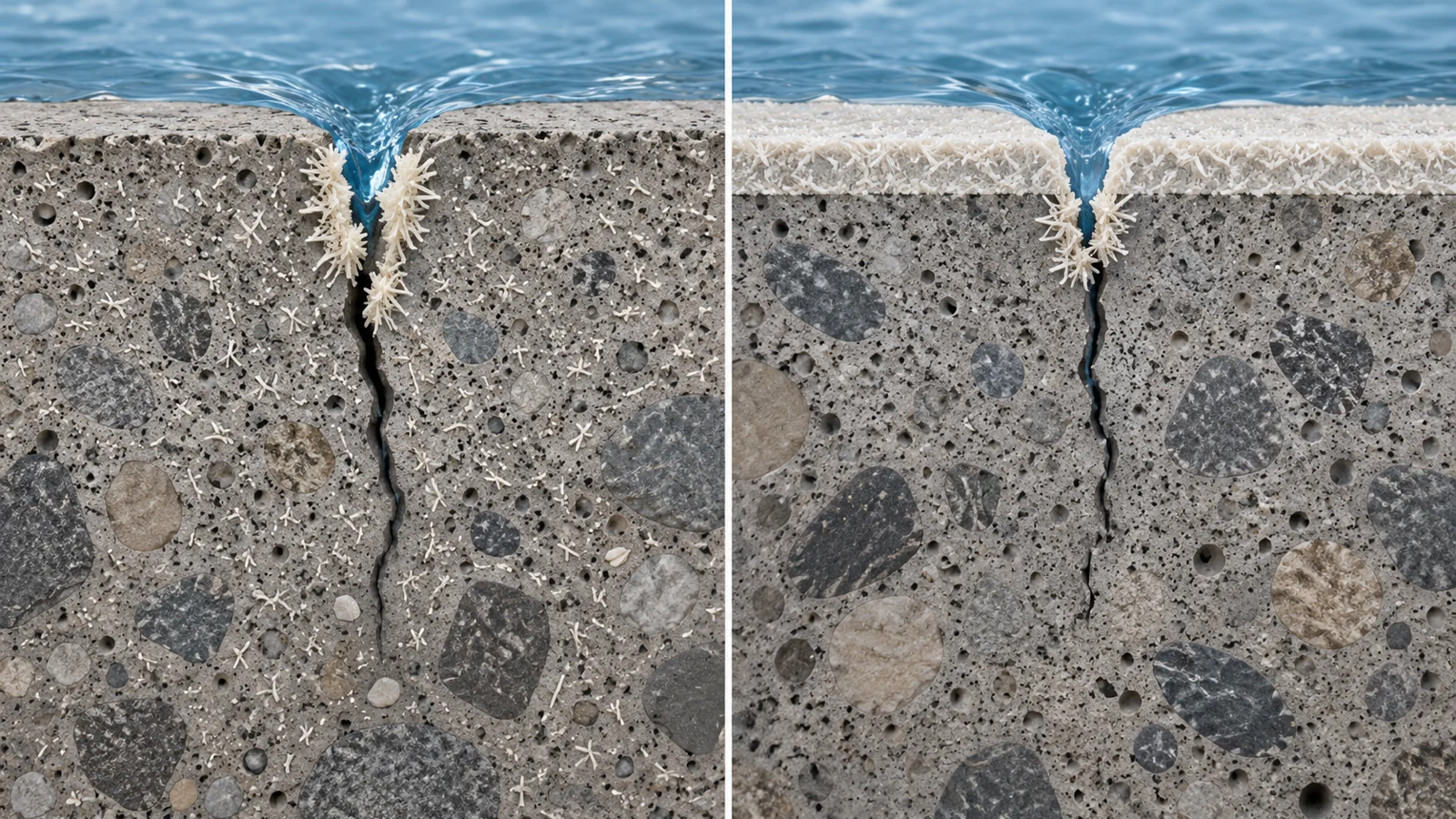
The authors attribute the repair process in the treated mixtures to the water-sensitive behavior of the crystalline additives. In their account, water enables a chemical reaction that produces deposits capable of filling gaps and cracks. They also associate the treatment with increased calcium silicate hydrate, or CSH, and with a more compact cementitious structure. This proposed sequence is important because water was part of the healing protocol, not merely an outside condition to be ignored.
The 2.5 percent mixture led the hardened results
Mix 3, containing the 2.5% additive, had the highest reported compressive strength. It was 28.38% higher than Mix 1, the conventional concrete. Mix 2 was 8.98% higher, while Mix 4, the coated conventional concrete, was 2.56% higher.
The pattern was similar in bending. Mix 3 had a flexural strength 31.17% higher than Mix 1. Mix 2 was 24.73% higher and Mix 4 was 17.72% higher. The coating therefore did not produce the same result as distributing the additive through the fresh mixture, although it was associated with a higher bending result than the uncoated conventional comparison in this experiment.
These percentages compare the tested formulations with one another. They are not measurements of how much load-bearing capacity a damaged specimen recovered after healing. A specimen can show a smaller visible crack or a denser local structure without having regained its original structural performance. The study’s strength results are best read as differences between concrete treatments, not as proof of restored strength after cracking.
Water absorption provided another strong separation. Mix 1 absorbed the most water, while Mix 3 absorbed the least. Mixes 2 and 4 fell between them. Lower absorption is consistent with a less porous, more compact material in these tests, and it supports the idea that the additive affected the concrete beyond the appearance of the crack itself. It does not, by itself, establish long-term watertightness, protection of reinforcement or a quantified extension of service life.
The treated cracks showed the clearest repair signals
The crack measurements identified no self-healing in Mix 1 under the reported comparison, while Mixes 2, 3 and 4 showed healing-related changes. Mix 3 displayed the most prominent crack repair characteristics. Microscopy also described the treated concrete as having more compact and consistent hydrated material, along with calcium-based crystals and cracks that had effectively closed after the healing process.
The control description needs a careful reading. The crack-width and depth discussion describes Mix 1 as showing no signs of self-healing, while the microscopy discussion describes its crack as only minimally repaired. These statements are not necessarily identical measurements of the same feature. One comes from the comparative crack assessment and the other from a qualitative microscopic view. Together, they indicate much less repair in the conventional mixture than in the treated mixtures, without proving that ordinary concrete can never undergo any limited closure.
The strongest evidence in the experiment is therefore convergent but still bounded. The treated mixtures combined measured crack changes with microscopic signs of deposits and a tighter-looking structure. The approximately 1 millimeter opening in the beams was a controlled test condition, not evidence that every crack of that width would completely heal. Nor does visible closure alone show that a beam has recovered its former ability to carry load.
The fresh concrete did not respond in a simple dose ladder
The treatment also changed the concrete before it hardened. Slump is a measure of the consistency of fresh concrete and gives an indication of how it behaves during handling. Mix 2, with the 1% additive, had the highest slump. Mix 3, with 2.5%, had a moderate value, while Mixes 1 and 4 had the lowest and equal measurements.
Air content followed a similar ranking. Mix 2 had the greatest amount, Mix 3 was intermediate, and Mix 1 had the least. The result matters because the higher additive dose did not produce the highest value in every fresh-concrete test. More measured air is not automatically preferable; the result simply shows that dosage affected fresh behavior in a way that was not a straight upward progression.
This is one reason the experiment does not identify a universally optimal dose. A formulation that performs strongly in hardened strength and water absorption may not behave identically during mixing and placement. The results point toward a balance between fresh workability, air content, hardened properties and the intended repair route.
What the experiment leaves open
The study offers a useful laboratory comparison, but several practical questions remain. The specimens were small, and the beams experienced a defined crack opening followed by a 12-day water-immersion sequence. Real structures encounter changing moisture conditions, repeated loading and other forms of exposure. The experiment does not establish whether the deposits would remain effective through those service cycles.
It also does not show how the treatments would perform in reinforced concrete, where cracks and reinforcement interact in a larger structural system. The authors identify reinforced applications, cost and environmental comparisons as areas for further work. Those questions matter to any claim about maintenance or sustainability because a material benefit must be weighed against the resources and labor needed to deliver it.
The coating result is especially easy to overread. Applying a crystalline treatment to a hardened specimen suggests a possible route for treating existing concrete, but it is not evidence of a building-scale deployment. Likewise, the differences between the four formulations do not establish that every crystalline product, every dose or every concrete mix would behave in the same way.
What this could mean for concrete maintenance
Concrete designed to limit fluid entry from within, combined with surface treatments for existing concrete, could eventually help owners preserve durability and reduce crack-related maintenance. The possible advantage is practical: new concrete and already placed concrete might be approached through different treatment routes rather than one universal repair method.
That prospect depends on the repair deposits remaining effective under service conditions and on the treatments being workable and economical. The February 2024 experiment supplies a laboratory comparison showing that the route and dose matter. It does not yet demonstrate a building treatment, restored structural capacity or a guaranteed reduction in future maintenance.
Key Sources
- Primary source: Investigation into the Effects of Crystalline Admixtures and Coatings on the Properties of Self-Healing Concrete.
DOI or Journal Page · Peer-Reviewed Paper · 2024-02-05