
Evidence date · 2021-11-25 · Research note 1 of 2
1 2
See current Track status →
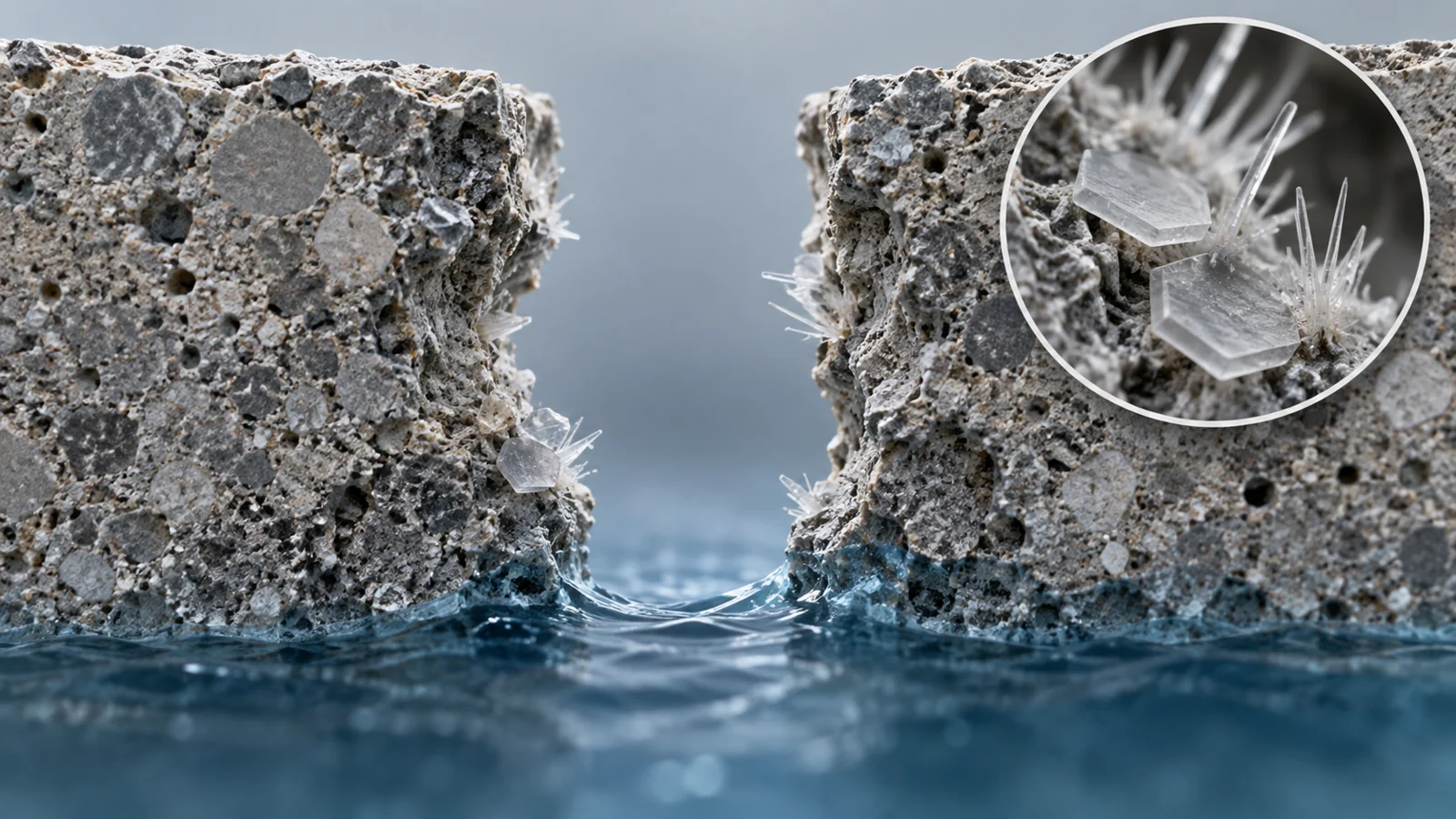
Concrete can sometimes heal narrow cracks on its own. Water enters the opening, reaches unreacted cement particles and helps generate new reaction products that accumulate inside the gap. The visible result may look like a crack closing, but the material doing the filling can vary substantially with the cement ingredients.
A study published on November 25, 2021, examined that chemistry in cement paste. It compared ordinary cement paste with pastes containing supplementary cementitious materials, a calcium sulfoaluminate expansion agent and crystalline additives. Rather than asking only whether a crack appeared more closed, the researchers collected the newly formed deposits and identified what they contained.
The central finding was not one universal healing mineral. Calcite was prominent across the tested mixtures, but the deposits also included different hydration products and salt-like phases depending on the binder and additives. That makes the chemistry inside a crack a useful starting point for understanding self-healing, while leaving the practical question of structural repair open.
When water reaches a young crack
The experiment focused on cement paste, the binder portion of concrete, rather than a finished concrete structure. The researchers prepared thin paste slices and created controlled gaps of approximately 100 micrometres between them. The specimens were seven days old when the artificial cracks were made, and water contacted the lower edge of each stacked specimen during a further seven-day healing period.
This arrangement represented a narrow path through which water could reach material that had not fully reacted. Further hydration could then produce new solids on the opposing surfaces. The study’s purpose was to capture those products under a repeatable laboratory geometry, not to reproduce every feature of a crack in a bridge, wall or roadway.
The distinction matters because a deposit can be chemically interesting without demonstrating how well a real structure carries load or resists water over time. The measurements describe what formed in a controlled early-age exposure.
How the researchers collected the new material
Separating new deposits from the original cement matrix is difficult in an ordinary concrete crack. Real cracks are irregular, and material from the surrounding paste can be collected along with whatever formed later. The researchers used a method designed to keep the crack geometry consistent and make the products removable.
They fabricated 32 paste slices measuring 100 by 100 by 10 millimetres. After initial curing, the seven-day-old specimens were dried and their surfaces were polished to expose unreacted material. A thin polyester film was placed between paired surfaces before the slices were assembled. Water was then poured around the lower portion of the bundles, with about 5 millimetres of the specimen contacting the water.
After seven days of immersion, the bundles were separated and the material in the artificial gaps was collected with a plastic tool. The samples were dried and treated with isopropanol to stop further hydration before analysis. This careful handling helped the researchers examine the products generated during the defined healing interval rather than allowing the chemistry to continue changing during preparation.
Several techniques supplied different kinds of information. X-ray diffraction with Rietveld refinement quantified identifiable crystalline phases, while noncrystalline hydrates were grouped as amorphous material. Thermal analysis tracked changes associated with phases such as calcite and portlandite during heating. Scanning electron microscopy showed the shape of the deposits, and energy-dispersive spectroscopy measured which elements were concentrated in those shapes.
The ingredients changed the mineral mix
In the ordinary cement reference, the main quantified phases were calcite and portlandite. Calcite is calcium carbonate; portlandite is calcium hydroxide, a product of cement hydration. In the reference deposits, they represented about 33% and 23% respectively by the reported X-ray analysis.
Ground-granulated blast-furnace slag and fly ash shifted the balance. The slag mixtures contained less portlandite as the slag replacement increased, consistent with portlandite being consumed during additional reactions. Fly ash showed a similar reduction. In one fly-ash mixture, portlandite represented 11% of the deposits, and at a higher replacement level both calcite and portlandite contents were lower than in the ordinary reference.
The microscope added another layer to this picture. Deposits from slag-containing paste showed strong calcium, silicon, aluminium and oxygen signals, which the researchers interpreted as evidence of calcium silicate hydrate and calcium aluminate hydrate. The fly-ash mixture showed a similar pattern. These hydrate identities were interpretations supported by morphology and elemental composition, not separate quantitative phase measurements equivalent to the X-ray results.
The expansion agent produced a different visual and chemical signature. Paste containing calcium sulfoaluminate showed needle-like hydrates, with elemental signals consistent with ettringite. The study also associates the calcium sulfoaluminate system with monosulfate and ettringite formation. Such expansive hydrates are chemically distinct from the calcite and portlandite emphasis of the ordinary reference.
Crystalline additives introduced still other phases. With sodium sulfate, the deposits included aphthitalite, an alkali sulfate, and thermonatrite, an alkali carbonate. In one mixture containing several additives, the reported aphthitalite proportion in the collected healing products was 18%, exceeding the calcite proportion. This was the notable exception to calcite’s usual position as the largest reported phase. The result shows why describing an ingredient as “promoting self-healing” is incomplete unless the material produced inside the crack is also identified.
Deposit mass is not the same as mineral percentage
The study reported two different kinds of quantity, and they answer different questions. A mineral percentage describes the share of a collected deposit assigned to that phase. Deposit mass describes how much material accumulated over a given crack surface area.
For the ordinary cement reference, the total collected product was 11.49 grams per square metre of crack surface. The slag and fly-ash specimens produced smaller amounts under these test conditions, with the fly-ash quantities falling to less than half of the reference. That comparison concerns the amount collected during the seven-day healing period, not a direct measure of crack closure.
The early timing helps explain why the result should be read carefully. The specimens were cracked at seven days, when ordinary cement still contained unreacted binder and the supplementary materials had had limited time to react. The study notes that the seven-day healing period was shorter than periods used in some other investigations. A smaller early deposit therefore cannot be converted into a universal ranking of which binder would heal best in every situation.
Composition also complicates a simple reading of the numbers. One mixture may contain a high proportion of calcite within a relatively small deposit, while another may produce a larger or more varied deposit in which calcite represents a smaller share. Measuring only calcite and portlandite can therefore miss the contribution of several other phases, including calcium silicate and calcium aluminate hydrates, sulfates and carbonates.
What the chemistry can and cannot tell us
The study gives a detailed baseline for the material forming in controlled cement-paste gaps. It links ingredient choices to recognizable differences in mineral phases, elemental signals and deposit shapes. That is valuable because crack filling is not a single chemical event: continuing hydration, carbonate formation and additive-driven reactions can occur together.
The same measurements stop short of demonstrating restored load-bearing capacity, lasting watertightness or durable protection in a concrete structure. The artificial gap, the paste-only specimens, the seven-day age at cracking and the short water exposure all shape what can be inferred. The reported deposit mass is not a crack-closure percentage, and the mineral proportions are not a universal effectiveness score.
A reliable repair claim would require the chemistry to remain protective under realistic cracking and service exposure. It would also need to connect the deposits to the properties infrastructure owners care about, such as limiting pathways for water and harmful ions. Those questions belong to later performance evidence, while this study establishes what the first products looked like inside a carefully controlled crack.
What this could mean for longer-lasting concrete
The 2021 findings point toward cement mixtures designed around the products they generate, not merely around the label of a self-healing ingredient. If a chosen combination can form persistent deposits that reliably seal small cracks under realistic conditions, it could help reduce the entry of water and harmful ions into concrete and support longer-lasting infrastructure.
That prospect remains conditional. The chemistry would have to survive service exposure and translate from artificial cement-paste gaps to realistically cracked concrete. If that connection can be demonstrated, ingredient-specific control of crack-filling reactions could eventually help infrastructure owners preserve durability and potentially reduce crack-related maintenance, without treating an early laboratory deposit as proof of those benefits.
Key Sources
- Primary source: Self-Healing Products of Cement Pastes with Supplementary Cementitious Materials, Calcium Sulfoaluminate and Crystalline Admixtures.
DOI or Journal Page · Peer-Reviewed Paper · 2021-11-25