
Research Signal – Source date 2026-06-09
A clinical trial registered as NCT07637487 is testing whether a daily tocotrienol supplement can change biological measurements associated with aging in otherwise healthy middle-aged adults. The study is asking a narrower question than whether a capsule can make people younger or prevent disease: after six months, do participants taking tocotrienol show different laboratory and health-related measurements from participants taking placebo?
The current ClinicalTrials.gov record lists the study as recruiting. It records an actual start date of October 31, 2023, an actual primary completion date of December 19, 2024, and an estimated overall completion date of January 30, 2027. Those dates describe different points in the study lifecycle. The primary-completion date does not by itself establish that the whole study was completed, analyzed, or reported. The supplied registry snapshot contains no posted results, so it supports an explanation of the experiment rather than an estimate of what tocotrienol does.
The aging question behind the capsule
The trial uses the term senolytic for an intervention intended to clear senescent cells. Senescent cells have stopped dividing but can remain metabolically active, and the study is particularly interested in the senescence-associated secretory phenotype, or SASP. In accessible terms, SASP refers to the collection of signals released by senescent cells that can influence their surrounding environment. The registry frames tocotrienol as a possible way to modify aging-related biology, while also making safety a study question.
That framing matters because the planned measurements are mostly indicators of biological state or activity. The study will examine SASP gene expression and SASP protein expression in peripheral blood, alongside inflammatory markers including tumor necrosis factor alpha and interleukin-6. It will also measure advanced glycation end products, protein carbonyl, malondialdehyde, and DNA damage as indicators related to chemical or oxidative stress.
A change in one of these blood signals could be scientifically interesting, but it would not by itself demonstrate that tocotrienol selectively removed senescent cells. It would show that a measured signal changed under the conditions of this trial. Connecting that change to senescent-cell clearance, and then to a meaningful improvement in health, requires more inference than the registry measurements alone can provide.
What the placebo comparison adds
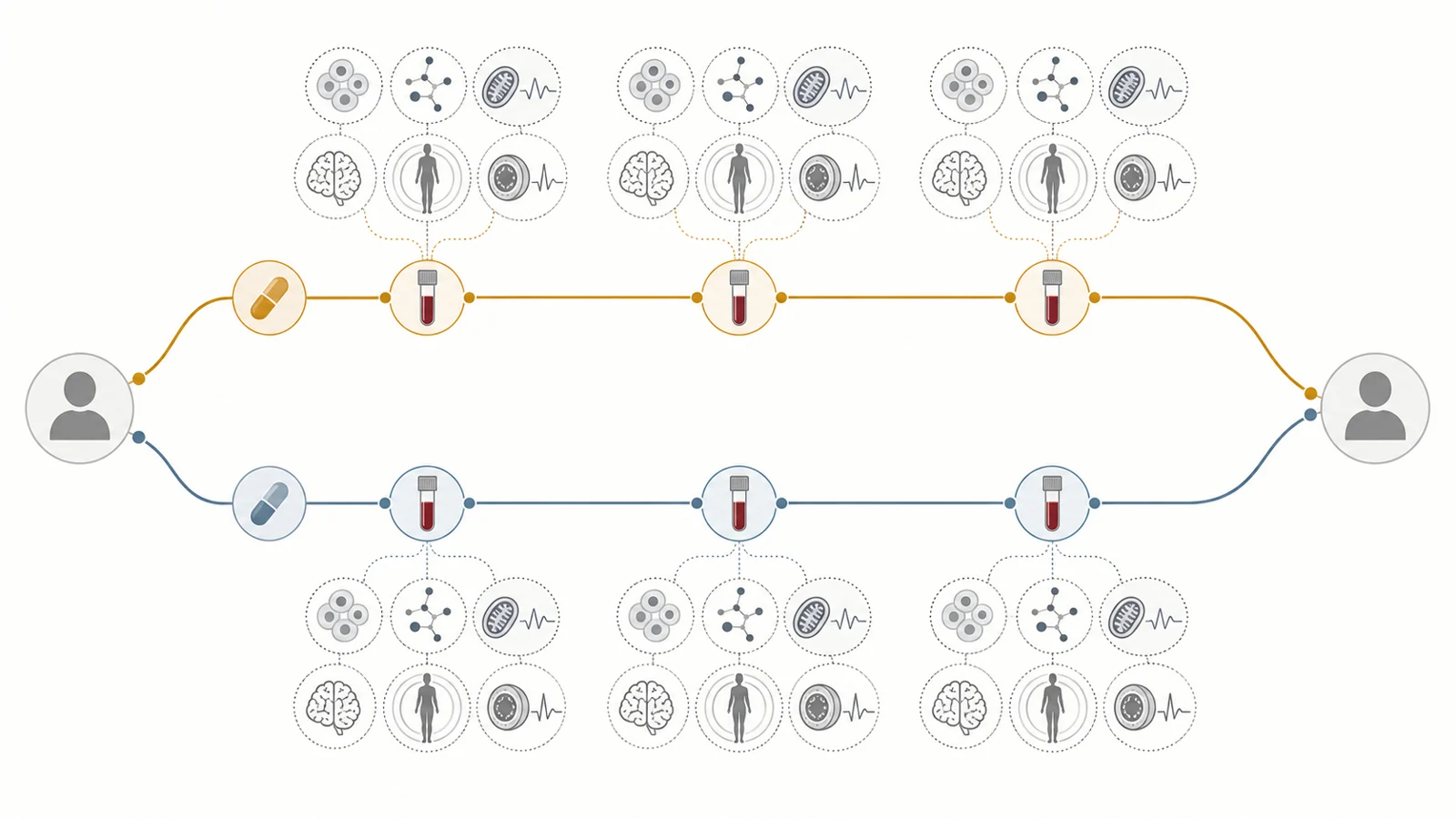
The study is described as randomized, parallel, and interventional, with an estimated enrollment of 220 people. Eligible participants are listed as adults from 35 to 50 years old, of any sex, with the condition recorded as healthy. One group is assigned tocotrienol-rich fraction at 200 milligrams per day, divided into two daily doses. The comparison group receives placebo capsules divided into the same stated daily amount. Participants are scheduled for assessments at baseline, three months, and six months.
This structure gives the investigators a way to compare changes over the same period in people assigned to the supplement and people assigned to a look-alike inactive capsule. The important unit of interpretation is therefore the difference between groups over time, not simply whether a measurement moved in the tocotrienol group. The registry describes estimated enrollment, not a confirmed number of people who enrolled, completed treatment, or supplied usable measurements. The supplied record also does not establish masking details, adherence, or the statistical analysis plan, so those features should not be assumed from the basic trial design description.
The schedule also defines the scale of the initial test. Six months can show whether selected measurements shift during a controlled comparison in eligible adults. It is a much shorter horizon than the period over which aging-related disease, preserved independence, or longer life would be evaluated. The trial is therefore positioned to examine intermediate biological and functional signals, with safety monitored as part of the human study, rather than to establish a lifetime preventive effect.
Circulating tocotrienol is one measurement, not the conclusion
The registry includes measurements of alpha-tocotrienol, gamma-tocotrienol, and total plasma tocotrienol concentrations using high-performance liquid chromatography. These tests ask whether the compound appears in the bloodstream at changed measured levels during the intervention. They help characterize exposure to the supplement.
Other planned tests ask what is happening in related biological systems. The study will measure mitochondrial ATP production, mitochondrial Complex V enzyme activity, and mitochondrial membrane potential in peripheral blood samples. It will also examine blood pressure, advanced glycation end products, protein carbonyl, malondialdehyde, and DNA damage. Together, these categories let the researchers compare the presence of the supplement with several downstream measurements of cellular energy handling and molecular stress.
The design is best read as a set of linked questions rather than a proven chain of cause and effect. A higher circulating tocotrienol concentration would not automatically mean that mitochondrial function improved. A change in an oxidative-damage marker would not identify which biological process produced it. The value of the comparison lies in seeing whether the pre-specified measurements move differently between the two assigned groups and whether those changes appear together across the six-month schedule.
Health assessments widen the test beyond blood
The trial also includes measurements that make the research question more human-facing. Body composition assessments include body mass index, body-fat percentage, visceral fat, basal metabolic rate, and waist-to-hip ratio. Bone-related measures include bone mineral content, while muscle mass and fat mass are assessed with dual-energy X-ray absorptiometry. Cognitive function is assessed with the Montreal Cognitive Assessment and a digit-span test covering forward, backward, and sequencing tasks.
Vascular assessments include blood pressure, pulse-wave velocity, and augmentation index. The registry also lists skin-related assessments and diet questionnaires, which can help describe participants and their measured changes during the study period. These measures are not all interchangeable. A blood marker, a memory-test score, arterial stiffness measurement, and body-composition result each describe a different part of a participant’s health profile.
Including them allows the investigators to ask whether any biological changes are accompanied by differences in selected functional or physiological measures. It still would not amount to proof that participants retained everyday capability, avoided an age-related disease, or experienced a durable extension of healthy life. Those outcomes would require appropriate evidence over a relevant period and are not supplied in this registry snapshot.
The safety question is similarly practical but open. The study is designed to record health changes or medical issues among people taking tocotrienol, yet the material available here provides no treatment-effect estimates or safety findings establishing benefit or harm. The recruiting label and lifecycle dates describe the current record’s study information; they do not turn the planned comparison into a reported result.
What this could mean for healthier aging
For people approaching later life, the attraction of this research is practical: an oral preventive intervention that helps preserve health could be easier to use than a complex clinical program. Tocotrienol would have to produce reproducible biological effects, translate into meaningful health benefits, and remain acceptably safe over the duration that matters before such a possibility could become a real option.
From the historical perspective of this registry record, NCT07637487 contributes a human randomized comparison of a six-month supplement schedule in adults aged 35–50. It does not establish the eventual benefit. It helps test whether a proposed aging-related biological effect can be detected in people, and whether the measurements needed for a larger, longer question are worth pursuing.
Key Sources
- Primary source: Tocotrienol Supplementa as A Senolytic Agent in Middle-aged Adults
Government or Regulator · Clinical Trial · 2026-06-09
Keep exploring