
Research Signal – Source date 2026-06-08
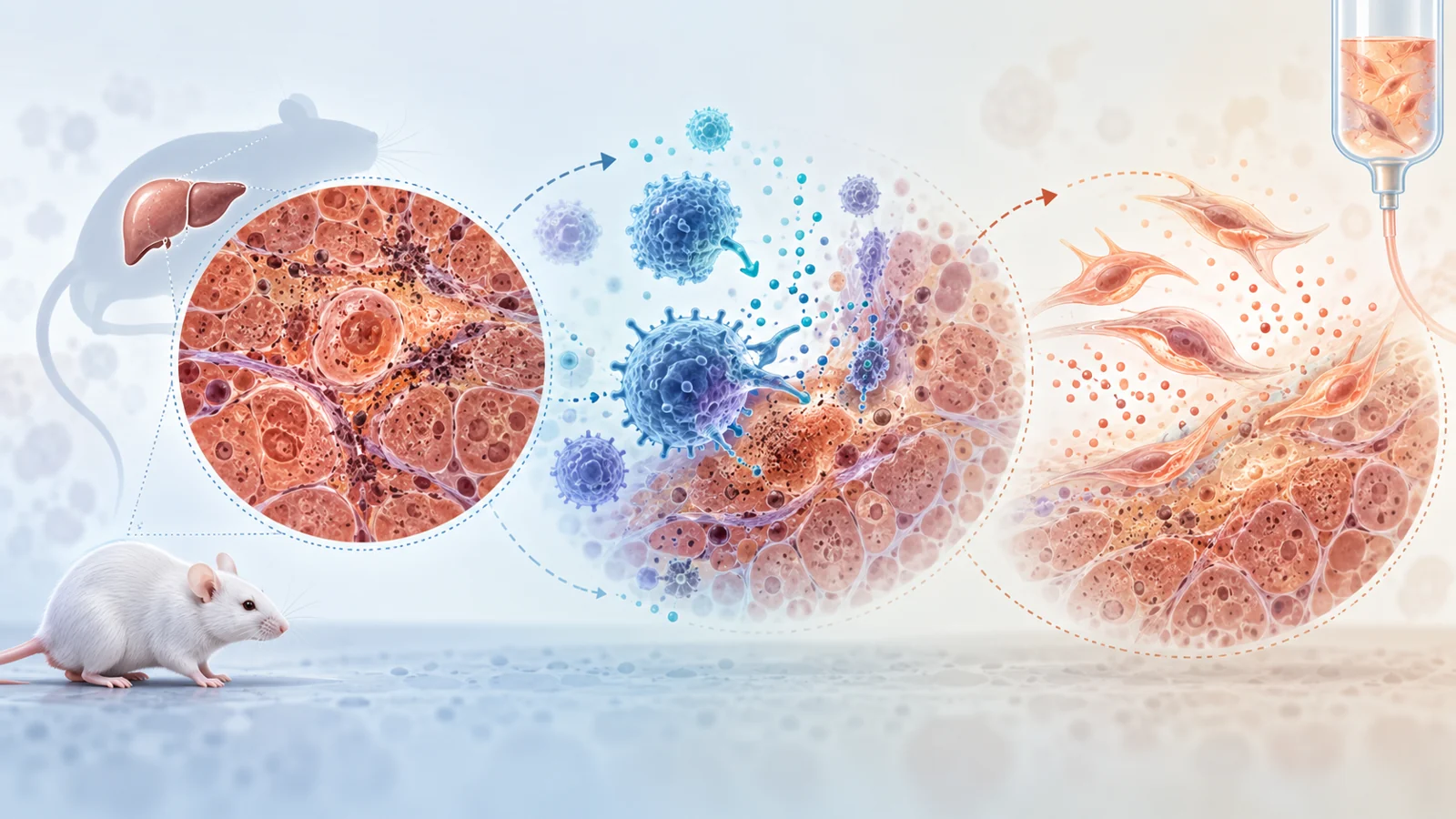
A new mouse study pairs two ideas in regenerative medicine: reduce the burden of senescent cells, then add regenerative mesenchymal cells. The combination produced stronger improvements than either treatment alone in models of chemically induced liver injury and accelerated aging. The authors also report a survival benefit in the doxorubicin model, but this does not show that people can live longer by slowing ordinary aging.
The useful question is narrower and more practical. Did an immune treatment make the tissue environment more receptive to regenerative cells after injury, and what did the pairing add beyond either intervention on its own?
The experiment started with induced damage
The researchers used two mouse models. In one, carbon tetrachloride was used to produce liver injury. In the other, doxorubicin chemotherapy was used to induce a state of systemic senescence and accelerated aging. Male and female C57BL/6J mice were studied, with groups of 10 animals. The comparisons included untreated induced groups, SenoVax alone, pluripotent stem cell-derived mesenchymal cells alone, and the combination.
SenoVax is described as a dendritic-cell-based senolytic immunotherapy, meaning an immune treatment intended to target senescent cells. These are cells that have stopped dividing after stress or damage but can remain metabolically active and release inflammatory signals. The regenerative treatment used pMSCs, mesenchymal stem cells derived from pluripotent cells.
In the combination protocol, the pMSCs were infused one week after the final SenoVax dose. That order is part of what the researchers administered; it is not proof that this sequence is necessary, optimal, or better than every alternative schedule.
Senescent cells may make repair harder
The study’s biological model is that senescent cells create a hostile repair environment through the senescence-associated secretory phenotype, or SASP. SASP factors include inflammatory and tissue-remodeling signals such as IL-6, IL-11, YKL-40, and IL-23 receptor-related activity. The authors propose that these signals can interfere with the proliferation, differentiation, and survival of regenerative cells.
That gives the two treatments different jobs in the experiment. SenoVax was intended to reduce the senescent-cell burden and its inflammatory signaling. The pMSCs were then meant to supply regenerative activity and factors associated with tissue repair. The measured pattern fit this hypothesis: the combination generally produced larger changes in inflammation-associated markers and in regeneration-associated markers than the individual treatments.
Those coordinated blood measurements make the proposed mechanism plausible, but they do not by themselves prove that selective senescent-cell clearance caused the benefit. A change in a circulating marker can show that the biological state shifted without identifying every step responsible for the shift.
Liver injury markers fell most with the combination
In the carbon-tetrachloride model, the researchers measured alanine aminotransferase, or ALT, and aspartate aminotransferase, or AST, as indicators of liver injury. The combination produced the largest reductions. In the discussion, the authors report reductions of about 58–62% with combined treatment, compared with roughly 32–40% for the individual treatments.
This is an important comparison because it shows what the pairing added: lower injury-associated enzyme measurements than either SenoVax or pMSCs alone. The result is consistent with reduced liver injury under the experimental conditions. ALT and AST are not direct measurements of newly regenerated tissue, however, and these biochemical changes do not by themselves show that the liver was restored or that natural aging was reversed.
The biomarker results pointed in the same direction. The combination lowered measured SASP-associated signals, including IL-6, IL-11, IL-23-related activity, and YKL-40, while increasing measured regenerative signals such as Klotho, FGF-2, VEGF, and GDF-11. The value of the pattern is its coherence across several measures, not any single marker acting as a standalone readout of rejuvenation.
Survival after doxorubicin is a different endpoint
The second model was designed around chemotherapy-induced damage and accelerated senescence. Alongside blood markers, the researchers assessed physical performance and followed the animals for survival. The combined treatment improved reported performance measures and produced better survival than the induced untreated controls, with the authors describing a statistically significant advantage over the single-treatment groups in the survival analysis.
These outcomes matter, but they answer a different question from whether an intervention extends lifespan during normal aging. The mice had first been exposed to doxorubicin, and the survival observation occurred within that induced injury protocol. It therefore speaks most directly to recovery or resilience after a severe experimental stressor. It does not establish a quantified extension of ordinary mouse lifespan, much less a human longevity effect.
The study also links the physical findings to healthspan because they concern strength, coordination, or movement. They remain tests performed in a chemotherapy-induced model, not a complete measure of how an animal ages across its natural life. The reported performance and survival summaries do not support a single reconciled numerical estimate for the advantage, so the direction of the result is more secure here than a precise headline number.
The causal story still has open questions
The experiment supports a useful sequence of observations: induced injury was associated with inflammatory and senescence-related signals; the treatments changed those signals; regenerative markers and selected functional outcomes improved most with the combination. The chain is compatible with the authors’ explanation that SASP factors suppress pMSC activity and that reducing this suppression helps the cells work.
Several details keep that explanation provisional. The models were acute or subchronic and chemically induced, whereas natural aging develops over a longer and more complex course. The groups contained 10 mice each, which limits the ability to detect subtle differences related to sex or age. The authors also note that direct measurements of senescent-cell clearance, such as p16INK4a or SA-β-gal staining, would strengthen the mechanistic case. The specific senescence-associated antigens targeted by SenoVax remain unresolved as well.
The reported pairwise comparisons and effect sizes show differences among treatment groups, but the supplied statistical description does not establish a formal interaction analysis demonstrating that the combination exceeded an additive expectation. “Synergy” is therefore best read as the authors’ interpretation of a stronger combined pattern, not as a settled causal property independent of the statistical definition used.
Translation raises another boundary. The paper refers to safety information submitted to the Food and Drug Administration, but the underlying data are not presented in the study. That reference cannot establish human safety, regulatory approval, or availability as an aging treatment. The experiment also does not show that such a therapy would preserve anticancer effects or prevent injury when given during chemotherapy.
What this could mean for recovery after chemotherapy
For people left with persistent tissue damage after chemotherapy, a combined strategy of senescent-cell targeting followed by regenerative-cell treatment could eventually offer a way to improve recovery of tissue function by making regenerative treatment more effective. That possibility depends on reproducing the benefit in more representative models, clarifying what SenoVax targets and how the sequence works, and demonstrating acceptable safety in humans.
The potential use is recovery after treatment, not prevention of chemotherapy toxicity and not treatment of cancer itself. At the June 8, 2026 publication date, the study offers an encouraging animal result about that recovery problem while leaving the distance to a clinical therapy substantial.
Key Sources
- Primary source: Synergistic senolytic-regenerative therapy significantly extends healthspan and lifespan.
DOI or Journal Page · Peer-Reviewed Paper · 2026-06-08
Keep exploring