
Research Signal – Source date 2026-05-15
A pilot study of a two-day nutraceutical regimen produced an apparently contradictory result: several blood proteins shifted in an exploratory analysis, while the study’s four pre-specified primary outcomes did not change significantly.
That difference is the key to reading the paper. The findings do not show that the supplement slowed aging, removed senescent cells, or produced a clinical benefit. They do show how an early human study can identify possible biological signals while leaving its main question unanswered.
The study was published on 15 May 2026 in the International Journal of Molecular Sciences. It followed a decentralized group of adults aged 45 to 79 who took Qualia Senolytic for two days and collected blood samples at home. The trial itself took place in April and May 2025.
The headline result was unchanged
Seventy-one adults were assigned to the intervention. The researchers selected four proteins as the primary outcomes: tumor necrosis factor, interleukin-1 beta, CXCL8, and vascular endothelial growth factor A. These were chosen as commonly studied proteins associated with the senescence-associated secretory phenotype, or SASP.
The primary analysis found no significant change in any of the four at day 7 compared with baseline. The statistical results for these outcomes remained non-significant across the reported analyses.
Other proteins were examined as exploratory outcomes. Before correction for multiple comparisons, the researchers saw decreases in CCL8, CXCL9, CXCL10, and CXCL11, alongside increases in interleukin-17F and oncostatin M. Some of these changes were consistent across the statistical methods used for proteins that met the model assumptions.
Those exploratory p-values did not survive false discovery rate correction. In practical terms, the study tested many protein-level possibilities, so some apparently interesting differences could arise by chance. The unadjusted results are therefore candidates for future investigation, not confirmed treatment effects.
This is how both statements can be true at once: the primary outcomes showed no significant changes, while other measurements produced preliminary signals. The second result may help researchers decide what to test next, but it does not overturn the first.
A seven-day study separated exposure from measurement
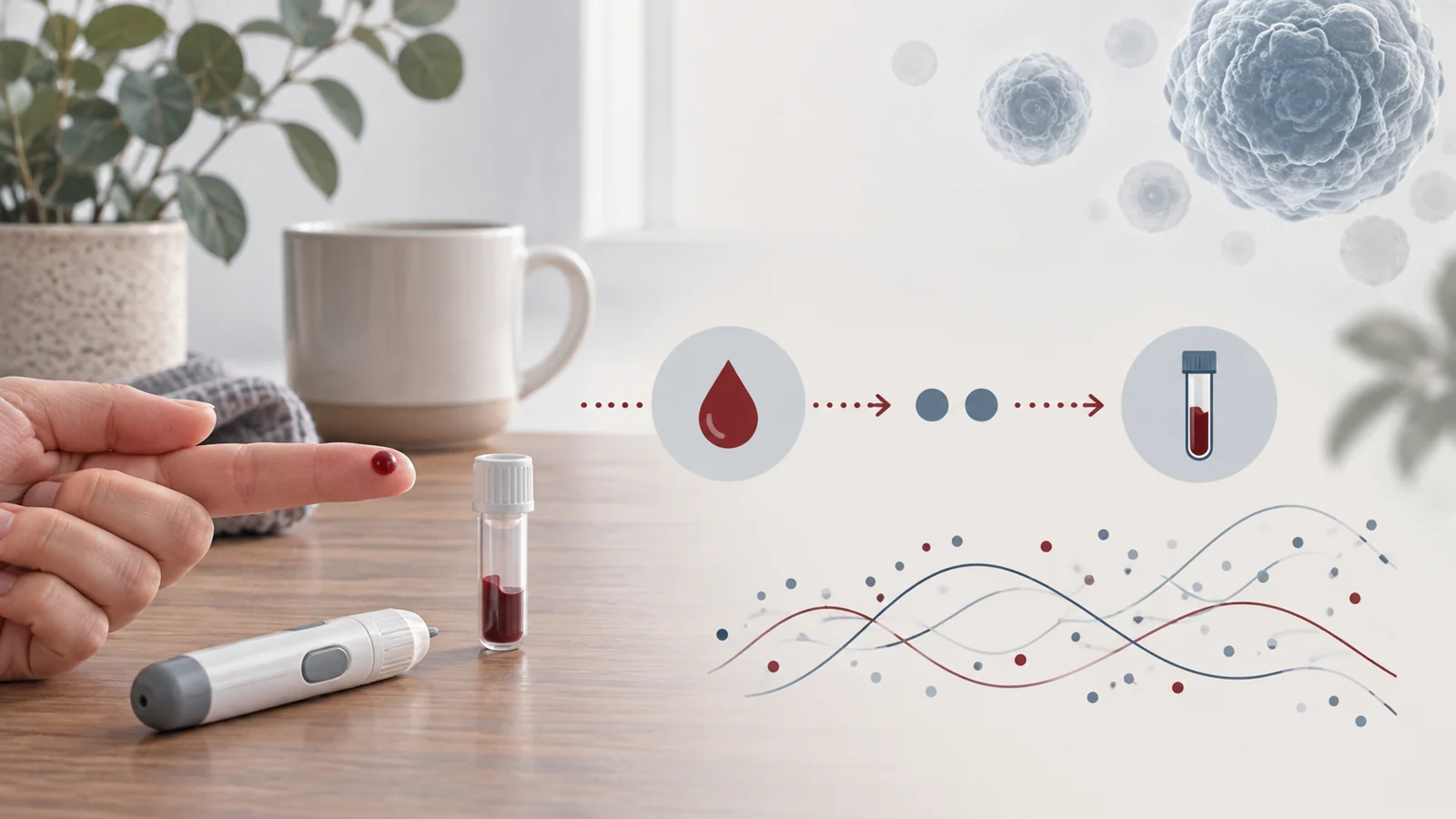
The protocol was short. Participants collected a baseline fingerstick blood sample at home on day 0. They took 12 capsules over days 1 and 2, following the product’s intended intermittent schedule. A second blood sample and questionnaires were completed on day 7.
The study was open-label and single-arm, meaning everyone who received the intervention knew what they were taking and there was no comparison group receiving a placebo or no intervention. The paper reports that the trial was registered on 23 April 2025, five days after the first participant enrolled on 18 April. The authors attribute the timing to administrative processing delays.
The formula contained multiple ingredients, including fisetin, a quercetin phytosome, curcumin, olive leaf extract, soybean isoflavones, luteolin, milk thistle silymarin, piperlongumine, and botanical extracts. It was formulated around a proposed “hit-and-run” senolytic approach: a brief exposure intended to affect cells that have stopped dividing. The study could not determine whether any particular ingredient caused a measured change, or whether the combination worked through synergy.
The day-7 measurement also matters. A single follow-up point can miss changes that emerge later, peak earlier, or vary from person to person. The authors note that lifestyle factors such as diet, exercise, sleep, stress, or an acute illness were not formally tracked during the week. Those factors could add variability to blood-protein measurements.
Blood proteins are not a cell count
Cellular senescence is a stable halt in cell division that can arise after stresses such as DNA damage or other age-related pressures. Senescent cells can sometimes serve useful short-term roles in tissue repair and immune signaling. When they accumulate, however, they may alter their surroundings by releasing a broad mixture of signaling molecules known as the SASP.
The study measured selected proteins circulating in blood. That can provide information about inflammatory or senescence-associated signaling, but it is not the same as counting senescent cells in tissues. A change in a circulating protein could reflect altered secretion, immune activity, metabolism, timing, or another biological influence. It cannot by itself show that senescent cells were cleared or that their total burden fell.
Several of the exploratory decreases—CXCL9, CXCL10, CXCL11, and CCL8—belong to a group of chemokines that the authors discuss as sharing regulation through the interferon-gamma and JAK-STAT signaling axis. They propose that this axis may be a more sensitive place to look for short-term effects in healthy adults than the four primary proteins selected for the trial.
That proposal is biologically plausible within the paper’s discussion, but it remains a hypothesis. The study did not demonstrate that the supplement acted on this pathway, nor did it establish that a shift in these chemokines represents senescent-cell removal. The result is better understood as a clue about which measurements might deserve closer testing.
Questionnaire changes tell a different story
Participants reported improvements in selected domains of several quality-of-life and symptom questionnaires by the end of the study. The reported changes included areas related to vitality, emotional wellbeing, general health, social functioning, stress, depression, and symptoms assessed by the Aging Male/Female Symptoms Scale.
These results should be kept separate from the protein findings. They were self-reported outcomes in a study where participants knew they had received the supplement. Without a placebo comparison, changes in expectations, attention, daily experience, or willingness to report symptoms can contribute to the results. The authors explicitly caution that the questionnaire findings should not be interpreted as evidence of clinical efficacy.
The survey data also became less complete at follow-up. Fifty-five of 69 participants who received the intervention provided fully scoreable questionnaire data at both time points. Participants who did not complete the end-of-study surveys had higher baseline fatigue, poorer general health, and lower social functioning than completers in the reported missing-data analysis. That difference matters because the people whose experiences were captured most fully were not necessarily representative of everyone who entered the study.
The safety and tolerability questionnaires did not show significant worsening in the assessed symptom domains over the seven-day observation period, and no participant discontinued because of unwanted side effects. This supports short-term tolerability within the symptoms and time window measured. It does not establish long-term safety or show what would happen with repeated use.
The remote method exposed a practical bottleneck
The study also explored the feasibility of home participation. The supplement and fingerstick kits were shipped to participants, who collected blood samples at home. Of the 69 participants who received the intervention, 68 rated their satisfaction with the product and experience; the mean score was 4.7 out of 5.
Retention was also relatively high. Sixty-nine of the 71 assigned participants received the intervention, and two were lost to follow-up. But staying in contact with a participant is not the same as obtaining a usable paired blood dataset.
Only 53 participants, or 74.6% of those assigned, provided both baseline and follow-up protein samples for the primary analysis. Fourteen were excluded because of insufficient sample volume, delayed return, or packaging problems. The full text identifies these specimen issues as a central challenge for a future decentralized study.
That distinction changes how the pilot’s feasibility should be read. The intervention could be mailed and the protocol could be completed by many participants, yet the most important laboratory comparison was available for a smaller group. The feasibility outcomes were evaluated post hoc, so they should be read as exploratory findings about running a remote trial.
The authors point to practical improvements such as providing spare blood-spot cards, adding detailed video instructions, using automated reminders with a defined return window, and offering real-time troubleshooting. These are not proof that the system is ready for large trials, but they turn a vague concern about home sampling into specific problems that can be addressed.
What home sampling could open up for aging research
A reliable mailed intervention and home blood collection could eventually allow adults in different locations to join controlled aging-intervention studies without repeated clinic visits. That could widen participation beyond people who live near research centers and let investigators study a broader range of adults than a single clinic can easily reach.
The benefit is conditional. Larger remote studies would still need dependable specimen collection and preservation, appropriate placebo or comparison groups, and outcomes that can distinguish a real biological effect from measurement noise, expectations, and ordinary changes over time. In this pilot, the home-based approach made participation possible for many people, while the sample-return problems showed how much the research infrastructure still matters.
The paper’s most useful contribution is therefore narrower than a claim about rejuvenation. It offers a preliminary test of a remote study model and identifies several protein changes that may be worth examining under stronger experimental conditions. Whether those signals reflect a reproducible effect remains an open question.
Key Sources
- Primary source: Exploratory Effects of a Novel Nutraceutical on Senescence-Related Protein Biomarkers in Healthy Adults: A Pilot Proteomics Study.
DOI or Journal Page · Clinical Trial · 2026-05-15
Keep exploring