
Research Signal – Source date 2026-03-20
A planned observational study is asking whether two different sleep tests assign the same sleep stages in people with asymptomatic or early Alzheimer’s disease. The registry describes an estimated 35 participants between 55 and 85 years old, of all sexes. Here, “asymptomatic” refers to people described as having Alzheimer’s disease without symptoms; it does not mean the study is enrolling healthy controls.
What the two tests actually record
The comparison is easier to understand by looking at the measurements involved. The mobile device uses electroencephalography, or EEG, which records the brain’s electrical activity. The registry also lists measurements of pulse rate, blood oxygen saturation, changes in blood flow and volume, motion and snoring.
An activity monitor is listed separately as a device that tracks physical movement. The laboratory sleep assessment records a broader set of signals, including brain activity, muscle movement, eye movement, electrical activity in the heart, blood oxygen saturation and breathing levels.
The planned comparison is therefore not simply a contest between two identical devices. It places a mobile set of measurements alongside a laboratory assessment that records several additional physiological signals. The central question is whether the tests produce matching sleep-stage classifications under the study’s planned conditions.
Two nights in the lab and three at home
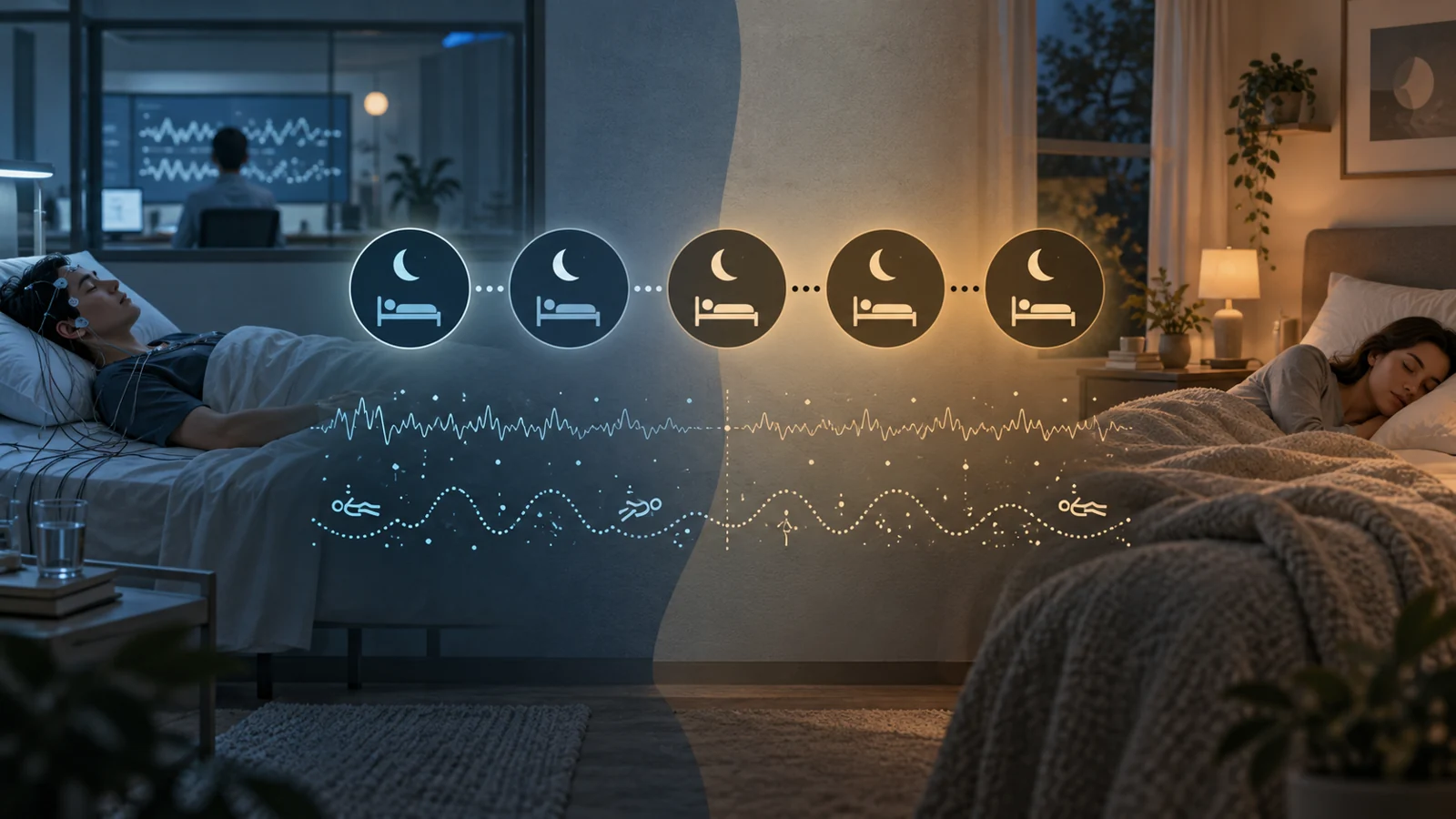
Participants are scheduled to undergo two simultaneous sleep tests in a sleep laboratory, each over an overnight period. They are also scheduled for one sleep test at home over three nights. Participation is expected to last at least a week and may last up to three months.
The two laboratory nights create the clearest side-by-side comparison. Because the tests are performed at the same time, researchers can examine whether they classify the same periods of sleep in the same way. The registered primary outcome focuses on the percentage of agreement between sleep-stage results from the EEG and the sleep study on Night 1 and Night 2.
The home portion changes the setting and extends the recording schedule. It makes home-based sleep recording part of the planned study experience, but the available material does not support a more specific claim about what those home recordings will establish. The schedule itself is the supported point: laboratory comparison over two nights and home recording over three.
What agreement would mean
In plain terms, agreement means the extent to which the two tests assign the same sleep stage. That is a measurement question. It is narrower than asking whether either test can diagnose Alzheimer’s disease, predict how the disease will progress or improve sleep, cognition or health.
The available registry snapshot lists the study as NOT_YET_RECRUITING, with an estimated start in March 2026 and estimated primary and overall completion in September 2026. It also lists no posted results. Those dates are planned registry milestones, not evidence that recruitment, study activity or completion occurred.
If results are eventually posted, the agreement measure could show how closely the tests classify sleep stages in this planned group. It would not by itself establish that laboratory testing can be replaced, that home monitoring reduces visits or costs, or that participants experience a clinical benefit. The study description supports an assessment of the planned comparison, not a finding about performance that has already been demonstrated.
What reliable home sleep monitoring could make possible
Reliable home sleep monitoring could eventually allow people with asymptomatic or early Alzheimer’s disease to have their sleep recorded repeatedly in their own homes. That capability would matter because sleep could be observed outside the laboratory and across ordinary nights, if the mobile recordings prove dependable and usable.
Easier access and fewer laboratory visits are possible future benefits, not outcomes shown by this registry entry. The necessary step is evidence that home recordings can provide trustworthy sleep-stage information alongside the laboratory comparison. Until that evidence is available, the study remains a planned test of agreement rather than a demonstration that portable monitoring is ready to replace laboratory assessment.
Key Sources
- Primary source: A Study to Compare Two Different Sleep Tests in Participants With No Symptoms or Early Symptoms of Alzheimer's Disease
Government or Regulator · Clinical Trial · 2026-03-20
Keep exploring